




By Ashford Peters
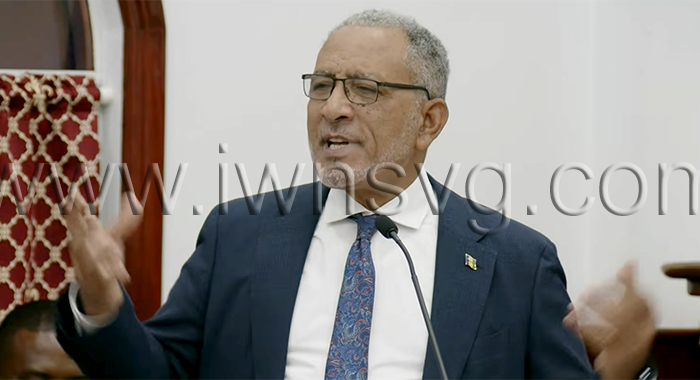
Parliament has approved the EC$1.9 billion Budget for 2026 presented by Prime Minister and Minister of Finance, Godwin Friday, who said the fiscal package “rejects the fiscal recklessness of the past”.
The New Democratic Party (NDP) administration used it super majority in Parliament — where it holds 14 of the 15 seats — to approve the budget, its first in over a quarter-century, even as the parliamentary opposition did not support the fiscal package.
In wrapping up the debate on Friday, the prime minister described the criticisms of the three-member Ralph Gonsalves-led parliamentary opposition as “weak, confused” and “delivered without conviction or self-belief”.
The Budget 2026 was the first since 2000 by an NDP administration, the party having defeated the Gonsalves-led Unity Labour Party (ULP) in November’s general elections.

The ULP defeated the NDP 12-3 in the March 2001 general elections and remained in office until the “yellow-washing” last year.
“The opposition’s response to the budget address that I presented was very disappointing to say the least…” Friday told lawmakers.
“It was weak, confused, and importantly, it was delivered without conviction or self-belief. And you know why? Because their presentation or their seeming critique of what we are doing, belies a guilty conscience,” Friday said.
He said much of what the opposition “wanted to criticise and reject”, they recognised to be the product of “their own government’s fault”, so they “spoke some subdued rhetoric, sometimes hollow words, that must have echoed in their own ears as not being genuine, as being false”.
Friday said that when the NDP went to the people during the election campaign, the party told them to “entrust us with the responsibility of leading the affairs of this country”, promising that “things would be done differently” and it would not be a matter of “changing faces and maintaining old practices…
“If anything, the vote in the last general election was not just to elect members around this table, even if in overwhelming numbers. It was more than that. It was a yearning for something different, something fresh, something new that appealed to their better natures,” the prime minister said.
“It was a repudiation of the politics of division and spite and pettiness.”
Friday said the opposition’s behaviour in Parliament “with the same attitude of spewing bile”, as when in government, and speaking in a manner that “disrespects people” that has “little regard for the honesty and truth that is required” in the Budget Debate process.
This conduct shows that the opposition “didn’t learn anything from the last election,” the prime minister said.
Friday said the opposition leader criticised the Budget Address, describing it as unimaginative, incoherent, and that it was written, in part, by ChatGPT.
Friday said he does not know how to use the artificial intelligence tool, and that the opposition leader’s allegation that other hands were used to help prepare the budget address shows that he, as prime minister, does not think he knows everything.
“What they would not acknowledge, but what is evident, from everything that you read in that document … compare it to anything that you’ve seen from the past 25 years, and tell me that it’s not a strikingly different document in terms of tone, construction, and the vision that it presents to the people of this country. It represents a fundamental shift in governance,” Friday said of his Budget Address.
Budget 2026 ‘rejects the fiscal recklessness of the past’
Friday said that whereas the former Gonsalves administration “prioritised rhetoric, we advanced honesty and responsible government in dealing with the nation’s social and economic conditions”.
He said the mandate delivered by the electorate was clear and signalled a desire to rescue the country, in what the NDP administration termed, and the ULP opposition sought to ridicule, as “a rescue to resilience strategy”.
“Because you can’t rescue somebody from one fire and then put them into another danger. You’ve got to go from a bad place to a better place,” the prime minister told lawmakers.
“You’ve got to go from rescue to resilience,” Friday said, reiterating the theme under which the budget was presented.
He added: “And, this strategy, fundamentally, it rejects the fiscal recklessness of the past where they didn’t just abandon the guardrails, they picked them up and they threw them away so that nobody could find them.”
Friday said the core of the budget is rooted in the NDP tradition of prudent conservatism… which moved the nation away from state-led economic growth toward a more productive model that views the state as a facilitator rather than a primary operator.
“The state can no longer be the engine of growth in this economy, even if we wanted to. The fiscal space that we’ve inherited makes it impossible. Nor can it continue a period of fiscal deficits and the servicing of inflated contracts.
“The 2026 budget address aims to provide investors, domestic and external, with a predictable roadmap that emphasises certainty,” he said. “Certainty. See, that’s what business likes.”
Friday said that the clear message is that St. Vincent and the Grenadines is open for business and for partnerships.
“That is how we will go forward. Poverty is not an option. Poverty is not pretty. Poverty, the pain of it, doesn’t get less.”