



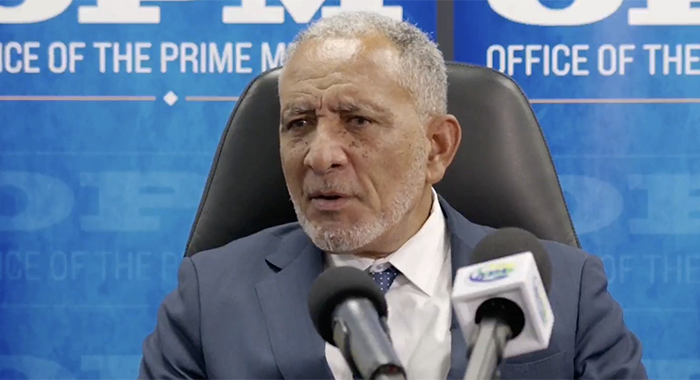

Prime Minister Godwin Friday has revealed that he recently summoned the most senior officers of the Royal St. Vincent and the Grenadines Police Force to a high‑level meeting in Bequia, as his government confronts what he describes as an “unacceptable” wave of gun violence across the country.
Speaking at a press conference in Kingstown on Tuesday on his return from an official visit to Taiwan, the prime minister said the meeting, held about two weeks earlier, brought together the commissioner of police, deputy commissioner, senior Coast Guard officials and other top officers, along with the Deputy Prime Minister and Minister of National Security St. Clair Leacock and his permanent secretary.
Friday said they “sat around the table and discussed the challenging situation”, focusing on the recent spike in shootings and the wider sense of insecurity in the country.
The session, he suggested, underscored both the scale of the problem and the need for a coordinated, strategic response.
“We know that the situation is unacceptable,” Friday told reporters, adding that the government has already made changes in the police hierarchy to signal a new approach.

He said adjustments at the top of the force were intended to show the public that “a new sheriff [is] in town” and that the leadership is expected to deliver different results.
On Monday, Trevor “Buju” Bailey was appointed to act as commissioner of police as the police chief, Enville Williams, is on seven months’ leave.
Junior Simmons has been appointed acting deputy commissioner of police, and Brenton Smith, an acting assistant commissioner of police.
The changes came into effect after a weekend that saw three shootings in Kingstown that left two women injured.
Then, around 1 a.m. Tuesday, a man was shot and killed in an abandoned building across the street from His Majesty’s Prison on White Chapel Road, Kingstown.
The prime minister acknowledged that such incidents deepen public anxiety and put his administration’s security record under scrutiny.
He said his government has given a clear commitment to confront crime directly and that the Minister of National Security has been “very forthright” in his pronouncements.
Translating that stance into visible change, he cautioned, will take time.
Police must act on intelligence about gun routes
One of the most troubling aspects of the problem, the prime minister said, is the flow of illegal firearms into SVG, describing it as an eye‑opening aspect of his discussions with law enforcement.
“We don’t manufacture them yet. Everybody seems to be able to get one who wants one. This has to end.”
What disturbed him further, he continued, is that there appears to be intelligence about where those weapons are entering the country.
“You can’t just simply know something and do nothing about it,” he said, adding that the government is putting in place a plan to address that specific dimension of the problem.
He declined to discuss operational details but made clear that border control and interdiction of gun shipments will be a central focus.
The prime minister noted his government’s responsibility to the public, saying, “The first thing that a government owes its citizens is security.”
In his view, that obligation extends well beyond preventing crimes.
“We are responsible for creating an environment where those things don’t happen, and that if they do happen, that the perpetrators are apprehended, prosecuted, and jailed,” he said.
Friday agreed that a whole‑of‑society approach is necessary, adding that he intends, at an appropriate time, to invite political leaders and civil society to a national conversation on crime so that “as a society we tackle this problem”.
He warned that the stakes are high. “We can’t be [in] a situation where people are afraid to go out. I mean, how do you function?” he said.
‘What I say in opposition, I will say here’
The exchange also revisited Friday’s own record in opposition, when he frequently blamed the previous administration for rising crime.
Friday responded that his rhetoric in opposition was not fundamentally different from his position as prime minister.
“When I speak in opposition, I don’t speak with… forked tongue,” he said.. “What I say in opposition, I will say here; obviously, it’s informed by a different set of circumstances and facts.”
He conceded, however, that timelines promised in opposition may need to be adjusted in office, and said he would not pretend otherwise.
If circumstances prevent his government from meeting earlier deadlines, he said, he will return to the public to explain why.
“I will come, I will tell you that the time frame has changed, and this is the reason why. And reasonable people will understand that.”
On the core question of responsibility, though, Friday was direct.
“You asked me [if] we were responsible. Of course we are,” he said. “We are the Minister of National Security… We are responsible for creating [a safe] society.”
He described the state as holding a “monopoly on violence” within constitutional limits, including the power to take away a person’s liberty, and said the implicit bargain is that government must, in return, ensure citizens’ safety.
In Friday’s view, one of the system’s most serious weaknesses is the level of impunity enjoyed by some offenders.
Restoring public confidence, he suggested, will depend on whether people see a consistent pattern of arrests, prosecutions and convictions when serious crimes occur.
Foreign help must align with national priorities
International assistance, including from Taiwan, forms another strand of the government’s strategy, but Friday stressed that foreign support must be clearly aligned with national priorities.
He said Taiwan has already provided some equipment and is hosting Vincentian officers for training, and that the issue of security cooperation arose during his recent visit. However, it was not the central topic.
To be effective, he argued, assistance cannot be ad hoc.
“We have to be very direct and say, ‘Listen, these are the things that we need. This is our plan for dealing with the problem. How can you help?’” he said.
Offers of bulletproof vests or surplus vehicles, he acknowledged, may be useful, but are not necessarily the most important needs at this stage. If support does not fit into a central, strategic plan, he warned, “then it’s kind of not achieving our purpose”.
He expressed confidence that Taiwan “will be very willing to assist” once the country presents a clear, long‑term crime‑fighting strategy and demonstrates its intent to follow through.
For him, that persistence is non‑negotiable. “Until the problem is resolved, you don’t relent,” he said.
“You don’t just simply send [help] here for six months, and the problem is still going on. No, we stick with it because what we’re doing is dealing with a problem.”
Friday said his own responsibility, as prime minister, is to show Vincentians that he understands their sense of insecurity and is prepared to act decisively.
“That’s why I came to government,” he said. He acknowledged that the public will ultimately judge his administration on whether it can reduce violence, curtail the inflow of illegal guns, strengthen policing and end the perception that people can commit serious crimes without consequences.