



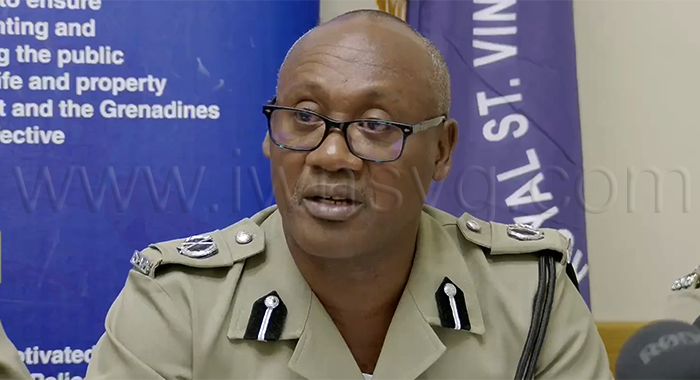

Acting Assistant Commissioner of Police Brenton Smith has assumed responsibility for crime-fighting in St. Vincent and the Grenadines, promising a more coordinated, intelligence‑driven and forensic‑backed campaign against gun violence and serious offences across the country.
Speaking at a press conference on his appointment as the officer in charge of crime-fighting, Smith noted that he takes up the portfolio at a time when gun violence, particularly in Kingstown and surrounding communities, is causing deep anxiety among citizens.
“Our responsibility goes far beyond reducing figures on a crime chart. Our responsibility is to save lives, bring offenders to justice and make our communities safer.”
Intelligence must lead to action
Smith framed his crime‑fighting strategy around a central principle: intelligence must be converted into evidence and operational action.

He acknowledged that the police often possess information and intelligence about individuals believed to be involved in serious criminal activity, but said that by itself, intelligence is not enough.
“Our responsibility is to bridge that gap between intelligence and evidence,” Smith said.
He outlined a plan to ensure that intelligence is properly gathered, assessed and shared with those who need it; used to identify lawful investigative and operational opportunities; directly linked to targeted interventions against individuals believed to be driving gun violence.
Smith said police will pay “particular attention” to people believed to be driving gun violence; the relationships and conflicts surrounding shootings and possible retaliations; and the movement, possession and use of illegal firearms.
Targeting illegal firearms and the networks behind them
Smith made clear that illegal firearms will be a major focus of the crime‑fighting effort.
He said every illegal weapon removed from the streets is “one less weapon available to be used in a shooting, robbery, or homicide,” but stressed that simply seizing the gun is not sufficient.
“Recovering the firearm is only one part of the job. Where possible, we must establish where the firearm came from, who possessed it, who may have supplied it or moved it, and whether forensic or ballistic evidence connects it to previous crimes,” he said.
To support this, Smith pledged to make maximum use of forensic, ballistic and technological capabilities available to the force.
He spoke of forensic and ballistic analysis to link weapons to multiple incidents; technological tools to track patterns, suspects and networks; and a focus on disrupting the individuals and networks responsible for putting guns into the hands of criminals.
Systematic review of homicides and shootings
Another key plank of Smith’s plan is a structured, ongoing review of homicide, shooting and firearm‑related investigations.
He said that for major cases, the force should always be able to answer some basic but critical questions:
“What do we know? What have we done? What remains outstanding? What further investigative opportunities exist? Who is responsible for the next action, and when will it be done?” he said.
Smith warned that serious investigations must not be allowed to go cold simply because the initial days or weeks have passed.
He promised that outstanding investigative opportunities will be pursued, forensic or ballistic evidence will be revisited where appropriate, and new intelligence will be assessed against existing investigations.
“No investigator should feel that he or she is carrying a difficult homicide investigation alone. Serious crime must be treated as an organisational responsibility,” Smith said.
Breaking down silos: ‘Connecting the pieces’
Smith said one of his main priorities as ACP in charge of crime will be greater coordination across the police force, arguing that criminals do not operate along organisational lines and neither should the police response.
He illustrated how seemingly minor encounters can become crucial, such as information gathered through a traffic stop or specialist and operational units.
“We must therefore remove unnecessary barriers between departments. Criminals do not operate according to our organisational structure, and neither can our response. We must connect our people, intelligence, investigations, technology, and operations,” Smith said.
Accountability beyond arrest numbers
Smith signalled a strong focus on accountability for commanders, supervisors and investigators.
He said those in charge must know the status of serious investigations under their responsibility, and he will expect regular crime briefings, investigative updates, and clearly defined operational objectives.
Where strategies are working, they will be strengthened; where they are not, they must be changed.
Crucially, he said accountability cannot be reduced to a simple tally of arrests.
“We must examine firearm recoveries, intelligence developed, investigation progress, cases brought before the courts, disruption of criminal activity, and importantly, whether our interventions are helping to prevent further violence,” he said.
“Ultimately, the most important measure is whether the people of Saint Vincent and the Grenadines are safer,” Smith added.
Linking human resources to crime‑fighting
Smith, who continues to hold responsibility for human resource management, said there is a direct link between effective HR practices and successful crime‑fighting.
“We cannot demand professional policing without ensuring that our officers are properly deployed, trained, supervised, equipped, and supported,” he said.
His approach to human resources includes identifying skills within the organisation, placing “the right people in the right positions”, and developing capabilities in investigations, intelligence, technology, supervision and leadership.
He stressed that professionalism and respect for the law are non‑negotiable.
“We will be firm with those who commit crime, but professional in our treatment of the public. We will be proactive, but lawful. We will be determined but disciplined. Effective policing and professional policing must go together,” Smith said.
‘Operate as one force with one purpose’
Smith called on the members of the Royal St Vincent and the Grenadines Police Force to back the new strategy, saying the commissioner, the country and the public all require their support.
“Regardless of where you are stationed or the department in which you serve, you have a role in making this country safer. Sometimes the smallest piece of information can solve the biggest case,” he said.
Smith was announced as the officer leading crime-fighting in SVG one day after Opposition Leader Ralph Gonsalves criticised his promotion, saying that he intends to write to CARICOM and the Commonwealth about what he termed the “dangerous politicisation” of the police force.