


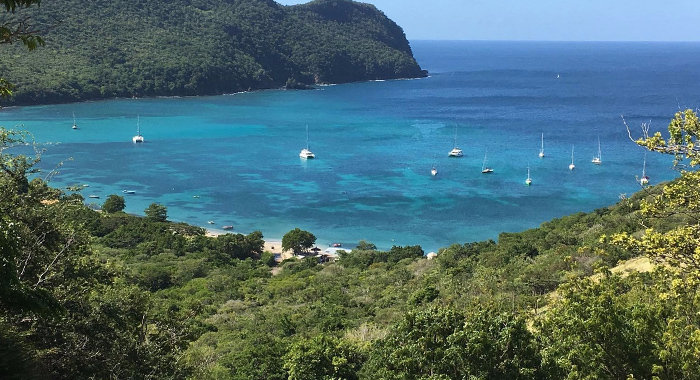
The New Democratic Party (NDP) on Saturday said it supports the government of St. Vincent and the Grenadines in the sale of approximately 100 acres of land at Chatham Bay, Union Island, for approximately EC$54 million.
The party, which came to office in November, said the sale took place under an agreement designed to protect the area’s biodiversity while strengthening the country’s fiscal position.
Prime Minister Godwin Friday referred to the sale in Parliament on Thursday, saying it had improved the government’s fiscal situation.
Responding to a question from Opposition Leader Ralph Gonsalves, the prime minister said that for April 1–July 31, 2026, the government recorded an overall deficit of EC$57.78 million, compared to EC$125.23 million for the same period in 2025.
He said the improvement was largely linked to higher capital revenue in 2026 and lower capital spending, particularly following the completion of major projects.

The higher capital revenue “mainly reflected EC$52.7 million that was received from the sale of land in Chatham Bay, in Union Island,” Friday told the House, noting that the transaction had previously been reported to Parliament.
It was not clear when the transaction was previously reported to the national assembly.
However, on July 2, the opposition leader had raised the matter in a question for written answer.
Gonsalves had asked Friday to “state whether the 100 acres, more or less, of land at Chatham Bay, Union Island, has been sold, and if so, the sale price, the proposed development of the land, and the purchaser”.
iWitness News is not aware whether the prime minister had supplied the written answer to the opposition leader’s question.
However, during Thursday’s meeting of Parliament, when the prime minister mentioned the sale, saying that it had been commented on previously in Parliament, Gonsalves did not accuse the government of failing to disclose the sale nor allege any concealment of the transaction.
In its press statement on Saturday, the NDP said the lands “are to be held by a company for conservation purposes, with binding covenants included in the sale agreement to ensure that the natural environment and biodiversity of the area are protected”.
The party noted that Chatham Bay is located near important forest reserves, including Water Rock Reserve, Large Forest Reserve, Colin Campbell Reserve and Jack O’Dan Reserve.
“These areas are of significant ecological importance and are associated with the habitat of the endangered Union Island Gecko, a species found only in Saint Vincent and the Grenadines and will receive strengthened protection in coming months,” the party said.
“Further, the NDP understands that the decision to proceed with the sale forms part of the Government’s wider effort to reduce the heavy debt burden left by the previous ULP administration, whose years of fiscal mismanagement contributed to the country’s debt reaching approximately 113% of GDP. This level of indebtedness has placed serious pressure on the State’s ability to fund critical needs, including healthcare, national development programmes and public-sector reform.”
The party cited the prime minister as saying proceeds from the sale will be directed towards clearly identified national priorities.
“These include contributing to the capitalisation of the National Development Bank, supporting the new Ministry of Fisheries, Land and Sea Conservation and Climate Resilience, and funding debt-reduction measures and initiatives aimed at improving Government efficiency.
“In addition, and most importantly the sale includes a significant safeguard for the public interest. Under the agreement, the Government retains the option to repurchase the lands within two years at the same price for which it was sold.”
The press release cited the prime minister as saying that the transaction reflects the government’s commitment to responsible fiscal management, environmental protection and transparency.
“This transaction reflects responsible Government: protecting our natural heritage, reducing debt, and investing in the future of our people. The public interest is protected through conservation covenants,” the Prime Minister said.
The NDP noted that the Unity Labour Party administration had reacquired the land several years ago after a private investor failed to develop the property for a proposed tourism project.
“The land was brought back into government ownership at a compensation value of less than EC$700,000. The current transaction therefore represents a substantial capital gain to the people of Saint Vincent and the Grenadines, while placing conservation at the centre of the land’s future use,” the NDP said.
“The NDP supports the Government’s commitment to transparency, responsible land management and the protection of Saint Vincent and the Grenadines’ natural heritage,” the party added.
The inflow from the sale comes at a time when the 9-month-old NDP administration is battling a difficult fiscal environment marked by high debt and constrained access to concessional financing.
Friday has argued that mobilising capital from state assets is part of a broader strategy to maintain stability without immediately resorting to broad‑based new taxes.
Over the past few months, Gonsalves had raised questions about whether the sale had actually taken place.
However, in a later debate on Thursday, after Friday mentioned the sale, the opposition leader debating the Companies (Amendment) Bill, accused the government of disposing of Chatham Bay at a steep discount to earlier valuations.
He told the House that the government “had to sell the crown jewel down in Chatham Bay for half, less than half the price it was valued for nearly 15 years ago”.
He suggested that the sale was part of a broader pattern of using one‑off transactions and external borrowing to paper over underlying fiscal weaknesses.
The former prime minister had, months before the sale was formally disclosed, used his radio show to rehearse the history of Chatham Bay, including its earlier ownership under an alien landholding licence granted to a foreign investor, the alleged failure to meet development obligations, and subsequent forfeiture proceedings that resulted in the land reverting to the Crown.
He has argued that, given the legal and political effort invested in recovering the bay, and the public infrastructure that has since increased land values in the Grenadines, the property should not have been sold for less than past valuations.
Friday has repeatedly underscored the need to “liberate private capital” and ease what he describes as a burden of heavy regulation and punitive fines that has discouraged investment, particularly by external companies.