



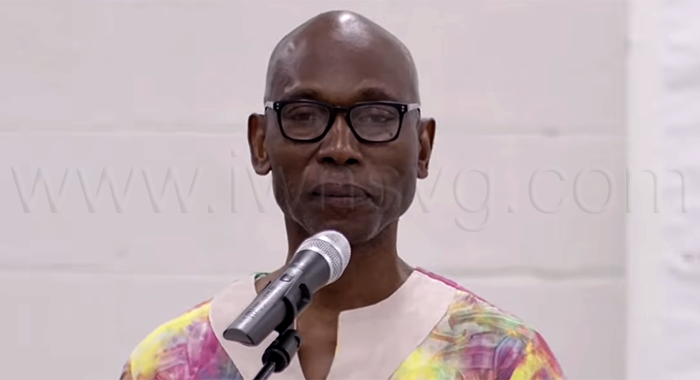

Lawyer and social commentator Jomo Thomas has questioned the Caribbean’s claims to emancipation and post‑colonial status, arguing that the region remains intellectually and structurally tethered to its colonial past.
Speaking as a respondent at the 2026 Oscar Allen Memorial Emancipation Lecture at the UWI Global Campus in Kingstown, Thomas used his reflections on the late community organiser Oscar Allen to advance a broader critique of Caribbean education, historical awareness and political culture.
The lecture, delivered by educator and climate resilience expert Andrew Simmons, was held under the theme “We want to be wise: Education, identity, and liberation in the modern post-colonial Caribbean.”
Thomas’ intervention challenged the very premise that the Caribbean is meaningfully “post‑colonial”.
‘Post-colonial Caribbean is not post-colonial’

In a characteristically blunt assessment, Thomas told the audience of state officials, diplomats, academics and community activists that the region’s institutions belie the notion of a completed break with empire.
As evidence, he pointed to the continued marginalisation of the region’s own story in formal schooling.
While English and mathematics are compulsory across CARICOM, he said, Caribbean history is not a compulsory subject in any country in the bloc.
“We live a lie to ourselves when we say we are emancipated,” Thomas argued, adding that this was why Allen had insisted, in his own popular phrasing, that “Emancipation ain’t reach yet. Emancipation still coming.”
From sceptic to admirer: a portrait of Oscar Allen
Thomas, who served as Speaker of the House of Assembly and has long been a prominent voice in public affairs, disclosed that he was not always an admirer of Allen’s style.
“I respected him deeply,” he said, “but I was not always a fan.” He had once thought Allen “too abstract … too quiet … not firebrand enough”.
That view shifted dramatically, he said, when they worked together in the People’s Movement for Change, and he came to appreciate what he described as Allen’s “simple profundity”.
Allen possessed, Thomas said, a unique ability “to speak in ways that were soft and gentle, but if you took the time to listen to him, you would see and hear profound truths in much of what he said”.
One line, in particular, stayed with him. “Brothers and sisters, the people are always watching,” he recalled Allen said.
Thomas said he saw the truth of that observation repeatedly in his own life — including something as simple as his changing running routes.
People who no longer saw him in one area would ask if he had stopped running, an illustration, he suggested, of how citizens quietly observe public figures even when those figures assume no one is paying attention.
Imagination, truth and the role of the intellectual
Linking Allen’s legacy to a wider tradition of critical thought, Thomas drew on a range of global voices.
He cited Albert Einstein’s observation that “imagination is more important than knowledge”, arguing that while knowledge allows us to catalogue what we already know, imagination opens up “new vistas” and possibilities.
That, he suggested, is the kind of expansive thinking Allen encouraged, especially through his relentless advocacy of reading.
Thomas recalled a poem he once wrote titled “Dreaming About Dreams”, whose closing line — “I don’t want to dream dreams that are just a dream; I want to dream dreams that we can live” — Allen had adopted as a fond refrain, greeting him with “the dreamer, dream real dreams” whenever they met.
Turning to the political responsibility of thinkers and activists, Thomas referenced a 1968 essay often associated with Noam Chomsky on “the role of the intellectual”.
The central point, he said, was that “the role of the intellectual is to tell the truth”.
He then quoted South African senior counsel Muzi Sikhakhane, author of The Odyssey of Liberation”:
“We must tell the truth until it kills us.”
“A people who is not truly liberated cannot be said to be free,” Thomas added, paraphrasing Sikhakhane, and said Allen would have united with those words.
Allen, he suggested, “would have died of truth … would have died for the truth”.
Reading, resistance and a forgotten Vincentian woman
To illustrate Allen’s belief in reading as an emancipatory act, Thomas turned to the life of Elma Francois, a Trinidad‑based Vincentian labour activist and organiser who is celebrated as a national heroine in Trinidad and Tobago but remains “hardly known” in St. Vincent and the Grenadines.
After successfully defending herself against a treason charge in Trinidad, Francois was asked how she had managed it.
Thomas recounted her now famous reply:
“I read. People must read. But more importantly, they must not read stupidness.”
For Thomas, that injunction could almost stand as an epitaph for Allen, who “loved books” and constantly urged colleagues and comrades to deepen their political and historical understanding through serious reading, not intellectual frivolity.
Remembering Allen beyond rhetoric
Thomas’ remarks came after Simmons had used his lecture to call explicitly for Allen to be recognised as a national hero for his decades of work with poor and marginalised communities.
While Thomas did not directly address the formal mechanics of such recognition, his contribution underscored the ethical and intellectual stakes of how societies remember figures like Allen.
He closed by returning to a biblical injunction that Allen himself had often cited — “act justly, love mercy, walk humbly” — before adding a characteristic twist.
The text says to walk humbly “with your God”, Thomas noted, but he did not think Allen “ever saw God”.
What Allen certainly saw, he said, was people — and he “walked humbly, anxiously, and loved people”.
Thomas said: “… that’s how the great Oscar Allen should be remembered”.