



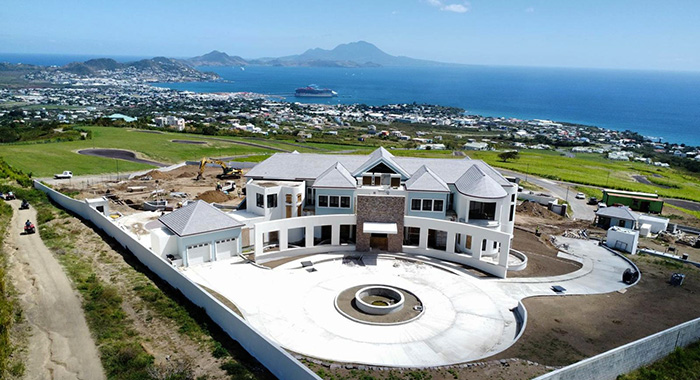

ST. JOHN’S, Antigua (CMC) — Antigua and Barbuda Prime Minister Gaston Browne says the Monetary Council of the Eastern Caribbean Currency Union (ECCU) has agreed that it should be kept “up to date routinely” on projects in excess of EC$10 million following the controversy over the construction of the multi-million-dollar residence for the governor of the bank.
Browne said that the issue was discussed last weekend at the 111th meeting of the council and that there had been the recognition of several flaws regarding the project.
“What we … noticed too that whereas the tendering process … literally mandated that the lowest bid be accepted at the end of the day, that bid was also flawed, because the other three bids came in in excess of EC$20 million,” said Browne, who has assumed the chairmanship of the Monetary Council.
“So, there were issues in terms of the lowest bid … and we felt that perhaps that the quantity surveyor at the time should have picked up that particular anomaly. So, one thing I can say for sure, there’s no evidence of any malpractice by anyone who was responsible for monitoring this particular project.
“In fact, it went through all of the necessary procedures. For example, the bids went to tender and they were selected accordingly. Bids for the consultants, for the contractor, architect, and all of the procedures were followed. This particular project is managed primarily by the board of directors.

“As you know, the council itself and council members, we concentrate primarily on policy formulation and the history of the operations of the council is such that it does not get involved in project management, so you did not have that regular, let’s say, feeding of information to the council,” he added.
Earlier this year, St. Vincent and the Grenadines Prime Minister Ralph Gonsalves wrote to Browne suggesting that the Grenadian-born Governor of the Eastern Caribbean Central Bank(ECCB), Timothy Antoine “of his own motion may wish to consider whether or not his continued occupancy of his office is tenable in all the circumstances” as it related to the construction of the residence.
“This is likely to be a painful, personal decision,” Gonsalves wrote in the Feb. 17 letter, a copy of which had been obtained by the Caribbean Media Corporation (CMC).
Gonsalves wrote to the Antigua and Barbuda leader, indicating that he had become aware of the matter through his son and Finance Minister, Camillo Gonsalves, who is also a member of the Monetary Council of the ECCU.
Gonsalves said his finance minister had advised him “regarding the extraordinary sum of EC$22 million being expended by the Governor of the Eastern Caribbean Central Bank to construct an official residence for the Governor.
“This act of excessive spending is outrageous,” Gonsalves wrote in his letter, adding, “it’s an absolute scandal.
“Cleary there has been an insufficient transparency by the Governor on this matter, and the oversight expected by the internal review mechanisms of the ECCB, the Board of Directors of the Bank, and the Monetary Council, has self-evidently been below acceptable or prudent standards.”
The ECCB serves as a central bank for Antigua and Barbuda, Dominica, Grenada, St. Lucia, St. Vincent and the Grenadines and St. Kitts and Nevis, the countries which together with the British territories of Montserrat and Anguilla, form the ECCU.
Browne, speaking following the weekend meeting of the Council, said that to the best of his knowledge, “the issue of the cost of construction of the Governor’s residence was never a formal item on the agenda.
“But we felt, however, that council members should have been kept informed via the directors, and that is where we felt that there was some weakness in terms of sharing information at the time.
“So, there has been a series of recommendations that were made to strengthen the reporting mechanism and the overall governance of projects that may be pursued by the central bank in the future. And there’s also requirement, for example, that any project in excess of EC$10 million that the counting should be fed up to the council, and they must get a no-objection from the Council before they pursue any such project,” Browne said.
He said that the idea is not for the council to micro-manage these projects.
“I mean, we expect that between the consultants that we employ and the board of directors and so on, that they have the competence to manage these projects. But at the same time, we are strengthening the reporting mechanisms, and at the same time to ensure that amounts in excess of 10 million EC dollars, that the tcouncil members should be kept up to date routinely.
So, one of the major outcomes out of this is that the governance framework will be strengthened. And whereas the information caught us somewhat flat-footed. In the future, we should have the information,” he said, indicating nonetheless that there was “the building necessarily would have cost less than the 20-plus million dollars, so there’s no evidence to suggest otherwise.
“I was making the point to some of my colleagues. And as you know, I’ve operated within the construction and land development space for a number of years. And, depending on the contractors, depending on the size of the property, depending on the quality of the property, and sometimes, too, depending on the means of the developer or the person who is literally constructing the property, the price varies.”
He said that there is no specific or fixed price, giving as an example the cost associated with transactions in Antigua and Barbuda, where the price varies.
“So, I’m saying that to say that you know this notion, that you know there were significant excesses, I can’t say that that was proven. And what I know for sure, having examined the processes, there’s no evidence of any wrongdoing, certainly not by the Governor or any of the directors or any evidence of any collusion involving the various experts,” Browne said.
This man is actually the best leader in the sub region. You’ll never hear him referring to his fellow Antiguan as little black boy. He isn’t addicted to power like the geriatric we have here in Vincy. PM Brown is authentic, he works tirelessly for his people . He isn’t beating his chest like our fake leader.
Depends on which meaning of the word corruption, being used, no?