



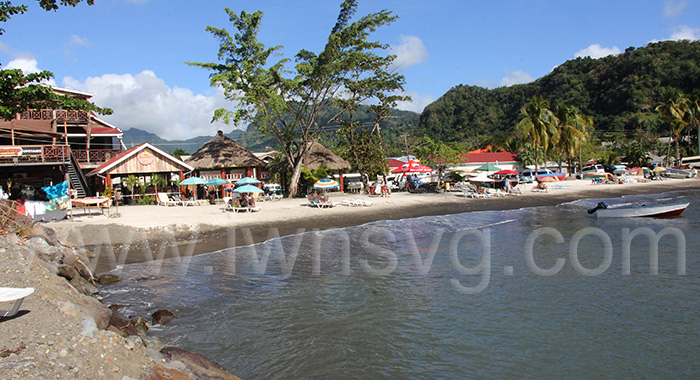

A new act will be brought to Parliament to replace the current law that bans all vending on beaches, even as the statute is not being enforced.
The new law will govern commercial activities on 17 of the nation’s beaches, and will require a permit for all commercial activities, from playing a steelpan to make money to serving meals as part of a tour.
Crown Counsel Franeek Joseph outlined the law to tourism stakeholders at the State of the Tourism Industry conference in Kingstown.
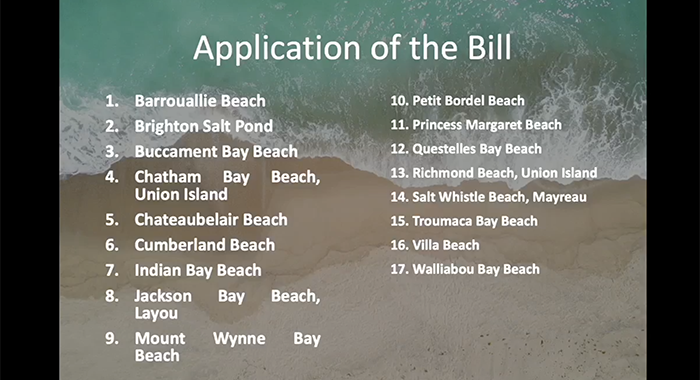
The law will apply to: Barrouallie Beach, Brighton Salt Pond, Buccament Bay, Chatham Bay (Union Island), Chateaubelair Beach, Cumberland Beach, Indian Bay, Jackson Bay (Layou), Mount Wynne Bay, Petit Bordel Beach, Princess Margaret Beach, Questelles Bay, Richmond Beach (Union Island), Salt Whistle Bay (Mayreau), Troumaca Bay, Villa Beach and Walliabou Bay.
Joseph said the government has acknowledged that commercial activities are taking place on beaches in an unregulated manner and has recognised a need for a regulatory framework.

The Beach Vending Bill 2025, therefore, aims to ensure public safety, environmental protection, economic activities and enjoyment of beaches for all users.
The law is currently undergoing review by a select committee of Parliament and the presentation at the tourism conference garnered feedback from sector stakeholders.
The Crown counsel said that the law will be administered by the National Parks, Rivers and Beaches Authority (NPRBA), which will be in charge of overseeing all vending on the beaches falling under the act.
NPRBA will review applications for licenses and permits to vend on beaches and will also be responsible for their suspension or revocation.
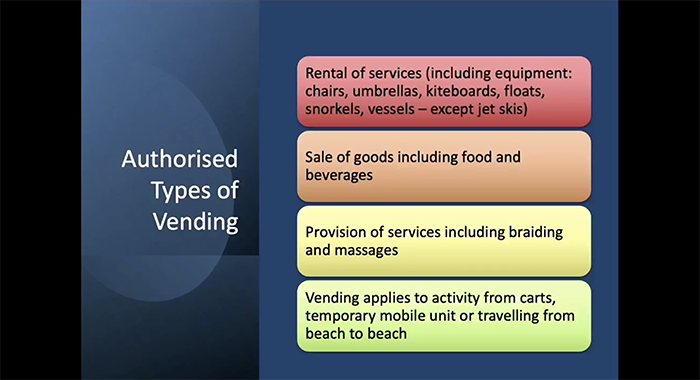
Joseph said the bill authorises certain types of vending conducted on beaches.
They include rental of services (including equipment: chairs, umbrellas, kiteboards, floats, snorkels, vessels – except jet skis); sale of goods, including food and beverages;
Provision of services, including braiding and massages.
The proposed law will also apply to people who use carts, temporary mobile units, and who travel from beach to beach to sell goods and services.
“And this would not only apply to individual applicants, but also to restaurant or hotel proprietors situated on or adjacent to a beach,” the Crown counsel said.
“And if any person operates or conducts any type of vending on a beach [without a permit], they would commit an offence under this particular bill, and of course, consequences would then follow.”
Individuals applying for the license must submit to the NPRBA an application form along with two forms of government-issued ID.
Companies will also have to submit documents showing the owner or the manager of the company.
For non-nationals, they must provide proof of their immigration status via a work permit, and the NPRBA may also require any additional information that it deems necessary, Joseph said.
If the application is successful, the NPRBA will issue the license “with certain conditions that the act actually sets out that each license holder must adhere to,” Joseph said.
A license holder must alert NPRBA of any changes within 30 days of the change.
“If not, this is an offence under that bill, and certain consequences would follow, which may include revocation or varying of the license that was issued,” Joseph said.
NPRBA will also issue permits for “occasional vending”, defined under the bill as “for a temporary duration of time, for example, for fairs, farmers markets, festivals, carnival or cultural, entrepreneurial, religious or recreational event,” Joseph said.
“And of course, you have to pay a fee with this, and the authority will make a decision and certain conditions will, again, apply for permits.”
All licence vendors and their employees must have an identification card issued by the NPRBA, which should be visible during their operation on the beach.
Applicants for permits must be 18 years or older and must have a liquor license or food handlers permit, where applicable.
“If you are operating under a business name, you have, of course, to be registered under the Registration of Business Names Act,” Joseph said, adding that vendors have to have liability insurance where required.

She said that where Town and Country Planning permission is required, this has to be obtained.
“And the authority would consider these things, as well as a number of other things, such as the type of vending that you propose to do, the scale of your proposed vending, what facilities may be utilised in the vending, environmental aesthetic impact on beaches,” Joseph said.
Other considerations include impact on neighbouring properties — including noise, smoke, smell, etc., potential impact of increased number of persons and vehicles at the proposed location, access to, from and along the beach, any proposal to erect and display an advertisement, proposed hours and days of operations and any law that exempts applicants from needing a work permit.
She said all licenses are valid for six months and must be displayed in a conspicuous place at the place of business, or be carried on the person of the license holder at all times.
The proposed law provides that the police and authorised officers of the NPRBA may enter a building or structure to determine whether they hold a license or permit and whether they are complying with the conditions of the licence.
Licences are non-transferable and the NPRBA can revoke, suspend or vary them based on a failure to comply with a condition or any dishonest activity by the license or permit holder.
However, before doing so, the NPRBA is obliged to reach out to the license holder and offer them the opportunity to object and remedy any alleged infringement.
Where a permit or license has expired or been revoked, all holders must vacate the premises within 48 hours and remove all structures.
Joseph, however, said the NPRBA may extend this if a written request is made.
However, if the license holder fails to comply with a final determination, the NPRBA may remove the materials at the cost of the license holder.
“There is, of course, an appeal mechanism under the bill, so any person who is aggrieved by a decision by the authority can appeal to an appeals committee, which is established under the bill,” Joseph said.
She said the act provides a transitional period, where people vending on beaches via lease from the NPRBA can continue to vend on the beach after the passing of the act, once they apply for a license and show proof of that.
Is the new outfit NPRBA looking at the situation for family picnics? Many families visit the beaches regularly to hang-out, and they take food and drinks. They have been doing this for years and I don’t think they should or would need a license.
I didn’t see anything about resources that will be on the beaches, like toilet facilities and water for drinking or showering.
You can’t have food service without having the resources for people to wash their hand after using the washrooms. There was no data about the cost of these licenses that vendors have to apply for.
There is a problem when it comes to Jackson Bay (Layou). Most vendors use the waterfront in Layou and not Jackson Bay to sell food, drinks and partying. Vendors must and should have garbage bin so that no garbage enters sea and the area is clean.
Then there has to be a cleanup system for the beach. I also believe a review of the beaches should be done to improve the area. There are stones and garbage in the water and on the beaches that make them very uncomfortable. The stones can be removed and replaced with sand so folks can relax on the beaches lying on the sand. Dry River area has sand that can be used on the beaches that can increase the area and stop the sea from coming too far on shore.