



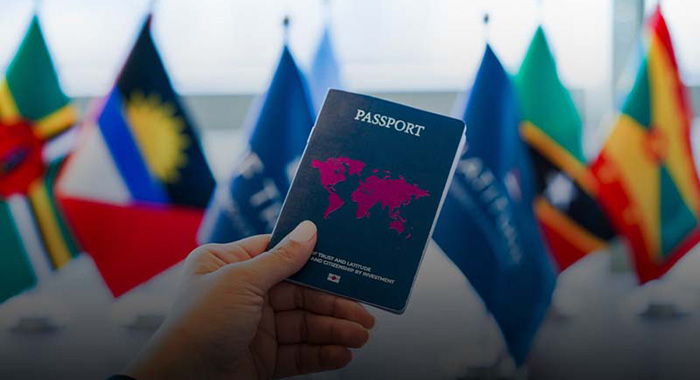

On page 37 of the election manifesto published by the newly elected NDP in advance of its overwhelming election victory over the ULP, there is a pledge to introduce a citizenship-by-investment (CBI) programme in St Vincent and the Grenadines.
CBI programmes are generally understood to mean and include the mechanism by which foreigners (subject to satisfying strict due diligence requirements) do one or more positive acts in consideration of being given immediate citizenship and a passport from the host country.
Such acts include:
(a) paying a sum of money into the national treasury, as a donation.
(b) purchasing high-end real estate (usually a condominium or apartment) in a designated and zoned area in the host country.

(c) establishing a local business capitalised at some minimum level, and employing a specified number of locals in that enterprise; or
(d) investing in national development bonds issued by the host country and holding these bonds for a specified minimum period.
Other variations on this theme exist and the list of choices specified above is not exhaustive.
The model described above is the one currently in use by certain OECS countries that officially market CBI programmes, with a CARICOM passport as the ultimate prize. This model, though attractive on its face, has severe adverse ramifications.
Residence by investment programmes (RBI) are fashioned in the same way, but without the negative attributes of CBI. Such programmes are currently used by, among others, Barbados and the Bahamas.
Both processes require stringent due diligence checks to ensure that crooks, criminals and other undesirables do not sneak through the vetting process.
Positive aspects of CBI programmes
A CBI programme has positive attributes to offer, e.g. cash receipts into the treasury and ancillary real estate development in condominiums and apartments in targeted zoned areas., which help to boost the housing stock in those areas. However, CBI does not offer anything that an RBI programme could not offer. Overall, CBI represents a net negative and sub-optimal choice compared to an RBI programme.
Negative aspects of CBI programmes
Probably the major defect embodied in CBI programmes is what I shall refer to as the “dilution effect”, under which the voting rights of existing and indigenous citizens could very quickly be diluted, with the result that they are pushed into a minority group of those entitled to vote in their own country. In effect, the family silver is being sold off to foreigners for a paltry sum, reminiscent of what happened after the Europeans took bits of broken mirrors and other trinkets to West Africa some centuries ago. This time, of course, they are using, not trinkets, but US dollars.
At the current average of around US$250,000, these OECS countries are selling their most precious patrimony for less than an acre of land (assuming a price of EC$20 per square foot). In fact, this bargain basement price looks even more ridiculous when it covers an entire family of applicants, all of whom obtain citizenship, a privilege which would be inherited by their children and grandchildren.
If the above seems far-fetched, this second defect drives home the point. A situation could arise, where a small group, or even a single super wealthy passport buyer, uses his wealth to buy out huge swathes of the country and in the process, disenfranchises indigenous Vincentians and relegate them to minority status. Sounds unreal? This is the harsh reality in Nevis, where (according to an article published in both the Financial Times and the Daily Mail) a super-wealthy bitcoin investor has bought up vast acreages of land with the help of crony politicians and the desire to create a state with its own laws within the island of Nevis.
A third disadvantage of such a scheme is that the person to whom citizenship has been sold is invariably an itinerant, who immediately uses his new CARICOM passport to make his way to Canada, the United States, the UK or some other developed country. He has no immediate intention of making any positive contribution to the pool of human capital in his new country of citizenship.
Some countries have already begun the process of targeting states that offer CBI programmes. After the EU closed a similar scheme in its member state Malta, the EU’s highest court ruled that such citizenships were fictitious. It is unlikely that visa-free access will continue to be offered by the EU to OECS states that offer CBI.
In fact, Norway, a non-EU country, has begun the process of deporting such passport buyers. Even the great paragon of virtue, Donald Trump, has expressed misgivings about Caribbean CBI programmes. Those interested in reading the Norwegian story may find it here.
In sum, CBI schemes are nothing less than an adventure in passport sales. Its proponents take the view that desperate times call for desperate measures, and in times of hardship, you sell your most precious asset first. The rest of us would say that that is an asset you sell last. These proponents take no account of the dilution in voting rights which the current population will suffer because of such sale.
Those familiar with company law will draw this analogy. Assume, for the sake of simplicity, a company has a shareholder (the SVG public) at a time when capital is required. The directors (the government) of the company issue a bundle of shares to total outsiders, without first allowing existing shareholders to invest further. Such a board of directors may find itself before the High Court facing claims for breach of trust or breach of fiduciary duty for ignoring the pre-emption rights of the shareholder. In fact, the board may be fired by the shareholder before the sale goes ahead.
In mitigation, a point raised by those in favour of introducing CBI in SVG is that the last ULP administration was in the practice of selling passports to a favoured few. To that I say this: The NDP has been elected to deviate from ULP policy, not to further extend and support it. It certainly should not be a case that the more things change, the more they remain the same. In any event, as far as we know, the ULP did not engage in selling passports on an industrial and unlimited scale.
I recall reading a recent article where a certain Mr. May was reported as saying that it is “almost criminal not to have CIP” in SVG. What he didn’t explain to us is why his home country (be it Singapore, Switzerland or elsewhere) has not engaged in passport sales. He failed to suggest that criminal charges be brought against the leaders of his home country. Very condescending to say the least!
It is not beyond the realms of possibility that, within a generation, the passport buyers and their descendants could lay claim to being the largest group of Vincentian citizens and then dictate the pace of what happens in SVG elections. (Imagine if 30,000 passports were sold and each buyer had four children, each of whom in turn had three children/grandchildren. In such a situation, native Vincentians, now in a minority, could well be told, “We represent the majority here now, and if you don’t like what we do, go back to Africa where you came from.”
Already, the Cayman Islands (which has no power to sell British passports and hence only sells RBI) has begun the fightback, as the locals come under numerical pressure from immigrant foreigners, most of whom are from Europe and North America. The sheer volume of foreigners is distorting the socio-cultural equilibrium within the islands. Those interested in reading that story will find it here.
Why is international mobility such a prized product?
In the current world, rocked by international political turmoil, internal repression and punitive taxation, wealthy foreigners are constantly in search of alternative jurisdictions which they may call “home”. Relocation may not be immediate for them, but the option to relocate is one which must be kept up their sleeves. The clientele seeking such alternative jurisdictions represents a mixed bag.
From Iranians seeking relief from US sanctions on their home country, to those fleeing the wrath of Putin in Russia, or Xi in China, or those seeking fiscal freedom from the UK which has recently abolished its non-domiciled tax regime, thus exposing large investment portfolios held offshore (by UK resident foreigners) to UK taxation; all of these foreign clients now seek fiscal and personal freedom.
Not only do they seek such freedom, but they would also like to have sanctuary in nice, sunny and sophisticated places, free from crime, and having no inheritance tax, capital gains tax, and preferably no (or very low) income tax. This freedom is an advantage that can be enjoyed by those living in almost every country in the world, where jurisdiction to tax is based on residence as a connecting factor, rather than on nationality, as is the case in the United States and Eritrea.
Enter the Cayman Islands and the Bahamas and, to some extent, Barbados, which, notwithstanding its horrendous exchange control regime, is still an attractive place by virtue of its vast tax treaty network and its retention of the non-domiciled taxation regime which the UK has recently abolished.
Within the OECS, St Kitts and Nevis and Antigua are among those sunny isles, both with zero personal income tax, although the charge still applies at the corporate level. Cheerful places indeed to anchor the superyacht while having a triple cocktail on the beach.
SVG, sadly, has not capitalised on its outstanding potential in this regard. It has failed to realise the importance of the financial services industry, the key twin pillars of which are low/no taxes and high levels of professional skills in trusts fund and company management. The jurisdiction shot itself in the foot not once, but twice. Firstly, by not abolishing personal income tax when VAT was introduced, but instead veering towards a statist model. Secondly, by imposing income tax on international trusts and business companies, seemingly the first and only non-tax-treaty jurisdiction in the world to do so, thereby, at a stroke, making SVG an unattractive place in which to do international business.
It is with this backstory in mind that we approach the issue of the sale of citizenship and residence. Henley and Partners Residence and Citizenship by Investment | Henley & Partners ranks the strength of passports internationally according to the number of countries to which a passport holder has visa-free access.
According to this ranking, the SVG passport is ranked 24th in the world. Admittedly, the Bahamas (22nd) and Barbados (21st) rank slightly higher but their citizens should know that the SVG passport grants a highly valuable nationality. (For comparison, the United States has a rank of 11th, and the UK a rank of 7th).
An alternative approach: permanent residence
Not surprisingly then, less desperate and more economically prudent administrations such as Barbados, Bahamas and the Cayman Islands offer an alternative to CBI. They offer permanent residence by investment. Under such a scheme, the foreigner is required to invest substantially more than the bargain basement prices charged by the OECS for full citizenship. By investing in the same asset classes listed above, the buyer gets a permanent residence certificate/card or stamp in his passport, but does NOT get a passport with which to move elsewhere. He is, however, free to live and may apply for citizenship, in say 5 -7 years and, if successful, obtains a passport at that time. In the meantime, he makes his skills, expertise and acumen available to the new host country.
Those interested in reading further and making a comparison between these schemes could look at:
Barbados Special Entry and Reside Permit (SERP) Guide| Barbados Dream Properties
Guide to Permanent Residency in the Bahamas | Bond Bahamas
How Does Permanent Residency Work in the Cayman Islands?
Steps SVG should now consider
Any prudent administration should be wary of selling the birthright of its people to itinerants. Instead, the new NDP administration should look to follow the paths set by Barbados and the Bahamas and make available a residence by investment programme. To that end, it should:
(1) abolish personal income tax as it moves towards a reduction of the tax burden suffered by its residents.
(2) carry out the zoning of geographic areas where international construction firms and developers with proven experience should be invited to come and construct high-end apartments that will please the eye of those foreigners who wish to apply for residence by investment.
(3) take steps to revive the financial services industry by taking business companies and international trusts out of the scope of income tax, so that SVG could reasonably compete with other offshore jurisdictions.
(4) encourage the attraction of SVG to professionals (fund managers and administrators, trust experts, captive insurance specialists, etc.) who could bring their clientele and expertise to the island, by giving such persons a fast track in the application process for RBI.
Finally, I wish Prime Minister Godwin Friday and his administration the best of luck as he embarks on this monumental task but he should not assume that he begins from a point of weakness. He should be fully cognisant that, within the Western Hemisphere, no other island state could match the quality of what SVG currently has in Mustique and Canouan.
I.N. Legair (barrister)
The opinions presented in this content belong to the author and may not necessarily reflect the perspectives or editorial stance of iWitness News. Opinion pieces can be submitted to [email protected].