



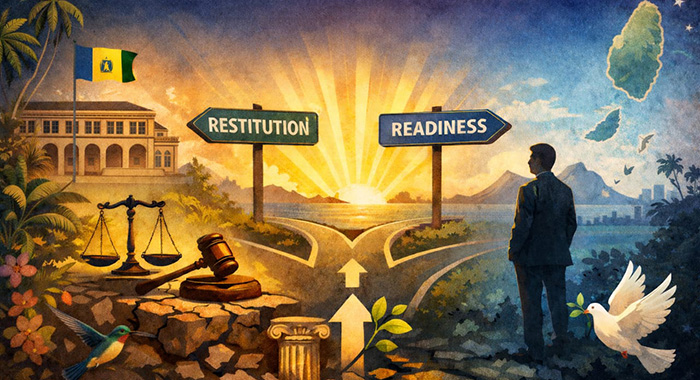

The transition of political power is always a moment of heightened emotion. In St. Vincent and the Grenadines, the change of government after 25 years of Unity Labour Party rule has understandably stirred deep reflections among those who felt marginalised, constrained, or deliberately sidelined during that long period. For many supporters of the New Democratic Party — particularly those who were visible, vocal, or merely perceived as sympathetic — political affiliation carried tangible consequences. Opportunities were limited, careers stalled, and aspirations deferred. These experiences are real, and they should not be minimised.
It is therefore natural that the change in government has generated strong expectations. For some, the moment feels like one of moral reckoning: a chance for restitution, recognition, and finally, favourable consideration after decades of exclusion. Yet while the sense of injustice may be justified, the expectations that follow must be carefully examined. Restitution in a democratic society cannot be confused with entitlement, nor can political change reverse time or suspend reality.
The central challenge is this: while many individuals were constrained in their personal advancement, the country — and the world — did not stand still. Over the last quarter century, economies evolved, technologies transformed entire industries, professional standards shifted, and governance itself became more complex. Qualifications that were once sufficient may no longer be so. Skills that were once competitive may now be outdated. In some cases, the very roles people feel entitled to today require competencies that did not exist, or were not emphasized, when their careers first began.
This is not a judgment on character or loyalty; it is an acknowledgment of structural change. Political discrimination may explain why someone did not advance, but it does not automatically confer readiness for senior responsibility in a vastly changed environment. To ignore this reality would be to risk personal disappointment and national underperformance.
At the individual level, this moment calls for honest self-assessment. What skills have been maintained? What knowledge gaps exist? What training or certification is now required to operate effectively at higher levels? For some, the path forward may involve retraining, professional upgrading, or even starting anew in a related field. This can feel unfair — especially when one believes those steps should have been taken years ago under different circumstances –but pragmatism demands that we deal with the present as it is, not as we wish it had been.

Patience, in this context, is not passivity. It is a strategic posture. Investing time in skills development, mentorship, and professional growth is not a retreat from justice; it is a preparation for sustainability. Short-term appointments that ignore competence in favour of political loyalty may provide momentary satisfaction, but they ultimately weaken institutions and undermine the very change people hope to see.
At the national level, the same principle applies. A new government must resist the temptation to simply invert old patterns of patronage. Replacing one form of political favouritism with another does not heal divisions; it entrenches them. True restitution lies not only in appointments or salaries, but in building systems that are fair, transparent, and merit-based — systems that ensure no future generation is punished or rewarded solely on the basis of political affiliation.
This is also a moment for collective reflection. The goal of political change should not be revenge or compensation alone, but national renewal. That renewal depends on competence, integrity, and adaptability. It requires recognising that while past wrongs deserve acknowledgment, the future demands preparedness.
Ultimately, the way forward — both for individuals and for the nation — lies in balancing justice with realism. There must be space for healing and inclusion, but also a commitment to standards and excellence. By embracing patience, setting realistic expectations, and pursuing thoughtful self-improvement, those who once felt excluded can position themselves not just to benefit from political change, but to contribute meaningfully to it.
In doing so, the country moves beyond cycles of grievance and entitlement toward a more mature democratic culture — one where opportunity is expanded not by who you supported, but by what you are prepared to do.
Ovid Burke
The opinions presented in this content belong to the author and may not necessarily reflect the perspectives or editorial stance of iWitness News. Opinion pieces can be submitted to [email protected].
This is a very thoughtful piece that everyone should read.
A lot of truth in this. Not good to repeat the actions of the past years. Qualifications and necessary skills/experience should be taken into consideration when hiring. Appointment to boards should not just be because of party support. An individual should be capable of contributing too.