




By Ashford Peters
The head of crime-fighting in St. Vincent and the Grenadines (SVG), Assistant Commissioner of Police Trevor “Buju” Bailey, is reiterating his call for parents to pay close attention to their children amidst the growing presence of the “6ixx” and “7even” gangs in the nation’s secondary schools.
Bailey made the call a week after he told the nation that the two rival gangs, which were involved in recent pockets of violence in schools and some communities in SVG, are attracting students who have no clue of their history or how they might benefit from membership in these gangs.
Speaking on Wednesday on the ruling New Democratic Party’s radio programme, New Times on NICE Radio, Bailey described it as a “growing problem” that “is still very much rampant in our schools”.
Bailey called on parents to speak with their children and “encourage them on a daily basis to stay away from gangs and other activities, and pay attention to their school work.”

He said he recently received “a startling revelation” from a head teacher who told him that between 20 and 25% of her student population do not return to classes after lunch.
Bailey said parents have to know where their children are at all times.
“If you have the time, it is good to just sometimes just come over to the school to pay a visit,” the senior police officer said.
“Don’t wait until there’s a Parents’ Day to find out at that time that … your child has been absent from school 15 times and late for 25 times,” Bailey said.
The chief detective emphasised the importance of “surprise visits” as a way of “letting your child or children know that you’re thinking about them, even though you know that they should be in school”.
He said that in that way, children know “they can’t skip school because they don’t know when mommy or daddy is going to pop up” and would have to explain any absences to their parents.
“So we don’t want our kids who are in school to be the gang leaders of tomorrow,” Bailey said, noting that parents are “sending them to school so that they can learn, learn the lesson well, and let education be the pathway for a better life for them and their children”.
Bailey said a parent should see their child or children as their investment.
“That is their lifelong investment. They invest in their education so that they will have a better life for themselves and their children.”
Meanwhile, on Feb. 19, in another call to the same radio programme, Bailey gave the public an idea of the gangs’ deep penetration into the nation’s schools and students’ ignorance about the origins of the gangs they are associating with.
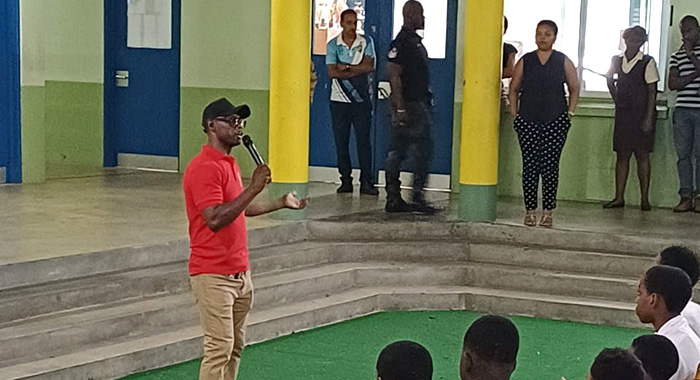
Bailey relayed his encounter with students who claimed to be members of the 6ixx and 7even gangs while attending a recent meeting with the principal and students of the West St George Secondary School.
He said he was “pre-armed” with information that the “6ixx and 7evens gang and the behaviour pattern was present in this school”, so he took the opportunity to address it.
He said he called a female student to the front who was very vocal and whose schoolmates were calling her by name, urging her to come forward.
“So, it indicated to me that she’s probably a very vocal person”, Bailey said.
“So, I invited her forward, and I asked her a simple question. I said to her, ‘Tell me one benefit that you get from being either a part of, or associated with, 6ixx?’
“And the answer was very interesting. She said, ‘I don’t know. I don’t know of any benefit’,” Bailey said.

The chief crime-fighter said Vincentian students are “getting involved in behaviour or associating themselves with groups and gangs that they know nothing of”.
Bailey said that it was clear that students heard of the 6ixx and 7even gangs but lacked knowledge of their origins.
“They don’t know the origin. They don’t know the history. … But they’re glad, and they freely associate,” he said.
The 6ixx and 7even gangs are said to originate in Trinidad and Tobago and are said to fall under the umbrella of highly-organised criminal groups or alliances (“super gangs”) with extensive hierarchies and massive membership.
They are said to operate in major urban areas, especially in larger countries.
The Muslims and Rasta City are two “super gangs” in Trinidad. The names appear to indicate that each group belongs to Islamic and Rastafarian faiths, respectively, but gang members vary in religious beliefs.
The Muslims are affiliated with an extremist international Muslim militant group known as Jamaat al Muslimeen, the group that orchestrated a failed coup against the Trinidadian government in 1990, resulting in the loss of 24 lives.
Rasta City is the gang that rivalled the Muslims. But, there was a split within Rasta City into the gangs Sixx and Seven — the latter faction claiming the name Rasta City for itself.
Bailey said that during his meeting with the principal, teachers and students of the WSGSS, he asked students to indicate if they were associated with the 6ixx gang, “and from the uproar that took place, you would have want to believe that they were in the stand cheering on a house member who’s sprinting home to the finish line from a 200-metre”.
He noted that “all of the teachers were there”, adding that he was “taken aback”, because he “couldn’t believe, having heard that there’s a presence”.
The senior police officer, however, said that seeing students indicating that they are part of 6ixx showed “that it was so deeply rooted…
“And I got a similar response when I asked of the 7evens,” Bailey said.
To further demonstrate how entrenched the gang culture was in the schools, Bailey said that using his knowledge of the streets, he used his right hand to form the symbol of the 7even and “a youngster was brave enough to say, ‘No, officer, yo go get beat up. Don’t make that 7even sign”.
Indications are that these gangs have been operating in St. Vincent and the Grenadines for some time but recent pockets of violence at schools and in various communities have caused the public to take closer note of them.
Bailey said one of his colleagues told him that during an engagement with students, he mentioned the names of some of the original members of the gangs and “where they were, who was in prison, and who was doing time and who was doing a shorter sentence, cooperation with law enforcement and so forth.
“And they (students) were shocked”.
Indicating the extent to which the gangs have penetrated the schools, Bailey said: “They just didn’t know. And the thing is, that is just one of many schools who have indicated that they have the presence of this gang violence in the school”.
Bailey appealed to parents and guardians to “take stock with our kids, the time that they’re coming home from school…
“… parents have to take a greater look at who the children are associated with. Where do they hang out? What are they doing? And their devices, the different sites that they going on to and engage their children in conversation.”
He said that parenting means more than just providing for a child’s physical needs.
“… it just can’t be that you provide their basic needs without engaging them in meaningful conversation.
“Because if you’re absent in their life in that regard, then someone else is going to take that opportunity, and they may be giving your child or children the wrong advice. So, from a parental point of view, we have that role to play,” Bailey said.
The chief crime-fighter said the church, the schools and community groups also have a vital role to play.
To further illustrate the serious negative impact on the school, Bailey referred to a conversation with a head teacher about a matter that occurred in a classroom, as reported by a teacher.
“… It pierced me when the head teacher said that one teacher reported that she was in a class teaching and a young man in the class took out his weed, rolled a marijuana cigarette in the class. He took a (cigarette) lighter and lit it (marijuana cigarette). He lit it … and start smoking whilst the teacher is at the front of the class teaching,” Bailey said.
“… it tells me that it is not just a law enforcement issue. It is a community, it is a national issue, that all of us have to be involved to get rid of this type of behaviour and eradicate it totally from our schools. It is a very, very serious issue. And, as I said, this is only one school. Many other schools have been reaching out to the police,” Bailey said.