



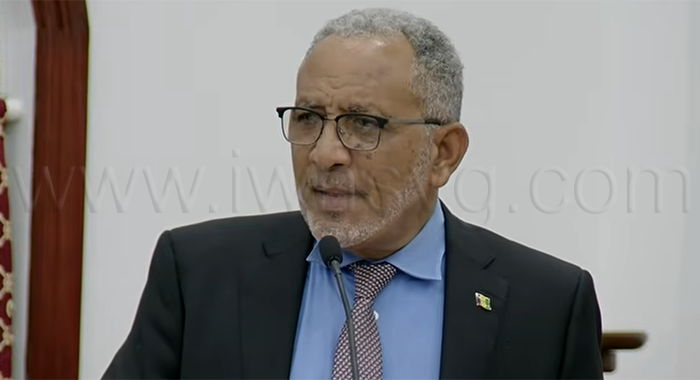

Prime Minister Godwin Friday has described the new Compassionate Gratuity Bill as a “big deal” for non‑pensionable, low‑paid public workers, arguing that his government has moved in months to fix an injustice that the previous Unity Labour Party administrations left unaddressed for a quarter century.
Speaking during Tuesday’s debate on the Daily Paid and Minor Salaried Officers (Compassionate Gratuity) Bill, 2026, Friday framed the legislation as both social justice and economic necessity for workers who retire without a government pension.
“This is indeed a very good day for the people of Saint Vincent and the Grenadines,” Friday said.
“We have before this Honourable House a bill… that looks after the people who tend to get overlooked, as was done by the previous administration for nearly 25 years.”
Friday said the bill is aimed squarely at daily paid workers and minor salaried officers — cleaners, attendants, ancillary health staff, drivers, guards and other low‑wage public employees who are not pensionable under the traditional public service pension arrangement.

“They are the lowly paid, lowest on the rank or the ladder of the public service, and they tend to get scant attention,” he said.
He reminded MPs that one of his administration’s early decisions was to include daily‑paid workers and part‑timers in the payment of salary bonuses to public servants:
“More than anyone else, they need this little extra money in their pocket,” Friday said, adding that if others had to take “a little bit less” so that these workers could be included, “then so be it”.
“That is what we did,” he said, arguing that the measure showed the government was serious about “looking out for the little person”.
Formalising and improving an old practice
Friday acknowledged that compassionate gratuity for non‑pensionable workers was not entirely new.
For years, he said, retiring daily paid and minor salaried workers could apply to Cabinet for a lump‑sum payment.
What the bill does, he argued, is to upgrade that practice into law and improve it.
It defines in legislation who qualifies as a daily paid or minor salaried officer and it sets out clear eligibility rules, including a minimum service requirement and coverage whether the worker retires or dies in service.
The prime minister further said the new law codifies a calculation formula – two weeks’ pay for each year of service – and it extends the maximum number of years on which the gratuity can be calculated.
While the informal practice and existing pension rules capped the service counted for similar calculations at 26 years, the new law extends it to 33⅓ years.
He said this move “puts money in people’s pockets” and gives long‑serving low‑paid workers a better lump sum at the end of their careers.
Closing the 60–65 pension gap
Friday located the bill in the wider context of National Insurance Services (NIS) reform, which has gradually raised the pensionable age from 60 to 65.
He reminded Parliament that non‑pensionable public workers do not receive a government pension.
Additionally, they must now wait until age 65 to qualify for an NIS pension, whereas previously they could receive it from age 60.
This, he said, created a dangerous five‑year income gap for retiring non‑pensionable workers.
In that context, the compassionate gratuity is not a luxury but a critical safety net, the prime minister said.
He said it gives retirees a lump sum they can use to start a small business or buy equipment, reduce debts, or bridge the years until NIS pension starts.
It also gives families of workers who die in service an immediate source of funds.
Money goes straight to designated beneficiaries
A key change Friday highlighted was the introduction of a designated beneficiary system for gratuity payments when a worker dies in service.
Under the previous arrangements, he said, families often had to go through costly and time‑consuming legal processes to obtain relatively modest sums — in some cases EC$10,000 to EC$12,000.
The new law allows the worker to name a beneficiary in advance, using a prescribed form attached to the act.
Timelines for payment: ‘3 months means 3 months’
Friday also drew attention to the bill’s strict timelines for paying the gratuity, noting that in cases of retirement, payment must be made within three months of approval, and in no case later than six months.
In cases of death in service, the same three‑month target and six‑month maximum apply to payments to the beneficiary or personal representative.
He said this provision came directly out of consultations and public complaints about long delays.
“We said, ‘Listen, we don’t want to hear that it’s okay, they’re entitled, and you will pay them in due course or in reasonable time.’
“We said, ‘Put a specific timeline in there: three months,’” Friday said.
He added that while the law allows up to six months “if necessary”, public servants administering the system should understand that “when we say three months, we mean three months”.