



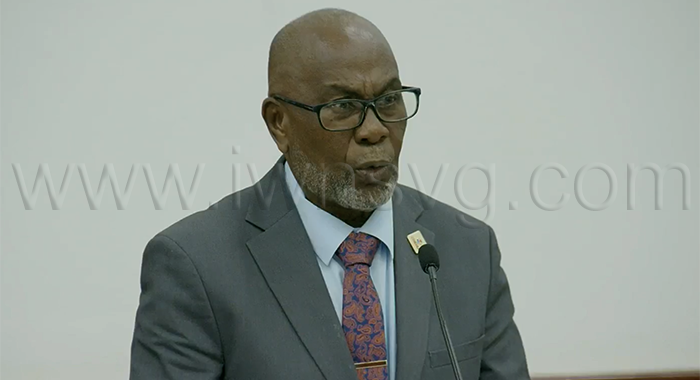

Minister of National Security St. Clair Leacock says some senior police officers choose not to work under the New Democratic Party administration, adding that other officers who are not committed to the government’s security agenda “should take that example and go home”.
Speaking in Parliament on Thursday, Leacock linked leadership changes in the Royal St. Vincent and the Grenadines Police Force (RSVGPF) to his wider effort to strengthen its operational response to gun violence and homicides.
Without naming individuals, Leacock, who is also deputy prime minister, told lawmakers that at least two senior officers had chosen to step aside since the change of government in November.
He said he would not hesitate to recommend further departures if he concludes that certain officers are not delivering.
“… one or two senior officers … never served a day under this administration, they asked for their leave, and we obliged,” Leacock said.

“It may well be that there are one or two more who should take that example and go home and make room for others who want to do it. And if they don’t … deliver, believe in me, I’ll make the recommendations for those who want to serve this nation and this administration faithfully well, to be put into position. I wouldn’t hesitate in it.”
His comments amounted to one of the clearest public signals to date that the new government is prepared to reshape the police leadership as it confronts public concern over crime.
Structural overhaul and daily reporting from acting high command
Leacock’s remarks about officers who have left the force came as part of a broader critique of how the RSVGPF was previously run and a defence of steps already taken since he became minister.
He said he has worked “structurally” with the high command and drew an implicit contrast between the current and former commissioners of police.
Trevor Bailey has been appointed to act as commissioner of police while the substantive office holder, Enville Williams, is on leave for seven months.
Without mentioning Williams by name, Leacock said it had taken the substantive commissioner “six months to understand” that his deputy should accompany him on foreign engagements, and that the deputy was “too often… left out”.
“It has taken him six months to understand that he is going on a tour of duty that his deputy is worthy of being in attendance. Too often, … he’s left out,” Leacock said.
“The daily reports I get. on where we are with the crime and violence. The current commissioner of police never falls short — real time, nor does Nolan “Grandpa” Dalloway in the RRU (Rapid Response Unit).”
Leacock went on to spell out his plans to redirect manpower, saying he wants 30 of the recruits sent each to the Special Service Unit and the RRU “to rebuild” those units “that we could have more men on the streets doing beat/patrol,” he said.
The minister also indicated he had specific officers in mind for leadership roles within specialised units, including the Special Services Unit and narcotics.
‘I applied for it because I can do it better’
Leacock repeatedly cast himself as an experienced security practitioner now in a position to correct long‑standing weaknesses.
“I’m in this job now for about nine months, and I applied for it because I was confident I can do it better than my predecessor. And so far, I’m doing exactly that,” he told Parliament.
He reminded MPs that he had previously served in uniform, trained officers, and taught recruits as a lecturer for about 10 years.
Push for professionalism, warning against political interference
Leacock’s suggestion that noncommitted officers quit came as he pledged to professionalise the force and reduce day‑to‑day political meddling in its operations.
He said human resource management was a “strong point” of acting Assistant Commissioner Benton Smith.
He noted that formal performance appraisals are typically annual and that his government had not yet been in office for a full year, but insisted promotions would be based on evidence rather than partisan considerations.
Leacock described himself as “the policy guy” whose work is to set direction and receive reports, while professionals in uniform run operations.
Crime strategy amid leadership change
Leacock’s comments about officers who have “never served a day under this administration” and may need to “go home” came as he outlined what he called a one‑year strategic crime reduction plan built around intelligence‑led and targeted policing and intensified operations against illegal firearms.
It also includes strengthened criminal investigations and use of forensic evidence, increased police visibility and patrols, deployment of drones and CCTV, and deeper community policing and engagement with schools, churches, youth and business groups.
Leacock said the government recognises that “recent incidents of gun‑related violence and homicides are matters of serious national concern” and that public safety remains a top priority.
He also underscored that the effectiveness of any crime‑fighting plan depends heavily on leadership quality and officer morale, linking that directly to the personnel changes already underway and those he hinted could come.
Publi. Servants, while holding their own politucal preferences, should do the wirk tgey are paid ti do in a non partisan way..
No one should expect them to change their politics, but should expect that it not impact on their work responsibilitues