



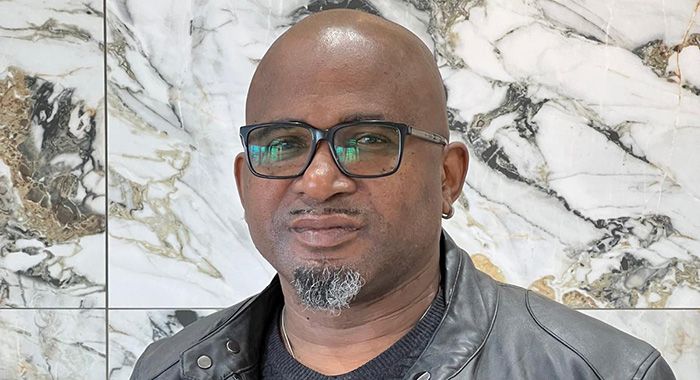

By Marlon Bute
Nellie the Ebou lifted the hoe over her shoulder. Her right foot was planted firmly on the earth, her hands tightened around the handle, and she swung.
She lifted it again.
There must have been anger. Perhaps fear too. Perhaps in that moment there was no time for either. We cannot know precisely what passed through Nellie’s mind. We do know, however, that this was no ordinary confrontation between two free human beings standing as equals before the law.
Nellie was not free.

She was an enslaved African woman living on the Grenadine island of Mayreau, part of what is today St. Vincent and the Grenadines. The account of her extraordinary act places it in the first decade of the 19th century, around 1805. The precise year is not established with absolute certainty, but what is important for us is that Nellie belongs to our history. She was a Vincentian woman.
She was one of us.
According to the account brought again to public attention by historian Dr. Garrey Michael Dennie, Nellie attacked a powerful white planter with a hoe while he was on horseback. Four other enslaved women were implicated with her, and together they disposed of his body in the sea.
They were caught.
Four of the women were executed on the estate. Nellie was taken from Mayreau to Kingstown, tried, and publicly executed.
Five African women paid with their lives.
The colonial authorities called what Nellie had done a crime. The enslaving class regarded her as a murderer. And, more than two centuries later, there are still those prepared to begin and end the discussion there.
I am not.
I have said elsewhere, in response to someone who characterised Nellie as a mere murderer, that such a judgement begins the story in the wrong place. It begins with the action of the enslaved woman and conveniently ignores everything that preceded it. When Nellie’s actions are placed within the context of the utter dehumanisation of the African enslaved, I consider what she did to have been spectacularly heroic.
It is, therefore, with considerable interest that I read Jomo Thomas’s recent piece on Nellie and with equal enthusiasm that I support Dennie’s call for Nellie the Ebou to be recognised as a National Hero of St Vincent and the Grenadines.
Her story happened here.
With the passage of time, we sometimes speak about slavery in ways that obscure its sheer brutality. Nellie was chattel. Another human being could claim ownership of her body and her labour. Africans were bought and sold. Families could be separated. Children born to enslaved women could themselves become the property of another person.
African men, women, and children were exploited principally as free labour for the creation of wealth for their white enslavers.
Slavery was, therefore, not merely an economic arrangement in which people worked without wages. It was a system of domination that sought to control every aspect of the African’s existence.
And it was inherently violent.
This takes me to two extraordinary Caribbean intellectuals, both sons of Martinique, Aimé Césaire and Frantz Fanon.
Césaire wrote powerfully against colonialism and the so-called civilising mission used to justify it. Fanon, who was influenced by Césaire, carried aspects of that conversation further. A psychiatrist and intellectual revolutionary, Fanon examined colonialism not merely as a political and economic system, but as one that affected the mind, identity, and sense of self of the colonised.
Importantly, for this discussion, Fanon confronted the question of violence and its utility in struggles against systems that were themselves maintained through violence.
I do not read Fanon as advocating violence for the sake of violence. Neither is that my argument.
But context matters.
If we begin the story at the precise moment when an enslaved woman raises a hoe against an enslaver, we can call her action violent and condemn it. But what of everything that came before?
The capture of Africans was violent. Their forced transportation across the Atlantic was violent. Their sale as commodities was violent. Forced labour was violent. The separation of families was violent. The denial of liberty was violent. The reduction of a human being to the legal property of another was itself an extraordinary act of violence.
The plantation system was not some peaceful arrangement occasionally disturbed by violent enslaved Africans. Violence, whether inflicted or constantly held in reserve, was fundamental to maintaining it.
There is therefore an important moral and historical distinction between violence employed to enslave and dominate people and violence employed by those people in resisting that domination.
This does not require us to glorify violence. It requires us to understand it.
Our African ancestors resisted enslavement from the beginning and in many ways. They escaped. They rebelled. They sabotaged production and destroyed property. They preserved aspects of their cultures. They created whatever spaces of autonomy circumstances allowed them.
And sometimes they fought back physically.
This is why I cannot accept the characterisation of Nellie simply as a murderer. The law that condemned Nellie was also the law that recognised the planter as having rights while recognising Nellie herself as property.
Why, more than two centuries later, should we inherit the moral judgement of that system?
There is another aspect of this history that has long interested me, particularly the resistance of the African enslaved woman.
Enslaved women cultivated provision grounds and small gardens. They grew crops and vegetables and raised chickens and other small animals. Their production supplemented the inadequate food available to them and helped sustain themselves, their children, and their families. Produce could be bartered for necessities or sold, allowing women to take part in small but important networks of exchange and commerce.
That too was significant.
In a system constructed around the appropriation of African labour, an enslaved woman who produced something over which she exercised some measure of control had carved out a small economic space of her own.
Some enslaved people accumulated resources through these and other activities and used them towards manumission, sometimes buying their own freedom or that of their children and loved ones.
Think about that.
People whom the law itself regarded as property used their labour, ingenuity, and enterprise to accumulate how they might buy themselves out of that condition.
And that tradition did not disappear with Emancipation.
In St. Vincent and the Grenadines, women became indispensable to agriculture, vending, and small commerce. They were farmers, washerwomen, shopkeepers, vendors, hucksters, fishmongers, and fishers. Vincentian women carried provisions, fruits, vegetables, and other goods to Trinidad and Tobago and elsewhere in the Caribbean. They traded. They saved. They sustained families. They educated children. They created opportunities for generations that followed them.
When we look at the prominent place occupied by women in Vincentian society today, we ought therefore to understand that it did not suddenly appear.
It has deep historical roots.
Long before the contemporary language of entrepreneurship, women’s empowerment and economic independence became fashionable, Caribbean women were producing, bartering, trading, saving, and investing in their families, often while having extraordinarily little formal social or political power.
My admiration for these women sits comfortably alongside my admiration for Nellie the Ebou.
The woman who cultivated her provision ground and sold the surplus and Nellie who raised a hoe against her enslaver were not engaged in the same form of resistance, but both were asserting something that the system was designed to deny them: agency over their own lives.
Rebellion, escape, sabotage, physical confrontation, cultural preservation, cultivation, barter and commerce formed part of a much larger tradition of resistance.
Our African ancestors were never merely passive victims waiting for someone to emancipate them.
It is for this reason that I welcome Dr. Garrey Michael Dennie’s call and appreciate Jomo Thomas’s contribution in bringing Nellie further into public discussion.
Nellie’s story allows us to recover an extraordinary African woman from our own Vincentian history. But it also opens a window onto the experiences of countless other women whose names did not survive in the historical record.
The more closely we examine that history, the clearer it becomes that women were never standing at the margins of the Caribbean experience.
They were among its principal authors.
And as I have commented elsewhere, had many more of the African enslaved risen against and hacked their enslavers to bits and pieces, slavery might not have endured for as long as it did.
That conclusion may make some uncomfortable.
But we should be far more uncomfortable with the system that made such resistance necessary in the first place. And which held our people in bondage for 300-plus years. A bondage, from which, we are still recovering and for which we have yet to receive reparations.
We are here because of resistance.
The opinions presented in this content belong to the author and may not necessarily reflect the perspectives or editorial stance of iWitness News. Opinion pieces can be submitted to [email protected].
I applaud the fact that you are supporting the call for Nellie the Ebou to be recognised as a National Hero of St Vincent and the Grenadines. Most of all, I applaud your recognition of the context of her actions. Let us all remember to look at Nellie’s story from the Mayreau perspective, from the female perspective, from the enslaved perspective and from the historical perspective.