



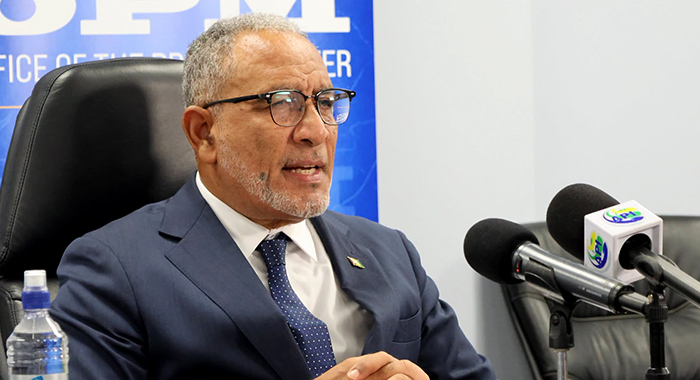

Prime Minister Godwin Friday says Taiwan has committed grant funding to help capitalise the national development bank (NDB) that the New Democratic Party (NDP) administration has proposed for St. Vincent and the Grenadines.
He told the media in Kingstown on Tuesday that Taipei will also increase support for community‑based social programmes targeting women, youth and constituencies across the country.
Speaking at a news conference on his official visit to Taiwan last week, the prime minister described the establishment of the NDB as “very much a go” and said Taipei has already pledged at least US$2 million in grant resources to help launch the institution, alongside access to additional concessional financing.
He also disclosed that Taiwan will provide US$1.5 million per year in grants for a range of social and community empowerment programmes, including a promised constituency development fund.
The announcements come as the new administration seeks to tackle a severe fiscal crunch while making good on commitments to expand access to finance for small businesses and to “put money into people’s pockets” through productive, sustainable activities.
National Development Bank ‘very much a go’

Friday said discussions on the NDB began even before the delegation left for Taipei, so that by the time they arrived, Taiwanese officials were already familiar with Kingstown’s plans.
“… and they are willing, very much so, to assist us in the establishment … We can say there’s a commitment of at least 2 million U.S. dollars as a grant to help to capitalise the bank, with other funding available and on soft terms,” Friday told reporters.
He signalled some caution about additional borrowing, noting that his government must weigh the benefits of cheap credit against the risks of increasing public debt.
“Those, of course, I am less excited about,” he said of the soft‑loan component, “but we have to balance the benefit of that with the advantage or the good that it will do in the economy, and to see whether it makes sense to borrow at 3.5% and lend on. These are things that we are studying here with our team, and we’ll decide how we go on.”
Friday said the legal framework for the bank is already in preparation, adding that Attorney General Louise Mitchell has been “diligent, working on this”, and Jason Haynes has been tasked with drafting the bill, following a series of public consultations across the country, including in the Grenadines.
A bank, not a charity — but geared to small business
The prime minister stressed that the NDB is intended to address a long‑standing bottleneck in access to capital, particularly for ordinary Vincentians and small enterprises that have been “locked out of the system”.
However, he was clear that the institution will be run on sound commercial principles, even as it adopts a more supportive posture toward small and medium‑sized businesses.
“What I’m saying to people, those persons, again, who are anxiously and eagerly awaiting the coming of the bank: it’s a bank; it’s not a charity,” Friday said.
“So, it’s a situation where we are going to manage it on business principles, but it will be much more supportive to small businesses. There will be an environment of encouragement, of support, of mentorship, and so on to help these businesses, small businesses, to succeed.”
He argued that the success of the NDB will not be measured by dividends paid to the government, but by its impact on the wider economy.
Friday also indicated that the bank’s design would take into account concerns raised by the International Monetary Fund about the governance of such institutions and the risk of adding to government debt.
Taiwan’s role in private‑sector‑led development
Friday linked Taiwan’s support for the NDB to his government’s broader economic strategy, which emphasises private‑sector‑led growth and foreign direct investment.
He recalled that during the visit, SVG hosted an investment forum in Taiwan, where the delegation presented the country’s economic situation and potential areas for investment.
Taiwanese businesspeople, he said, showed strong interest in sectors such as solar energy, tourism and hotel development, and the marine and shipyard industry.
Support for technical and vocational education
Taiwan’s development partnership with SVG, Friday said, extends beyond the NDB into education and skills training, particularly in technical and vocational education and training (TVET).
The prime minister described the current TVET system as “simply inadequate” to meet the needs of the economy and the country’s young people, noting that youth unemployment remains high even as the country imports skilled workers for construction projects.
He said he used the visit to push for a “big, transformative” TVET agenda and that Taiwanese officials responded positively, including to the idea of sending young Taiwanese professionals to work and train in SVG.
He added that the government is also exploring short‑term technical and vocational internships for Vincentian youth in Taiwan, in areas such as shipbuilding and other specialised industries, as a way of “transferring knowledge” and building a modern skills base at home.
Agriculture, youth and technology
The prime minister also highlighted ongoing and potential Taiwanese contributions to agriculture, particularly in making the sector more attractive and profitable for young people.
He pointed to the smart agriculture initiatives and tissue culture lab at Orange Hill, which he described as well‑known beyond SVG and ripe for scaling up.
The project, he said, is “a model to attract youth into an agriculture that is driven by modern technology and is much more productive, much more profitable”.
Taiwan, he added, is “very, very excited” about the possibilities of using new production, logistics and technology methods to transform agriculture into a serious business again, akin to the era of banana production.
US$1.5m annual for social, community programmes
Beyond the development bank and sector‑specific projects, Friday announced that Taiwan has agreed to provide US$1.5 million annually in grant funding to support a range of social and community empowerment programmes.
He said this support will be used partly to seed the long‑discussed constituency development fund, an initiative that Deputy Prime Minister St. Clair Leacock had raised in earlier discussions with Taiwanese officials.
He also said the grant would be directed at specific groups, particularly women and young people.
He framed this support as another way of turning assistance into productive opportunity rather than dependency.
“This is all, you know, very, very good opportunity for us to be able to, as we say, put money into people’s pockets by making them productive. So that if we invest $100, they can make $200 from it. That’s the way you do it,” he said.
“This trip gave us a lot of possibilities,” Friday said. “Some of them will bear fruit more quickly than others, but we are moving towards that.”
He insisted that his administration’s guiding principle remains to make development tangible for people across the country.
“My campaign, my strategy, is to deal with people,” he said. “We don’t just build [things] because they’re big and they look pretty.
“The point is that what we’re trying to do is to put money in people’s pockets in very real ways… What you want is people earning, people finding ways in which they can make a decent living as they used to, and providing for themselves and their families. And we are looking for every opportunity to do that.”