



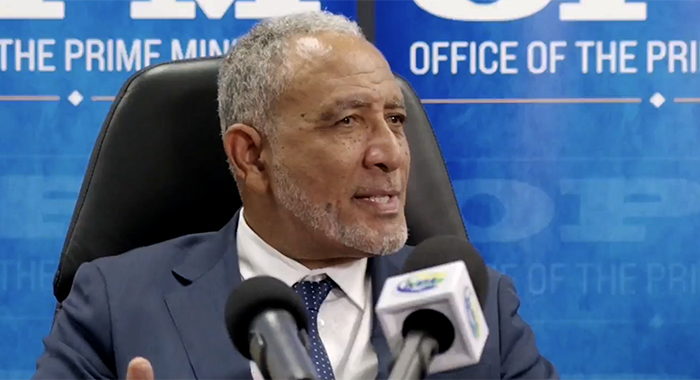

Prime Minister Godwin Friday says his government is in “very serious” and ongoing talks with Taiwan over ways to ease St. Vincent and the Grenadines’ crushing public debt, with Taipei signalling a “genuine willingness” to help as the new administration confronts a debt‑to‑GDP ratio exceeding 113%.
Speaking at a press conference in Kingstown on Tuesday following his official visit to Taiwan last week, the prime minister said the trip was not only a celebration of 45 years of diplomatic relations but also a critical opportunity to discuss how to manage a loan portfolio of about US$345 million owed to Taiwan.
He said his government is determined to address the problem “now”, insisting that SVG will not become a “failed state” under his watch.
Friday painted a stark picture of the fiscal situation his New Democratic Party government inherited when it came to office in November 2025.
He said much of the US$345 million loan portfolio with Taiwan had already been drawn down, adding that the debt‑to‑GDP ratio was likely to rise above the current 113% without corrective action.

At the same time, the government has “very little” fiscal space to fund social programmes and growth‑oriented investment.
He repeated his longstanding criticism of the previous administration’s approach to borrowing, saying the Unity Labour Party administration, which was voted out in November after almost 25 years, was “very laissez‑faire and blasé about it, as if to say that this doesn’t really matter”.
While in opposition, Friday had warned that “at some point the bill has to be paid”.
He told the media on Tuesday that that moment has arrived.
“We inherited that on November 27,” he said, adding, “I’m not going to pass this on to a next generation. We have to fix the problem now. St. Vincent will not be a failed state. We will take whatever measures are necessary to correct that problem.”
Taiwan showed ‘real interest’ in solutions
Friday said the official visit to Taiwan allowed his team to place the debt issue directly on the table with one of the country’s most important lenders.
“We have had very serious conversations with all parties — the International Monetary Fund, World Bank, our friends in the region… and our own team here, because we’re earnestly looking for solutions,” he said.
Given the size of the Taiwanese loan book, he said, Taipei had to be part of any credible plan.
“Of course, Taiwan… It’s necessary for us to engage with them as well, to seek to find ways in which we can manage the debt better going forward.”
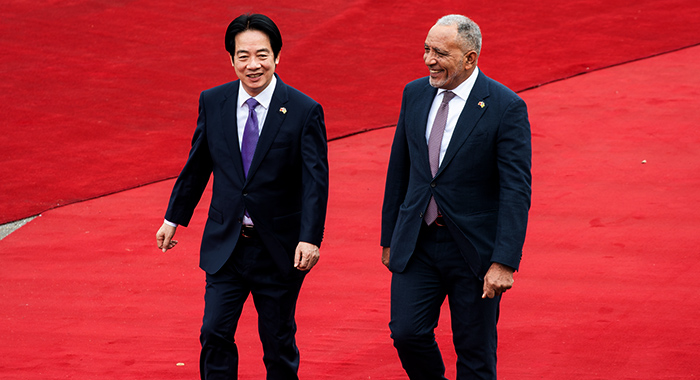
The prime minister said the response from Taipei has been encouraging even as the discussions are still ongoing.
“To our great satisfaction… we were greeted with real interest in seeking to understand our situation, and a genuine willingness to work with us to find ways in which we can resolve this,” he said.
While he stopped short of detailing any restructuring formula, Friday suggested that short‑term relief measures are already in motion.
“A lot of this is still in discussion, but… the goodwill is there, and there are measures that have been performed which I think will very much help our situation in the near term,” he said.
The prime minister declined to disclose specifics, citing ongoing talks. “Our efforts are yielding fruit … there is light at the end of the tunnel,” he told reporters.
“You will hear more about those as we go along, but I can promise you the news is good news.”
Beyond new borrowing: using existing funds better
Friday made clear that his government is not interested in repeating what he characterised as the old model of simply negotiating more loans and presenting that as success.
“We could go to Taiwan and come back and say they got US$125 million to borrow last time; we got US$200 million,” he said. “But the problem is, how are you going to repay it?”
Instead, he said discussions with Taiwan have focused on two fronts. The two countries discussed managing existing debt more effectively, including considering “other instruments, other mechanisms” for long‑term sustainability.
The prime minsiter said talks also focused on maximising value from undrawn and committed funds by reviewing funds that have been committed but not yet drawn down and re‑examining how remaining resources linked to past projects can be used “most effectively” to support growth, rather than deepening the debt burden.
“We are now looking to find ways in which we can utilise the investments that were made with the money that was borrowed… and at the same time work with our partner in Taiwan to find ways to generate some fiscal space for this government,” Friday said.
He framed this as part of a broader effort to align future cooperation with debt sustainability, not just new spending.
Balancing debt, social programmes and growth
Friday stressed that any arrangement with Taiwan and international partners such as the IMF and World Bank must balance three competing priorities: stabilising and reducing debt; maintaining and even expanding key social programmes; and freeing capital for productive investment and growth.
“We are earnestly looking for solutions for us to be able to manage our fiscal situation, the debt situation,” he said, adding that this must be done “without sacrificing the necessary social programmes… and at the same time also generating capital for investment in productive activities”.
He reiterated that social commitments and development ambitions cannot simply be abandoned in the name of austerity, but acknowledged that current debt levels are unsustainable.
During the press conference, the prime minister restated his government’s commitment to maintaining diplomatic relations with Taiwan.
Friday what exactly did you get from your trip to Taiwan? Going around the Mulberry tree without saying nothing is all I gathered from your press conference..