



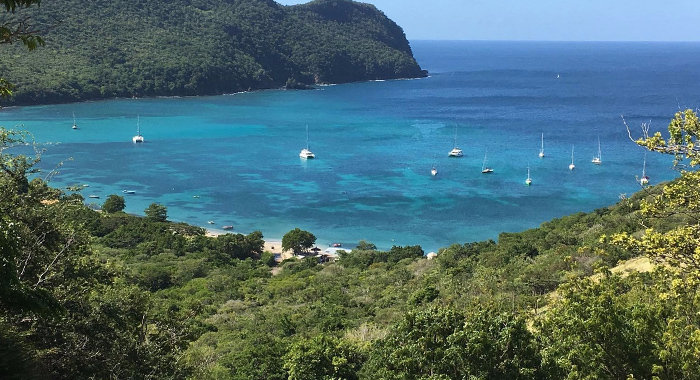
On Aug. 31, the Office of the Prime Minister issued a hurried press release in response to the public outcry over the Government’s secret sale of Chatham Bay to a mystery investor, purportedly for “conservation” purposes. Unfortunately, the press release is downright misleading, and raises many more questions than it answers.
This has nothing to do with debt, or the Belize Blue Bond
The press release takes great pains to point out that:
While arrangements like these may be new to Saint Vincent and the Grenadines, they have been used elsewhere for similar purposes. In our own Caribbean Community, Belize’s Blue Bond, a landmark 2021 debt-for-nature refinancing deal, reduced the country’s national debt by 12% of its Gross Domestic Product (GDP) and generated millions for marine conservation. The current transaction with AHRA LLC has secured nearly EC$53 million and placed conservation at the centre of the land’s future use.
This comparison is profoundly misleading. The Belize Blue Bond was not a sale of public land. It was a sovereign debt-refinancing transaction tied to conservation commitments. The Belize Blue Bond is emphatically NOT an “arrangement like” the sale of Chatham Bay. First, and most critically, the Belize Blue Bond did not involve Belize selling one square inch of State-owned land to a private purchaser. Under the Belize Blue Bond, Belize retained ownership and sovereignty over its natural assets, undertook legally enforceable conservation commitments, and secured financing to refinance expensive sovereign debt. SVG sold approximately 100 acres of State land to a private company. Those are not similar transactions. None of that is “like” the sale of Chatham Bay.

In fact, the Belize Blue Bond explicitly did not include privately owned land or the seabed. It is the opposite of what the government has done with Chatham Bay. Secondly, the Belize transaction had a clearly identifiable debt-management objective: refinance expensive debt, retire US$553 million of existing obligations at a discount, and use part of the resulting savings for conservation. What debt-management objective does the Chatham Bay sale achieve? The press release does not say.
Thirdly, despite lots of talk in the press release about the national debt and the Belize Blue Bond, the press release conspicuously does NOT say that the $53 million sale price of Chatham Bay will be applied to the debt. We demand to know: whether the Government used the $53 million to pay down the debt, as was the “like” case of the Belize Blue Bond?
Did the Government place the $53 million in the Contingencies Fund? Or did it simply use the $53 million to meet recurrent expenses? Finally, the scale is also completely different. Belize used the transaction to retire approximately US$553 million in external commercial debt, reducing its public debt by about 12% of GDP. By contrast, the approximately US$20 million received for Chatham Bay, even if every cent were applied to the national debt, would reduce SVG’s debt stock by only around 1.5%. Was that marginal debt reduction worth permanently disposing of what the Government itself calls “an exceptional national asset”?
The lack of transparency about AHRA LLC and the agreement
The press release identifies a company called AHRA LLC as the purchaser of Chatham Bay. However, it has not provided any information about AHRA LLC itself. Who owns AHRA LLC? What is AHRA LLC’s environmental expertise or experience? Remarkably, the sale of Chatham Bay was announced on the same day that Parliament amended the Companies Act in a manner that reduces the registration and disclosure obligations attaching to certain external companies connected with land ownership. Last week, we would have been able to learn about AHRA LLC’s beneficial ownership.
Today, we cannot. We demand to know: Who owns AHRA LLC? Who ultimately controls it? Who are its directors or managers? What is its record in environmental conservation? Why was it selected? The press release obliquely refers to certain terms within the Government’s agreement with AHRA LLC. But the full agreement remains a mystery. The Government cannot ask Vincentians to trust unspecified “binding covenants” while refusing to show the public what those covenants actually say. If those covenants are the justification for selling Chatham Bay below market value, publish them.
We demand to know: if the agreement’s covenants prohibit subdivision? Resale? Development? Change of use? Do they bind successors? What happens if AHRA breaches them? Can AHRA sell the company rather than the land? Does Government have a right of re-entry? The Press Release also says Government may repurchase Chatham Bay at the same price within two years. Why? If this is a permanent conservation transaction with a carefully selected conservation partner, why is the government contemplating buying the property back almost immediately? What circumstances trigger the option? Who controls whether it can be exercised? If the option to repurchase is not exercised in year two, is it lost? And where would the Government find another EC$53 million to repurchase land it has just sold? We also demand to know: how the Government arrived at the value of US$20 million for Chatham Bay, and what other offers for the property were considered before deciding to sell to AHRA LLC.
Finally, it was the practice under past administrations that the sale of State land would be conducted by the lawyers of the Attorney General’s Chambers, on behalf of the Government. This saves time, promotes consistency, ensures transparency, and saved the Government the exorbitant fees charged by private lawyers who base their fees on the value of the property sold. This time, in the sale of Chatham Bay, the Government of Saint Vincent and the Grenadines was represented by a private lawyer.
We demand to know: Who was the private lawyer? Who selected the private lawyer? On what basis? What legal fees, if any, were charged to the State? Were any fees calculated by reference to the EC$53 million purchase price? And why was public counsel not used?
Environmental protection and sustainable development are not ‘either/or’ propositions
The Prime Minister’s statement presents Vincentians with a false choice: either sell Chatham Bay for conservation or retain it for large-scale resort development. Those were never the only two options. Government could retain ownership and prohibit inappropriate development. It could zone the land. It could create a protected area. It could permit tightly controlled eco-tourism. It could pursue sustainable development. The question is not “conservation or concrete?” The question is why conservation required the sale of the land. Let us not forget that an eco-resort called the Tenuta Chatham Bay Resort already occupies six acres of private land at Chatham Bay.
The continued existence of Tenuta Chatham Bay Resort proves that environment and resort development are not per se incompatible. The mere presence of tourism does not establish environmental destruction, any more than conservation necessarily requires an absence of all economic activity. We demand to know: what does the Government mean by the Press Release’s phrase “conservation, with binding covenants that protect the area’s natural environment and biodiversity”.
Will Vincentians retain exactly the same right of access to the beach and surrounding lands that they enjoyed when the State owned the property? Will there be other restrictions on public access to Chatham Bay? Will yachts continue to be allowed anchorage in Chatham Bay? Will existing eco resorts on Chatham Bay be closed, acquired, or otherwise restricted in operation?
Why can’t we protect and preserve Chatham Bay ourselves?
The press release suggests that the sale of Chatham Bay was based on a need to protect it and conserve its environment. However, the Government has not identified a single, specific environmental emergency or imminent threat that suddenly required Chatham Bay to be sold. Further, over the last three decades, SVG has proven capable of protecting other environmental treasures, like the Tobago Cays Marine Park, the Vermont Nature Trail, or the La Soufriere Volcano.
We demand to know: what is the specific, urgent environmental threat to Chatham Bay that required its sale at this time? What can AHRA LLC do to protect Chatham Bay that the Government of Saint Vincent and the Grenadines could not do itself? And why does AHRA need to own Chatham Bay in order to protect it?
More questions than answers
The Government has sold what it itself describes as “an exceptional national asset” to a private company whose ultimate ownership remains undisclosed, at a price substantially below previously reported valuations, under an agreement that the public has not seen. We still do not know why Chatham Bay had to be sold in order to protect it. We do not know who ultimately owns or controls AHRA LLC. We do not know why AHRA was selected. We do not know how the sale price was determined, whether competing offers were considered, what the EC$53 million will be used for, what legal fees were paid, or precisely what the so-called “binding covenants” require. The Government’s Belize Blue Bond comparison answers none of those questions. Belize refinanced its sovereign debt and committed itself to conservation. Saint Vincent and the Grenadines sold public land. They are not the same thing. If the Government is confident that this transaction is genuinely in the national interest, it should stop asking Vincentians to take that claim on trust. Publish the valuation. Publish the agreement. Disclose the beneficial owners. Explain the selection process. Account for the money. Chatham Bay no longer belongs to the people of Saint Vincent and the Grenadines. The people are entitled to know exactly why.
The opinions presented in this content belong to the author and may not necessarily reflect the perspectives or editorial stance of iWitness News. Opinion pieces can be submitted to [email protected].
While I take issue with many of the statements made in this piece, I would like to focus on just one: “SVG has proven capable of protecting other environmental treasures, like the Tobago Cays Marine Park, the Vermont Nature Trail, or the La Soufriere Volcano.” While I am no expert on the Vermont Nature Trail nor the La Souriere Volcano, I can very confidently state that SVG has absolutely not proven capable of protecting the Tobago Cays Marine Park. As a resident of the park – and the fact that there are any residents in a marine park at all should raise a huge red flag – and someone who has completed almost 2,000 dives in these waters, I have personally seen, commented publicly about and carefully documented conditions over the past 30+ years. The grievous lack of protection of these waters and marine life therein is shameful and must be corrected on an urgent basis.