


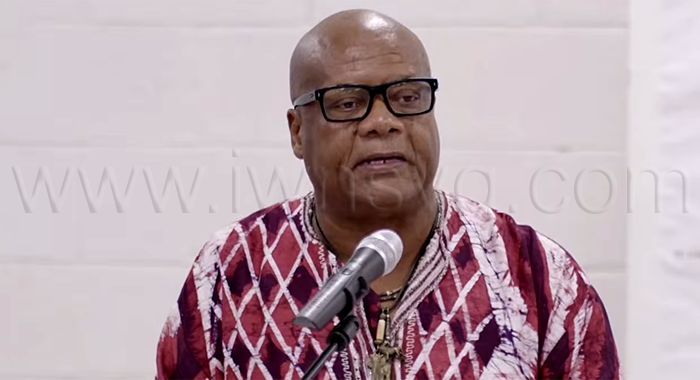

Education must move “from the womb to the tomb” and become an instrument of liberation, not just certification, Vincentian educator and climate resilience expert Andrew Simmons told the 2026 Oscar Allen Memorial Emancipation Lecture in Kingstown.
He, who holds a doctorate in climate change and sustainable development, used the legacy of the late community organiser Oscar Allen to issue a blunt warning about the Caribbean’s unfinished emancipation.
Simmons rooted his address in the theme “We want to be wise: Education, identity, and liberation in a post-colonial Caribbean”, arguing that political independence has not erased deep structural vulnerabilities, nor has the region’s education system yet produced the critical, community‑centred citizens that Allen spent his life trying to cultivate.
“Knowledge in itself doesn’t make much sense unless people can use that for their own development,” Simmons said.
Remembering Oscar Allen: ‘one person can start a stream’

Simmons anchored his lecture in the life and work of Oscar Allen — community organiser, lay theologian, writer, and “a true revolutionary” whose chosen weapons were “literature and freedom … education, faith, and organisation”.
He opened his substantive remarks with two images: “the longest river starts with one drop of water” and “a fire starts with one spark”.
From there he drew a parallel to Allen’s life: “One voice, one act of service at a time can create change far greater than itself.”
Allen, he argued, could have pursued personal wealth but instead “dedicated his being to empowering the poor and marginalised people of St. Vincent and the Grenadines and the wider Caribbean”.
That, Simmons said, is what made him a revolutionary in the Bob Marley sense: “It takes a revolution to make a solution.”
‘We want to be wise’: education, identity and liberation
Moving from tribute to analysis, Simmons unpacked the lecture theme in three interlocking parts: wisdom, education, and liberation, all grounded in Caribbean realities.
Drawing on Biblical texts from Ephesians, Ecclesiastes and Proverbs, he defined wisdom not as mere accumulation of knowledge, but as a way of living.
This includes practising humanity, admitting what one does not know, listening more than speaking, learning from mistakes, reflecting before acting, and relying on facts rather than assumptions.
“Wanting to be wise means practising humanity … Wisdom should guide what we do,” Simmons said, adding that Allen embodied this approach: “filled with knowledge,” but always focused on whether that knowledge was “useful to people”.
Education as a practice of liberation
Simmons then turned to education, insisting it must be seen as a lifelong process — “from the womb to the tomb” — not limited to schooling or job preparation.
At its best, he argued, education should foster knowledge, skills, values, and judgement, enable people to ask better questions, help them understand power and act with greater independence and equip communities to analyse their own situations and take action to change them.
Citing Brazilian educator Paulo Freire, he aligned Allen’s work with “education for liberation”, in which learners are partners and agents, not empty vessels.
He said that “for me, it is not here” in its full form in SVG, calling for a serious re‑examination of the education system in light of climate change and sustainable development.
Education, he stressed, is both a human right and an instrument of resilience-building.
Simmons said education is critical to understanding climate risks, preparing for and adapting to shocks, using new technologies, and participating in decisions about land, livelihoods, health and the future identity, diversity and citizenship.
On identity, Simmons described Caribbean identity as layered and dynamic, shaped by indigenous histories, African survival and creativity, European colonialism, Asian migration, resistance, religious traditions, language and labour and ongoing intra‑regional and diaspora movements.
He warned against treating diversity as an obstacle, saying, “We should not see our diversity as a barrier to development; it is part of our heritage and one of our strengths.”
The real question, he said, is whether institutions “allow people to participate fully as citizens while respecting that diversity.”
He called specifically for a collaborative framework to incorporate the Garifuna diaspora in Latin America and elsewhere — estimated at over 800,000 people — into the citizenship and development of SVG.
Liberation vs freedom in a still‑colonial world
Simmons distinguished liberation from freedom, saying that liberation is the active process of confronting and dismantling unjust restrictions while freedom is the condition we hope to achieve and sustain.
Political independence, he argued, has not automatically resolved economic vulnerability, inequality, external dependence, weak institutions, and inherited ways of thinking.
Small Caribbean states, he noted, still operate within global systems they did not design, shaped by debt, trade dependence, geopolitical pressure from large states, including the United States and the difficulties faced by countries such as Cuba and Venezuela.
He recounted being part of a Caribbean delegation in 2015, where he saw wealthy states “pulling our people apart” with offers of funding, undermining regional unity at critical climate negotiations.
“We can talk about how we are vulnerable … but we need to question CARICOM and the quality of leadership we have in the region,” Simmons said.
The answer, he said, is not isolation, but “informed, coordinated, and principled engagement” grounded in Caribbean civilisation, while also facing domestic failures.
“Outside pressures cannot excuse poor decisions at home… When our own development choices increase vulnerability, damage ecosystems, or exclude communities, our governments and institutions must also be held accountable.”
He cited Hurricane Beryl and other disasters, noting how a few hours of extreme weather could erase years of development, and argued that the real challenge is building resilience in advance, at household and community levels.