



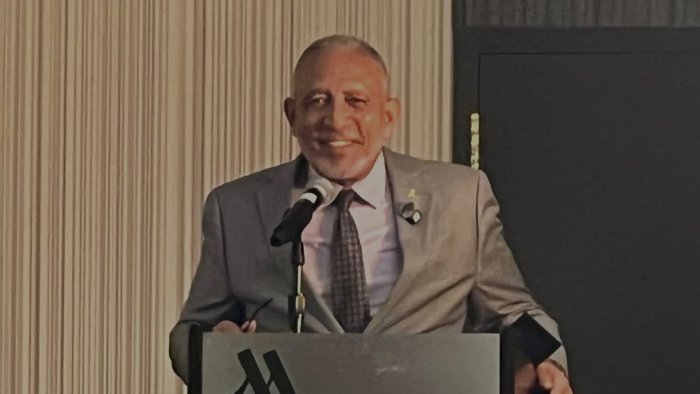

Prime Minister Godwin Friday has urged Vincentians living abroad to move beyond traditional remittances and embrace a deeper, more structured role as “strategic partners in development”.
He told an audience in New York on Saturday that the country’s future depends on a tighter bond between those at home and those overseas.
Addressing the diaspora investment event under the theme “Reconnect, Reinvest, Rebuild: Turning Vincentian Global Success into Local Opportunity”, Friday framed the diaspora not as a support act to the local economy, but as an essential pillar in a new phase of national development.
“This is more than a slogan. It is a call to action,” he said.
“It is an invitation to see ourselves — wherever we live in the world — as one Vincentian family, bound together by a shared history, a shared identity, and a shared responsibility to shape our future.”

Friday acknowledged the global footprint of Vincentians, noting that from the villages and towns of St. Vincent and the Grenadines (SVG), its people have ventured to North America, Europe, the wider Caribbean and beyond in search of opportunity, education and a better life for their families.
He said they have made their mark in medicine and nursing, in finance, technology, hospitality, academia, law, sports, the arts, public service and community leadership.
“Your success is not an accident,” he told them. “It is born from the same resilience, creativity, and faith that sustain our people at home.”
Vincentians abroad, he added, carry with them the spirit of SVG — its values, culture, music, food and sense of community.
However, Friday also warned of a subtler risk not only the obvious geographical distance between the homeland and its diaspora, but a growing emotional and generational distance as well. Reconnection, he argued, must go beyond occasional trips and nostalgic ties.
“Tonight, we say very clearly: you have never ceased to be part of us,” Friday said.
“We are one Vincentian people, wherever we are. Reconnecting means more than a visit home every few years. It means renewing the bonds of trust, of communication, and of purpose between those at home and those abroad.”
Friday positioned himself not only as head of government but also as “a fellow Vincentian who knows that our future depends on our unity.
“We need your ideas. We need your expertise. We need your networks. And yes, we need your investment.”
The core of his appeal was a call to rethink how the contribution of Vincentians abroad is measured and structured.
SVG at new juncture of devt
Friday became prime minister after the New Democratic Party’s (NDP) 14-1 election victory in November.
He said that for many years the diaspora’s contribution has often been seen primarily through the lens of remittances —“those hard-earned funds sent to support families, build homes, and help communities.”
For this, he offered “a heartfelt thank you,” stressing that such support had been, and continued to be, invaluable.
But he argued that SVG now finds itself at “a new juncture” in its development. The country, he said, is undergoing a period of economic transformation, rebuilding and modernising its infrastructure, strengthening resilience to climate change, supporting innovation and private sector growth, and investing in its young people.
“To move to the next level, we must shift from seeing the diaspora mainly as senders of remittances to recognising you as strategic partners in development,” Friday said.
He laid out a wider vision of reinvestment that includes Vincentians abroad taking equity stakes in businesses and projects in SVG and entering joint ventures with local entrepreneurs.
It involves professionals overseas sharing their knowledge and experience through mentorship, training and opening doors to new markets, and it extends to diaspora participation, where appropriate, in the country’s capital markets and financial instruments, channelling savings into productive investment.
“As Minister of Finance and Economic Planning, I am acutely aware that growth does not happen by accident,” Friday told the gathering.
“It is planned, nurtured, and built through clear policy, sound governance, and strong partnerships.”
The government’s role, he emphasised, is to create “an enabling environment where diaspora investment is welcomed, protected, and rewarded.”
This, he said, is not an abstract promise. He cited work already under way to simplify the processes for doing business and registering companies, and to explore ways of making it easier for diaspora investors to participate in projects in tourism, agriculture and agro‑processing, renewable energy, technology and the creative industries.
He also pointed to efforts to strengthen institutions capable of acting as honest brokers between investors and local partners, and underlined a commitment to good governance, transparency and accountability in public policy.
“When you invest in St. Vincent and the Grenadines,” Friday said, “you are not only seeking a financial return — you are investing in your own story, in your own people, in your own homeland”.
To make the case for investment, the prime minister placed the appeal within the wider context of the country’s vulnerability and resilience.
SVG, he reminded his audience, has “endured natural disasters, economic shocks, and global disruptions.”
He cited the COVID-19 pandemic, volcanic eruptions, Hurricane Beryl and the persistent threat of climate change as tests of the nation’s resolve.
“Our country knows what it means to rebuild,” he said. “Yet each time we are tested, Vincentians rise again.”
Rebuilding, he said, goes far beyond repairing damaged infrastructure such as bridges, roads, schools and hospitals. It also includes rebuilding confidence, expanding opportunity and reinforcing the systems that allow people to thrive. In this broader sense, he described diaspora investment as “a powerful tool of resilience,” capable of creating jobs and sustainable livelihoods, supporting innovation in agriculture, fisheries and food security, and expanding tourism offerings in ways that are, as he put it, “authentic, environmentally responsible, and community-based.”
He also highlighted the potential for the diaspora to help develop new technology and digital services that could connect Vincentians to global markets, and to strengthen small and medium-sized enterprises, which he characterised as “the backbone of our economy.”
A significant dimension of Friday’s remarks focused on the role of young Vincentians, many of whom now study or work overseas. He stressed that the goal is not to limit their ambitions or mobility, but to retain and deepen their connection to the country’s development.
“Our aim is not to limit their horizons,” he said, “but to ensure that wherever they go, they remain connected to the development of Saint Vincent and the Grenadines.” He said he envisioned a future in which “a young Vincentian in New York, Toronto, London, or elsewhere sees a pathway to contribute—whether by returning home, investing, mentoring, or collaborating with partners on the ground.”
Moving from broad principles to concrete mechanisms, Friday described how his government intends to make engagement more systematic. Through the Ministry of Foreign Affairs, Foreign Trade, Foreign Investment and Diaspora Affairs, and through its diplomatic missions, the government, he said, is working to create structured channels so that engagement with the diaspora becomes “easier and more systematic—not just occasional.” In that context, he pledged, “We intend to listen and to respond.”
He identified several areas where diaspora capital and expertise could be especially impactful, including sustainable tourism and ecotourism, agriculture and agro‑processing, food exports, renewable energy and climate-resilient infrastructure, and the development of ICT, digital services and innovation hubs. He also highlighted education, healthcare services and the creative industries as sectors ripe for partnership between those at home and those abroad.
Beyond economics, Friday stressed the symbolic and motivational value of recognising Vincentian achievements overseas. He argued that the accomplishments of the diaspora “are not separate from our national story—they are part of it,” and he promised that his government would “do more to highlight the contributions of Vincentians overseas, so that the next generation can see what is possible and be inspired to dream even bigger.”
Trust, he acknowledged, is essential if talk of partnership is to translate into actual investment. “Investment flows where there is trust,” he said, adding that his administration is committed to strengthening that trust “through open dialogue, clear policies, and responsible stewardship of the national interest.” In that spirit, he told the audience: “We welcome scrutiny. We welcome collaboration. We welcome your questions, your ideas, and your expectations.”
In closing, Friday returned to the overarching theme that the work ahead cannot be left to the state alone. “When we say ‘Reconnect, Reinvest, Rebuild,’ we are really saying: let us shape the future of Saint Vincent and the Grenadines together,” he said.
He outlined a vision of a country in which children, whether born at home or abroad, are proud to call themselves Vincentian; in which the economy is more diverse, competitive and resilient; and in which citizens enjoy rising standards of living, quality education and good healthcare. He added that this future should preserve and strengthen the nation’s culture, natural beauty and democratic traditions.
“This is not the task of government alone,” he cautioned. “It is the task of a nation—of a global Vincentian family.”
He ended with a personal challenge to each member of the audience, asking them to consider three questions: “How can I reconnect more deeply with my homeland? In what ways can I reinvest—financially, professionally, personally—in the development of Saint Vincent and the Grenadines? How can I help rebuild and renew opportunity for the next generation?”
“If each of us leaves this event with one concrete action—one commitment to partner, to mentor, to invest, to advocate—then this gathering will have achieved its purpose,” he said.
Thanking the diaspora for their “patriotism, your perseverance, and your love of country,” Friday urged them to ensure that “the fruits of your global success are felt in the villages, towns, and communities from which we all sprang.”
“Together, let us reconnect. Together, let us reinvest. Together, let us rebuild,” he concluded. “And together, let us turn Vincentian global success into lasting local opportunity.”