



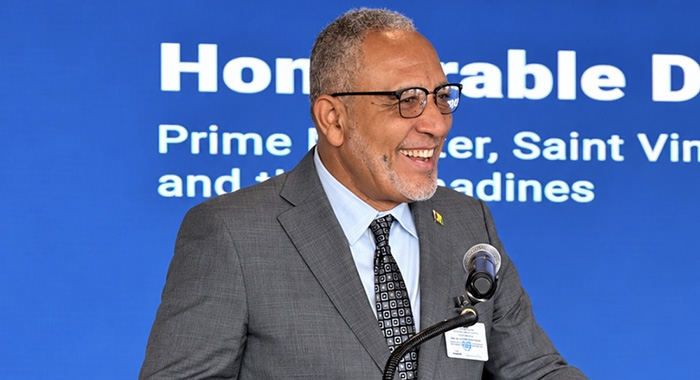

Prime Minister Godwin Friday used a high-level forum at the United Nations to send a clear message about the future of small island states.
Speaking on Wednesday at the Family Offices for Sustainable Development Summit in New York, he said that countries like St. Vincent and the Grenadines (SVG) must not be defined by their vulnerabilities.
They are small and exposed to disasters, but their ambitions are not small, he said, adding that his government’s main goal is to improve the quality of life of the people of SVG.
The prime minister said development is not about numbers on a page but about people’s lives.
“It is about whether the young people in my country, or in Tonga, or in other SIDS can find meaningful work, or children can have access to quality education, or farmers, fisherfolk and entrepreneurs can build viable livelihoods, that they have access to capital,” Friday said.

“In our context it is also about the road to a community, or the healthcare facility that serves it, or the electricity that powers it and whether these can withstand the next hazard.
“Painful experience has taught us that a single disaster can erase years of progress. So, an ever-present challenge is whether it is possible to invest in resilient infrastructure without compromising debt sustainability.”
The prime minister said that these considerations inform how his government pursues development.
“We are cognisant that development is an ongoing process which requires continuous effort, innovation, inclusivity, adaptation and commitment.”
The prime minister, however, said his government does not believe that vulnerability has to define our future.
“However, it can be a reason to innovate, build differently and partner more strategically,” he said, adding that resilience should not be seen as optional expenditure, but as an investment in the continuity of development.
Friday said that in this way, the conversation about development can become and must become a conversation about investment.
He said recent Organisation for Economic Co-operation and Development — Inter-American Development Bank (OECD-IDB) analysis highlighted particular sectors for investment that can reap economic and developmental returns.
Those include resilient infrastructure, renewable energy, sustainable tourism, agriculture and agri-processing, the blue economy, digital transformation and entrepreneurship and human capital.
“But the public purse will never be large enough to finance all our ambitions, especially when repeated shocks mean borrowing for recovery. Meanwhile, private capital often hesitates to enter markets where perceived risks are high, transactions are small or returns uncertain.”
The prime minister siad the question was “Dow do we translate our priorities into credible, investable opportunities, while managing the paradox that our vulnerability can also make investment more expensive?”
For him, a vital part of the answer is that “we must build strong partnerships wherever they are available to us.
“Private capital, multilateral institutions, civil society, regional institutions and international development partners can work together with governments, from the early stages, supporting project preparation and investment aggregation to create bankable possibilities and ready-to-go pipelines.”
Friday said that his government, which came to office in November, has taken steps to establish predictable regulatory frameworks, strengthen public investment management and created transparent processes through which investors can identify opportunities and appreciate the risks.
“We have signaled clearly that we welcome private investments,” he said.
“Further, in the case of small economies like ours, regional collaboration create the scale that individual countries cannot always achieve alone. Caribbean countries have honed the ability to work together to aggregate opportunities, develop common standards, share expertise and create investment platforms capable of attracting institutional capital.”
The Vincentian leader said that multilateral institutions can also play a critical catalytic role.
“We need greater use of guarantees, first-loss instruments, concessional finance, technical assistance, political-risk coverage and other forms of blended finance that can reduce risk and crowd in responsible private investment.
“If public and multilateral resources are used wisely and effectively, we can unlock private capital for development priorities that would otherwise remain under-financed.”
Friday said he believes that private capital must be recognised not merely as a source of financing, but as a partner in sustainable development.
“We can aim to reduce risk to a level at which private capital can participate, while preserving public value.
“In reality, a project on critical infrastructure, for example, is not simply about a physical asset. It protects lives, preserves economic activity and reduces future losses. Investment decisions must therefore better account for the economic value of resilience and avoided disaster losses.”
He said that development and financial institutions should utilise investment and risk-assessment methodologies that recognise resilience benefits, particularly for SIDS.
“SIDS must not be an after-thought. We must design with them in mind from the ground up. We also encourage expanded use of instruments such as catastrophe-risk financing, parametric insurance, contingent financing and climate-resilient debt mechanisms.
“A new model of public-private collaboration must be governed by a clear development compact. Public-private partnerships should be transparent, developmentally aligned and designed around measurable outcomes.”
Friday said that while governments have to provide an enabling environment, the private sector, in turn, must bring responsible investment, innovation, skills and long-term commitment to local economies, a willingness to transfer knowledge. And multilateral institutions can help to bridge the gap between the two.
“It is our objective to improve upon what presently exists and to create better opportunities for those who come after.
“We have priorities. We have opportunities. We have ambition. What we need now is a stronger ecosystem that connects these with capital, with innovation, with expertise and risk-sharing, and a willingness to think outside the box.
“I hope to see us build investment pipelines rather than project wish lists and resilience rather than repeated recovery.”
Friday pointed out that the volcano in SVG ewas hit by a hurricane even as it was recovering from a volcanic eruption.
“This is the work we must embark on together, to build prosperous, resilient and sustainable nations for the next generation,” he said.