



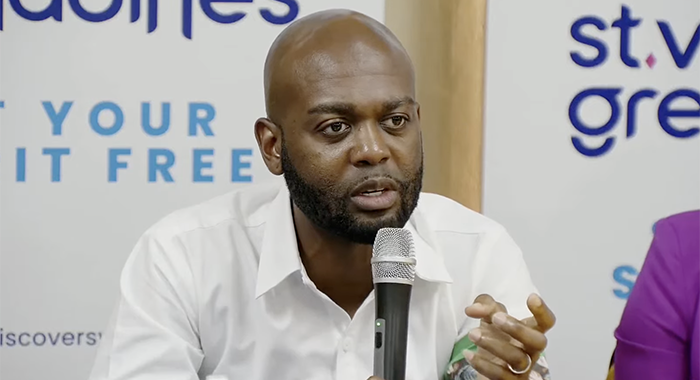

Tourists travelling beyond Kingstown could find more accessible public restrooms at local shops under a proposal Tourism Minister Kishore Shallow says will pair new facilities with existing businesses and make shopkeepers responsible for keeping them clean.
Speaking recently on New Times, the ruling New Democratic Party’s radio programme, Shallow said the government was planning to work with shops along travel routes to provide restroom stops for visitors.
The proposal, which he said was expected to begin in the new year, would also aim to create opportunities for communities to earn income from tourists.
“We are partnering with existing shops because they are right there,” Shallow said. “We don’t have to go on sending additional cleaners. It is a partnership.”
Callers to the show urged that the facilities be kept sanitary and designed for people with disabilities.

Shallow agreed, saying shopkeepers would need training in hospitality and would be expected to maintain the facilities.
“We want to create a very good impression on our tourists,” he said. “We want to give shop owners the opportunities to make an extra dollar.”
The proposal formed part of a broad account of the government’s tourism plans, in which Shallow described efforts to attract more cruise passengers, develop local visitor experiences and coordinate the work of the tourism ministry and the SVG Tourism Authority.
He said the government wanted residents to prepare for more visitors by developing experiences rooted in local life.
He suggested that fishermen could offer visitors the chance to go fishing and prepare their catch, while farmers could build “farm-to-table” visits around their produce.
“These are the kind of experiences that we are actually packaging from tourism,” Shallow said. “We are not leaving it to chance.”
He said the Tourism Authority was working on a package of “different experiences” that visitors could book online.
Cruise growth and a long-term port agreement
A central part of Shallow’s pitch was the government’s agreement with Global Ports Holding (GPH), to lease the cruise ship facility in Kingstown to the company for 30 years.
The minister said the arrangement was intended to bring in private-sector expertise and investment as cruise ships grow larger and some vessels exceed the capacity of the existing port.
Shallow noted the agreement provided for US$20 million in investment in its first phase and US$60 million in a second phase, for at least US$80 million in planned infrastructure work.
He also said a special-purpose vehicle would allow Vincentians to hold a 30% stake in the port operation.
“We’re not selling anything,” he said, describing the agreement as a 30-year lease. He argued that the partnership would reduce the government’s exposure to port operating costs while generating revenue and creating investment opportunities.
Shallow cited cruise-season figures to make the case for preparing businesses and communities for increased visitor numbers.
He said 231 vessels and 247,976 passengers were recorded in 2024–25, followed by 246 calls and 239,391 passengers in 2025–26.
For the coming 2026–27 season, he said, 355 calls and 344,704 passengers were anticipated.
He described the projected passenger increase as an opportunity for taxi operators, tour guides, vendors and other businesses, while urging residents to develop services and experiences to meet demand.
The minister also defended a “Sunday Village” launched when a large cruise ship called at the modern port.
The initiative brought vendors and local products together for visitors, and Shallow said it would be repeated when cruise vessels arrive on Sundays.
He said about 40 people had expressed interest in participating and that organisers would use feedback to improve future events.
“We expect now that even Vincentian locals are going to turn out,” he said, describing the village as a way to give visitors something to do and support local sellers.
Rebranding, training and digital borders
Shallow outlined four tourism priorities: the Love SVG initiative, rebranding, development of the visitor product and the cruise-port transition.
He said Love SVG included hospitality training, cleaning public spaces, improving beaches and painting bus stops, while the branding work would seek to represent both St. Vincent and the Grenadines.
He acknowledged public criticism of the new Tourism Authority logo and said feedback had led to revisions.
The discussion also touched on the possibility of a digital border system, including facial-recognition technology.
Shallow said a delegation had visited St. Kitts to examine its system and that the government was considering a similar solution for SVG.
Beyond cruise tourism, he pointed to events such as the Caribbean Premier League, SVG Sailing Week and Vincymas as opportunities to attract visitors and raise the country’s profile.
He said tourism growth would depend not only on infrastructure and promotion but also on maintaining the country’s cultural identity and improving the visitor experience.
“We have to always be open to feedback, constructive criticism,” Shallow said. “That is the only way we are going to improve.”