



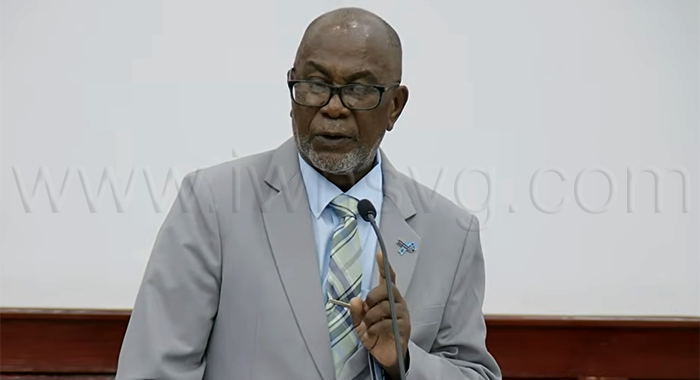

Deputy Prime Minister and National Security Minister St. Clair Leacock says the government is prepared to seek regional security assistance and expand police operations in response to recent violence, while arguing that enforcement alone cannot solve the country’s crime problem.
Speaking on NICE Radio on Monday after a violent weekend, Leacock said he would meet with Prime Minister Godwin Friday and a select team to review reports on the incidents and refine the government’s response.
Four people were killed and four others injured in a shooting incident in Green Hill on Friday night.
Leacock said the authorities would act “as resolutely as we can”, adding that regional support could be called in if necessary.
“If I have to go and ask Barbados through the Regional Security System network to get me soldiers from the Barbados Defence Force, I’ll do it,” he said.

“If I have to go to Guyana to ask for help from the Guyana Defence Force to come here and help us, I will do it.”
Leacock said the government was weighing the security response against concerns that a heavier police presence could be portrayed as creating a “police state”.
He confirmed that police presence would increase in areas where schoolchildren and members of the public gather, including busy bus stops and commercial locations.
“The answer to that is yes,” he said when asked whether officers would be deployed to such areas.
He added, however, that authorities must balance public safety with young people’s freedom to meet and socialise.
The minister described the weekend’s violence as part of a broader gang problem that, in his view, had been allowed to grow amid the former Unity Labour Party administration’s denial that gangs existed in St. Vincent and the Grenadines.
“There has been this domestic denial that we have gangs,” he said. “If it looks like a duck and it quacks like a duck, it’s a duck.”
Leacock said the police had recovered 40 shell casings following the shootings in Green Hill.
He cautioned that the number of casings did not necessarily reflect the total number of shots fired, and said new forensic capabilities could help investigators link weapons and ammunition to multiple crime scenes.
The government, he said, had invested in fingerprint expertise and forensic equipment, with FBI assistance, and was developing a more intelligence-led approach to policing.
He also cited police training in areas including cybercrime, intelligence, immigration, prisons and special operations.
Other measures outlined by Leacock included more than 120 new police recruits, an integrated unit bringing together specialist officers for rapid responses, and plans to put two additional Coast Guard vessels into service for patrols and pursuit operations.
The national security minister said further police promotions were expected, describing them as performance-based.
He also said the government was working to improve police facilities, though the cost of replacing or upgrading stations would be significant.
Leacock raised the possibility of changes to bail rules for people accused of serious gun offences, questioning whether suspects should be able to return to the streets soon after arrest.
He did not announce a specific legislative proposal, saying the issue needed to be examined with other aspects of the response.
The minister also asked whether authorities should remove signs promoting gangs, including by painting over them, but presented it as a question for public consideration rather than a settled government decision.
He argued that the response should distinguish between gang promotion and young people’s need for safe places to gather.
“You can’t arrest yourself out of criminal behaviour. You can’t prosecute yourself out of criminal behaviour,” Leacock said, recounting advice he said he had heard from community representatives in New York.
He called for faith-based organisations, civil society, families, schools and government to take a more active role in prevention.
He said discussions to bring religious groups together with police and national security officials were expected to begin that week.
Leacock placed particular emphasis on families and adult mentorship, saying, “The family, the family, the family, family, is the basic unit of society.”
He also pointed to what he described as a shortage of male teachers and mentors in some schools, and said parents should know where their children are, who they spend time with and what is happening in their schools.
He rejected poverty as a simple explanation for crime, saying economic hardship could create pressure but did not determine whether someone would offend.
He described crime as a multifaceted problem involving social, family, economic and potentially public-health factors.
The violence has also created concerns beyond law enforcement, Leacock said, citing negative international coverage and possible damage to tourism and investment.
He said tourism officials and marketing teams were working to reassure visitors that St. Vincent and the Grenadines remained a destination worth visiting, while trade missions and overseas representatives were working to protect the country’s investment reputation.
“We have to be careful in our messaging,” he said, arguing that public discussion should allow criticism without causing lasting harm to the country’s image.
He said the government would continue to pursue both stronger policing and longer-term social and economic measures.