




By Jada Chambers
Public cooperation during the tropical wave, which hit Saint Vincent and the Grenadines on Tuesday, allowed emergency teams to focus entirely on recovery efforts.
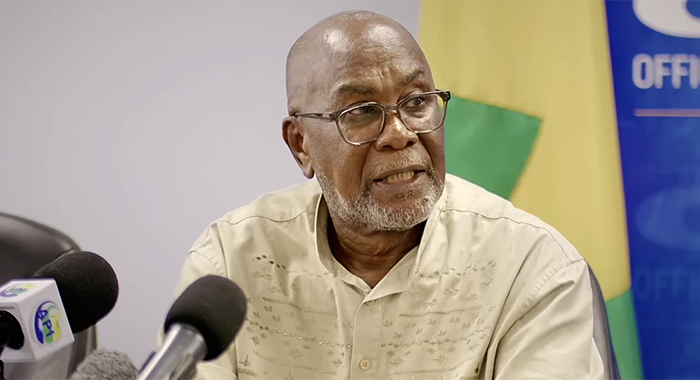
This comment were made by Deputy Prime Minister and Minister of National Security, Major St Clair Leacock during a press briefing in Kingstown on Friday, where government officials addressed the aftermath of the tropical wave that triggered severe overnight rainfall and flash flooding across the country, disrupting critical infrastructure and the healthcare system.
Drawing on recent national security exercises he attended in Barbados, Leacock emphasised that maintaining law and order is a frequent vulnerability during natural disasters.
“…And that allows me to say there are things very often we take for granted. Only yesterday, for example, I was in Barbados on a national security exercise… there are occasions in which the job of recovery is made more difficult by those who would take advantage of the misfortune of others to be in exercises that are not in the nation’s best interest,” Leacock said.

While thanking God that such public disorder did not manifest, he highly commended the readiness and swift deployment of the Royal St Vincent and the Grenadines Police Force members, particularly the Special Services Unit (SSU) at the Milton Cato Memorial Hospital (MCMH).
Leacock said that SSU officers were deployed to MCMH early in the morning to clear floodwaters and assist nursing staff with the massive clean-up operation. “I was particularly heartened to know that the SSU… responded promptly and efficiently to the priority emergency of the day,” Leacock stated, while congratulating Prime Minister Godwin Friday for leading and understanding these priorities.
“And spending detailed time going to the affected communities, starting with the priority of the MCMH for very obvious reasons,” Leacock said.
Deputy Minister Leacock was also satisfied with the resilience of the state infrastructure, adding that key operations were fully synchronised before dawn. Following early briefings from his permanent secretary, the police, the National Emergency Management Organisation (NEMO), and the National Broadcasting Corporation Radio, officials were actively managing critical decisions by 4:00 a.m. “I am pleased to say that the state apparatus is intact and it works.”
Following these early morning briefings, Prime Minister Godwin Friday coordinated field operations to inspect damaged properties. Leading the state’s response, the Prime Minister mapped out a deployment strategy for the recovery teams before personally visiting the several places, beginning with MCMH. “And sometimes one cannot always rush to conclusions on the thing that immediately is seen by the eyes, as experience would teach us. A lot of this is revealed subsequently.”
As recovery operations advance, national security officials have urged the public to remain patient while the full, long-term extent of the damage is uncovered. Infrastructure Minister Nigel Stephenson and Central Leeward Representative Conroy Huggins have already initiated detailed structural assessments in Buccament. These inspections aim to restore the area and engineer reinforced infrastructure to ensure homeowners are not exposed to similar vulnerabilities during future climate events.
The October 6 weather event was an intense tropical wave that moved across the Windward Islands, dumping over 5 inches (130.2 mm) of heavy torrential rainfall across SVG within a 24-hour period. Monitored closely by the country’s meteorological services and managed nationwide by NEMO, this severe atmospheric disturbance triggered widespread flash flooding, extensive landslides, rockfalls and overflowing rivers. These events paralysed major transit corridors, blocked roadways in Kingstown, damaged residential properties, and disrupted operations at critical public facilities like MCMH.