



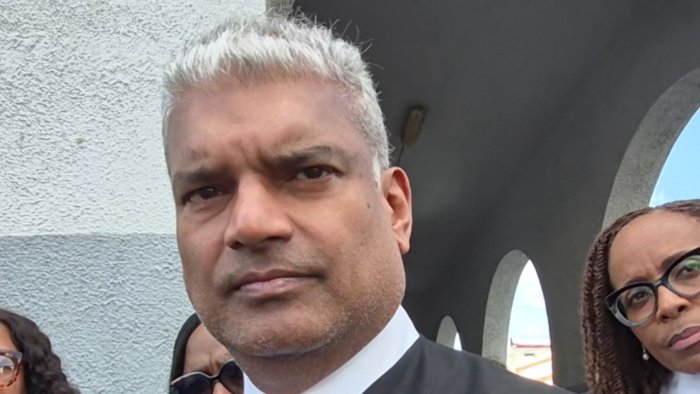

Lead defence counsel Anand Ramlogan has posed a rhetorical question to the judge, asking why the framers of the Constitution would want to grant Commonwealth citizens the right to run for office in one section only to nullify it in the next — arguing that the legislature would not enact two concepts that are “impossible to reconcile.”
In his closing submissions, Ramlogan outlined the constitutional principles governing the election petitions brought by opposition Unity Labour Party candidates Carlos Williams and Luke Browne.
Williams, who lost to Prime Minister Godwin Friday in the Northern Grenadines, and Browne, who lost to Foreign Affairs Minister Dwight Fitzgerald Bramble in East Kingstown in the 2025 general election, asked the High Court to invalidate both results over the two men’s Canadian citizenship.
Closing arguments concluded on Nov. 12 before Justice Thom, who has reserved her judgment until the new law term, with a decision expected early next year.
Ramlogan suggested that the Constitution could not grant Commonwealth citizens the right to run for office in one section and strip it away in the next.

He described such an interpretation as giving with the right hand and taking with the left, questioning whether that could genuinely have been the legislative intention.
He argued that the court must resolve any ambiguity, confusion, or doubt over constitutional eligibility in favour of the expressed democratic will of the electorate and their constitutional right to elect their representative.
To illustrate the practical complications of the petitioners’ argument, Ramlogan posed a hypothetical scenario involving a person born in Canada who lives in SVG, marries a Trinidadian, and acquires citizenship of Trinidad and Tobago by naturalisation.
He noted that although such a person is a Commonwealth citizen, swearing allegiance to T&T would disqualify them from running for office under the petitioners’ interpretation, arguing that while the petitioners’ analysis repeatedly runs into such difficulties, the defence’s interpretation avoids them.
Ramlogan explained that someone who did not know SVG existed, lived in Canada for 80 years, acquired Vincentian citizenship through naturalisation, moves to the country and resides there for one year, would qualify to run in a general election.
He gave another hypothetical scenario emphasising the importance of the Commonwealth status.
Ramlogan explained that a naturalised Canadian citizen who does not hold citizenship of SVG qualifies to run for parliament only by virtue of being a Commonwealth citizen, pointing out that if that person renounces their Canadian citizenship, they cease to be a Commonwealth citizen and lose the right to run
Ramlogan added that if someone, who was born and has lived in SVG has a medical problem, and accessed Canadian citizenship to access healthcare, that person can run for election.
He noted that Commonwealth citizens are permitted to contest elections in Grenada and Jamaica without holding local citizenship, and pointed out that Barbados’ original 1966 Constitution similarly allowed Commonwealth citizens to serve in Parliament until it was expressly amended to restrict seats to Barbadian citizens—whereas in some other regional jurisdictions, non-citizen Commonwealth nationals may serve as senators even where local citizenship is required for elected members.
He noted that before independence, Vincentians held British citizenship and passports, and only acquired citizenship of SVG once the country became independent.
Ramlogan questioned whether the framers of the Constitution intended at that stage to divide citizens so that some could be elected while others could only vote.
He further argued that whether a candidate owes allegiance or adherence to another state is a question of foreign law, maintaining that no court has yet decided whether any holder of a Canadian passport is under allegiance or obedience to Canada.
Turning to constitutional interpretation, Ramlogan argued that the Constitution is predicated on the principle of democracy.
To illustrate how courts imply rights from democratic principles, he cited the 2001 general election deadlock in Trinidad and Tobago—where an 18–18 seat tie left neither side with a majority in the House—and lawmakers successfully argued for their right to be paid, despite no such explicit right existing in any Caribbean constitution.
Ramlogan noted that constitutional rights can arise by implication from the democratic foundation of the Constitution—a principle he maintained applies to Friday and Bramble.
He continued his point, saying the consequence of disqualification can have a dire effect on the democratic process, and insisted that when Parliament grants a right, it can take that right away only through clear and express words.
Ramlogan argued that under the Constitution, a Commonwealth citizen is qualified to run for Parliament and should not be interpreted as owing allegiance to a foreign power or state.
“If you are with us on that, that is the end of the case,” he told the court, characterising the petitioners’ case as requiring “great intellectual contortions.”