



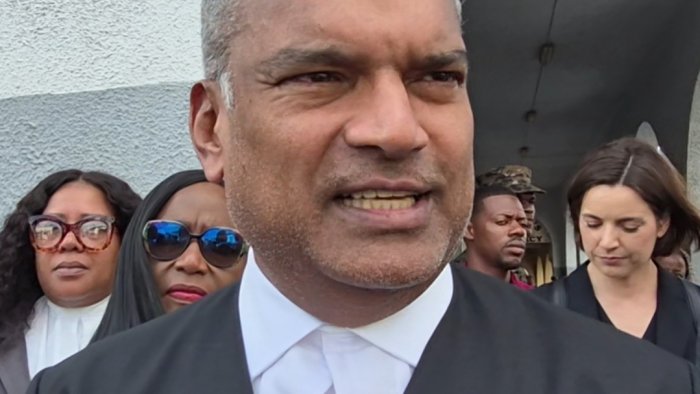

Lead defence counsel Anand Ramlogan has argued that if the court rules Prime Minister Godwin Friday is ineligible to serve in Parliament, it is effectively implying he violated Section 42 of the Constitution—which imposes a financial penalty on any member who sits or votes in the House knowing, or having reasonable grounds to know, they are unqualified.
The submissions form part of consolidated High Court election petitions filed by unsuccessful Unity Labour Party (ULP) candidates Carlos Williams and Luke Browne following the November 2025 general election.
Williams, who lost to Friday in the Northern Grenadines, and Browne, who lost to Foreign Affairs Minister Dwight Fitzgerald Bramble in East Kingstown, are asking the court to invalidate both results.
The petitioners contend that Friday and Bramble breached Section 26(1)(a) of the Constitution—which disqualifies anyone under acknowledgement of allegiance to a foreign state—by voluntarily acquiring Canadian citizenship.
The defence has countered that Section 25 permits Commonwealth citizens to sit in Parliament, maintaining that Canadian citizenship does not constitute allegiance to a foreign power.

Closing arguments concluded before Justice Gertel Thom on Nov. 12, with a ruling expected early next year.
Ramlogan submitted that “criminal offences” must satisfy certain cardinal principles, including that they must be clear and precise.
He argued that the law must allow the average person to understand the consequences of their actions, adding that the court must resolve any doubt in favour of the citizen.
Counsel insisted that the court must interpret the purpose of the law in a coherent and sensible way rather than viewing its provisions in a “compartmentalised, disconnected manner,” maintaining that election law requires simplicity to eliminate ambiguity and confusion.
He argued that unlike constitutions requiring local citizenship to serve in parliament, St. Vincent and the Grenadines’ Constitution stipulates that a candidate must be a Commonwealth citizen, calling this a fundamental distinction.
Urging the court to “look at the law in a coherent, composite manner,” he argued that the Constitution’s provisions must be read harmoniously to avoid an “absurdity” where a rule qualifying Commonwealth citizens to serve in Parliament effectively becomes a disqualifying one.
Ramlogan then pointed to Section 42 of the Constitution, which states:
“Any person who sits or votes in the House knowing or having reasonable grounds for knowing that he is or entitled to do so shall be guilty of an offence, and liable to a fine not exceeding one hundred dollars, or such other sum as may be prescribed by Parliament, for each day on which he so sits or votes in the House.”
Warning the judge that ruling in favour of the petitioners would require the court to consider Section 42—and effectively expose the Prime Minister to potential prosecution for knowingly sitting in Parliament since 2001 while disqualified—Ramlogan maintained that the law must be clear and express so an ordinary person can understand the consequences of their actions, with any ambiguity resolved in favour of the individual.
Ramlogan said that the petitioner’s did not present any evidence that the interest of SVG is somehow not aligned with the interest of Canada and the rest of the Commonwealth.
Ramlogan also contended that the petitioners are asking the court to “separate the sheep from the goats,” arguing that such distinctions are for Parliament to make.
Pointing to the statutory definition of an “alien,” Ramlogan noted that under the law, an alien is a person who is neither a Commonwealth citizen nor a British protected person, while a “foreign national” refers to a citizen of a non-Commonwealth country.
Describing this as a clear “statutory demarcation” for Commonwealth citizens, he told the court: “If you are outside that circle, you are an alien. If you are inside the circle, we are one.”
Ramlogan explained that according to the constitution, a citizen from a hostile Commonwealth country can contest in SVG’s general election. However, if that person gains citizenship in a non-commonwealth country, even if that country is friendly, then they are no longer eligible to contest the election.
“That is what the law says” he added.
Ramlogan said that the definition of a foreign power or state is not stated in the constitution.
He argued that Section 26’s disqualification provisions must be interpreted more narrowly than Section 25 so they do not neutralise the core qualification rules.
He contended that the petitioners’ case attempts to take away from that constitutional right by subtracting Commonwealth citizens who have sworn an oath of allegiance to another Commonwealth country from that protected category—a move he characterised as an unlawful interference with, and revocation of, their right to run for office.
Ramlogan contended that a citizen does not give up any constitutional rights by accepting foreign citizenship. However, he argued, it must be “clear as daylight” that when someone makes that decision, they are giving something up.
Accusing the petitioners of performing “intellectual gymnastics,” he argued that they are asking the court to whittle down the pool of people eligible to run in elections, even suggesting that narrowing the category down to the Organisation of Eastern Caribbean States (OECS) contradicts the Constitution’s broad inclusion of all Commonwealth citizens.
Pointing to principles of democracy examined during SVG’s 2009 constitutional referendum bill, Ramlogan also noted that Caribbean constitutional scholar Professor Hamid Ghany—whom he credited with an “illustrious and eminent” curriculum vitae—had dealt extensively with the issue. He maintained that narrowing the category of qualified candidates falls strictly within the jurisdiction of the legislature, unlike countries such as Grenada and Jamaica whose constitutions restrict candidacy solely to their own citizens.