




By Kenton X. Chance
GEORGE TOWN, Cayman Islands (CMC) – Antigua and Barbuda’s Minister of Tourism, Henry Charles Fernandez, has a simple message for Caribbean government.
He wants regional leaders to be as committed to regional interconnectivity as they are willing to pay international airlines to fly to their countries, often times “half empty”.
“And so, we need to convince our leaders and by extension our people who put our leaders and ourselves there, the importance of this regional connectivity,” said Fernandez, amidst the ongoing debate in the Caribbean about the taxes that regional governments impose on the aviation sector and visitor arrivals
Fernandez made his position known as he participated in a panel on “Multi-Destination Tourism” as part of the Caribbean Tourism Organization (CTO) Business Meetings and Caribbean Aviation Day conference held here last week.

The event was jointly organised by the Barbados-based CTO, the Cayman Islands government and the International Air Transport Association (IATA).
Fernandez, who also has ministerial responsibilities for economic development, said it is unacceptable for Caribbean governments to pay a US carrier to fly to their countries, “quite often half empty, but then say I have nothing to put into a regional carrier…
“There has to be a commitment that we must do it. We have to do it,” Fernandez said, noting, “everything costs money, but we need to look further down as to what happens as people travel through the islands.
“Because when you travel to an island in the Caribbean, you’re really traveling to the Caribbean, and we have so much to offer, so many different experiences to share. And why are we holding back on that?”
He said that in addition to commitment, taxes are often cited as an issue affecting regional connectivity.
“I think it’s important to note that a lot of the airports, the taxes are hypothecated to pay back for that. So, you have everybody’s cramming to put a new airport and to put a new cruise port and so on. And to get the money you have to sign off your taxes.”
But he said despite that situation, the region must be willing to consider whether reduced taxes would translate to higher visitor arrivals, which would mean even more money from visitor spend.
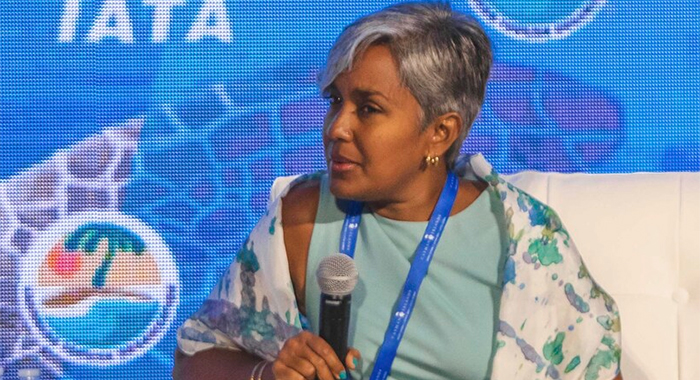
Economist, Marla Dukharan, who also participated in the panel discussion, said government ministers were better positioned to speak on whether their countries can afford to reduce the aviation taxes and if so, by what percentage.
She, however, said there are already “pockets”, such as the ABC Islands — Aruba, Bonaire and Curacao — as well as Dominica, Martinique and Guadeloupe that have multi-destination tourism.
“You have this happening and perhaps that might be the answer — little pockets as opposed to one big pocket … It’s really about what we have to lose. Let’s look at that as opposed to also looking at what we have to gain.”
Dukharan said that the Caribbean is “the most open region in the world” in terms of exports as a percentage of gross domestic product (GDP) and “for that reason, our economies depend so heavily on connectivity, air and sea connectivity”.
But she noted that the Caribbean is also the most tourism dependent region in the world.
“And so, for that reason, for the tourism sector, we need to solve this problem,” she said, adding that according to the Caribbean Policy Research Institute in Jamaica, in 2019, the tourism sector contributed a third of the region’s GDP directly, 53% of total exports, 43% of total employment and 40% of the informally employed, noting that 40% of all jobs in the Caribbean is in the informal sector.
“So, this sector needs to work well,” Dukharan said, adding that the Caribbean’s also the most expensive tourism destination in the world.
To illustrate, the economist said that she went to the travel website Expedia and chose a random date — Oct. 23 to the 29 — and looked at flights from Barbados to various destinations.
“We have in excess of 30, 40, and in some cases more, per cent of the total ticket cost that’s just taxes,” Dukharan said, adding that this is “just one slice of the pie but it is an important slice of the pie.
“This is something we absolutely have to address in this region, because it seems to me like instead of being a race to the bottom, we are a race to the top as it relates to taxes in this region,” she said, adding that regional air connectivity is important not just for tourism but also because the region is the most open in the world.
“We really have to think very seriously about this tax structure… And those who are the most profitable are the ones who need to shoulder a relatively larger share of the taxes than those who are least profitable when you are taxing the ticket,” Duhkaran said, adding that she did not know which sector this is — whether aviation or accommodation or something else.
“You’re taxing everybody in the destination equally regardless of if you’re a taxi driver, or a five-star hotel — and that doesn’t make sense. And so, that is something I think we need to get right: the progressive nature of the taxation regime as opposed to what I see as a regressive taxation regime.”
Jamaica’s Tourism Minister, Edmund Bartlett acknowledged that the tax discussion is an important one that has been long in coming, recalling that in 2010, there was a discussion in the Cayman Islands that focused on convergence in the northern Caribbean.
He told the panel that tourism is a highly consumption-driven activity.
“And so, the question of, for example, taxation shouldn’t be a serious consideration for tourism because of who and what we are and what we do. Tourism for us is an export, but it’s an export that we import. So, it means that you have to provide the incentives for the import of your export.
“And taxation is, in my mind, anathema. And the reason that we can’t avoid the direct taxation, which increases the cost of travel, is that the purpose of travel is to consume and consumption is laced with economic returns and responses. At every step of the consumption chain, there’s revenue, revenue, revenue, revenue,” Bartlett said, noting also that in most instances there is the general consumption tax (GCT).
“The capacity to generate revenue from GCT is endless because it is linked directly into the consumption patterns. And I believe that if we are to enable this enrichment process that tourism provides better than everywhere else…”
Bartlett said that global economies that had been predicated on minerals and oil and other commodities are morphing into tourism.
“Dubai is your best example,” he said, adding that Saudi Arabia is spending enormous amounts of money to create the products of the Red Sea and Neon to build Jeddah “in a manner that you will never imagine.”
Bartlett said the coronavirus (COVID-19) pandemic has given the Caribbean the opportunity to reimagine tourism.

“Traditionally, tourism happened, it wasn’t structured, wasn’t programmed; it wasn’t planned … Now is the moment and we also realise that tourism and travel is influenced by economies of scale. So small destinations in non-contiguous locations across the Caribbean cannot benefit fully from the impact of tourism and travel,” Bartlett said, adding that the region has to find a way to recover from the pandemic and to recover well.
“And we cannot recover alone. It will not happen. So, the question is can we do it? The answer is an unqualified yes.
“But do we have the political will to do it? That’s the big elephant in the room. Because it means that we will have to forgo our great sense of sovereignty and nationalism. And begin to look at how we can collaborate and cooperate and stop competing and start ‘copeting’. Nice new word; ‘copetition’ instead of competition. And that’s the essence of what multi destination is going to be.”
The Jamaican Minister said that to gauge multi-destination tourism which is to provide multiple experiences on one visit, at package price, it means the harmonisation of various protocols and policies.
“It means that our political leaders have got to understand that there is now going to be something called a single airspace in the Caribbean. So, we’re not charging to fly in Jamaica, over in Grenada, over in St. Lucia … and the airlines have to pay for multiple air space planning as you move island.”
He said multiple-destination tourism in the Caribbean means that the region will have to look at visa facilitation so that there can be a single visa that allows for touristic travel.
“It means pre-clearance arrangements. So, when you land in Jamaica and you clear customs and immigration, you’re domestic into Barbados and St. Lucia and Trinidad,” he said, acknowledging that reducing or eliminating aviation taxes in the Caribbean region is “a very touchy subject and it might cause a little problem somewhere else…
“I’m not saying taxes are to be eliminated. I’m saying taxes are to be reconfigured. In other words, instead of putting the tax to the visitor before they arrive, in other words, tax the import, tax it when it comes as the export because it is consumption.”
The newly-appointed CTO chairman and the Cayman Islands Tourism Minister, Kenneth Bryan says he does not think it is “correct that we put all the pressure on my political colleagues.
“There’s other stakeholders in the room that also have to do some compromising here, because we do have our constituents to take care of.”
Bryan and his newly appointed chairman of the CTO board of directors, Rosa Harris, the Cayman Islands director of tourism were present, last Wednesday, when IATA Vice President for the Americas, Peter Cerdá, said that travel and tourism in the sector needs “more than just good sounding words and declarations.
“We need action,” Cerdá told the Caribbean Aviation Day conference as he presented a case for marketing the region as a single destination.

Barbados Tourism Minister, Lisa Cummins, was concerned that 56% of the cost of an airline ticket to Barbados is made up of taxes, even as she sought to explain the reason for the situation.
“But let us break down where fees and charges go to in-country because the things that we want and the things that we have to be able to provide him with a price tag. That helps to support the airlines where we have incentive programmes and cooperative marketing programmes in the source markets,” she argued.
Cerda said to fly from Port of Spain to Barbados, taxes and fees account for 40 per cent of the ticket prices. In comparison, Lima, Peru to Cancun, Mexico, another beach destination, taxes and fees only represent 23 per cent.
Cummins suggested that “perhaps” the taxes should be reduced.
“Will they be reduced? That’s possible too, but at the same time, the other side of that is that what Barbados has experienced is that there has to be a balance between asking your destination to remove those charges and to reduce those charges that then contribute to the profitability margins of the private sector carriers which will be the airlines.
“So how do we find that balance between ensuring that airlines are profitable, and they are also able to benefit from the best support mechanisms that are being provided by the destinations?”
Bryan told the panel that the end game is “success”, adding “but when we asked ourselves to say we are going to reduce our taxes, I want to know that they are just as committed to the long-term benefit for them from a sustainable standpoint of the aviation community than it is for us politically. So, this is not a one side show.
“I am the representative and the chairman of the CTO and I represent my members. So, the stakeholders are going to have to come to this conversation and talk as well because they, too, will have many benefits.”
Bryan said that having pockets of multi-destination tourism in the region “is probably going to be the best way to get to this very difficult task as the whole region, but it might take a hub and spoke approach.
“We have about three to four pockets within our Caribbean region with some great infrastructure to facilitate the spoke and hub theory.
“We have Barbados, we have Jamaica, we have Bahamas and Cayman ready to compete and that allows the opportunity to service the other islands who are not necessarily in the position to do so. And see if those pockets work in its own right because the other factor we haven’t considered is the customer. Who’s the customer? What does the customer want?”
The Cayman Islands Tourism Minister said that the pockets system can work along lineage lines, for example, noting that Dutch, English, French and Spanish are spoken among the 24 CTO member destinations.
“And I personally think — just my preliminary analysis — that this pocket approach is probably what’s going to be best. And then the major hubs can work collectively together.”
But Bartlett said it is important to understand what is required to ensure a multi destination strategy to work.
“First of all, from the public sector side, we, ministers, politicians and, then, of course, the private sector because the product has to be also created.
You cannot have multi-destination simply by trying to connect. Connect to what? So we have to develop a Caribbean product because there’s a marketing dimension to all of this. And so, the private sector teams have to come together to create now a product with a price so we can package it and go to the market together as one,” Bartlett said.
Let’s see what will happen in the next 5 years, or whether this was just an exercise in vocabulary…
I did not read the entire article but I have to applaud the fact that some are at least mentioning the fact that , (reading between the lines) it is too expensive to vacation in the Caribbean, compared to similar destinations.
Since I used to live in the more populated Northern hemisphere, I know that most people want to go to a warm place with beaches and palms and get the most for their money. The Caribbean does not fall into that category. Add the fact that too many inhabitants in the Caribbean will cheat travellers, and, in places live SVG, murders, robberies and rapes are a turn-off.
Government has much to do in the non-tourism areas that influence tourism, before substantial growth can occur….besides just the too expensive costs.