



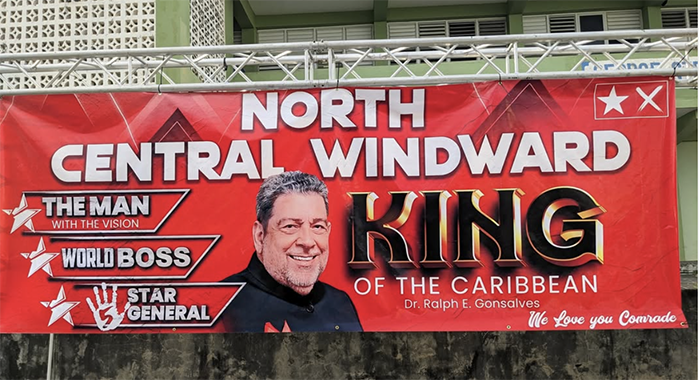

Vice President of the opposition New Democratic Party (NDP), St. Clair Leacock, says Prime Minister Ralph Gonsalves should reject the reference to him as “King of the Caribbean”.
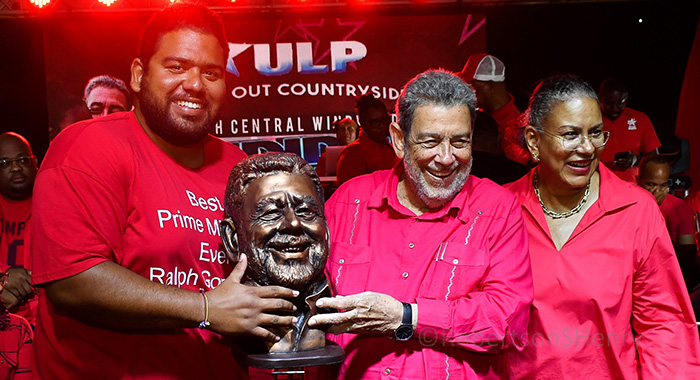
Speaking in Petit Bordel Thursday night, Leacock also criticised the presentation by the PM’s son, Storm Gonsalves, of a bust of the PM to him as a 79th birthday gift publicly in Colonarie on Saturday.
Last Saturday, a banner at the ruling Unity Labour Party’s (ULP) constituency conference for North Central Windward, referred to Gonsalves as “THE MAN WITH THE VISION”, “WORLD BOSS”, “5 STAR GENERAL” and “KING OF THE CARIBBEAN”.
Gonsalves, who has been representing the constituency since 1994, was selected as the ULP’s candidate for the district in the next general election, expected by November, ahead of the February 2026 constitutional deadline.
“… we saw on social media, on your phone, a picture of his sons presenting him with a bronze statue,” Leacock said told the NDP campaign event.

In presenting the metal bust to his father, Storm Gonsalves, the prime minister’s youngest son, said he (Storm) had had it made by a regional artist.
“And as you could see, as my shirt says, ‘The best Prime Minister ever’ deserves the best, and I commissioned an art piece by a regional artist, Sherland Peters,” Storm Gonsalves said.
“And tonight, in front of you all, we are going to unveil this work of art for the PM, and you’re going to let me know what you think about it,” he said.
However, Leacock said that Gonsalves had said years ago that a statue should be built in his honour.
“Well, alyo ain’t build it, he pickney dem build it,” the Central Kingstown MP said.
He said that to the best of his recollection, no previous leader of SVG, whether as chief minister or prime minister, had wanted a statue.
“But Ralph Everad Gonsalves has served for 24, approaching 25 years of service, a privilege that we should have him captured by a bronze statue,” Leacock said.
“But not to be outdone, there was a large banner at his event … marked ‘King of the Caribbean’,” Leaock said.
“Now, even if he didn’t think so, he could have told his people, take that damn thing down. I am no king,” Leaock said.
“But the fact that Ralph wraps themselves in that character or caricature … tells you he doesn’t feel the equal of all of us. He feels that there’s something inherent about him that sets him apart from all Vincentians, all Caribbean people.
“Mind you, this is a person who doesn’t believe in colonialism; he’s supposed to be the strongest fighter — pardon the fact that he was the first to go and meet the King of England when the Queen passed. But his image of us after 25 years is that he has graduated to be a king.
Leacock said that if Gonsalves is a king, “it means that he sees the rest of us as his loyal subjects; we are less than him”.
He said that every ULP MP, Cabinet member and every aspirant for political office in the party is “guilty by association, and on that merit alone — or demerit would be the better word — should be disqualified from holding office in St. Vincent and the Grenadines and representing any set of people.
“Because, subliminally, they all … aspire to, one day, to replace that king, that king. They all see themselves as better than us, and you can’t find a more outstanding demonstration of that than the guy who currently serves in this constituency.”
Leacock said that North Leeward voters have a clear and easy choice in the NDP’s Kishore Shallow.
Leacock said that he does not like to talk about his parents in politics and broke down in tears when he did so in Bequia sometime in the past.
“But when I heard you (Shallow) a few weeks back now … in Spring Village, say, in crystal clear language, ‘I swear on my mother’s grave I am committed to a better life, to the people of Spring Village and all of North leeward’, I knew we had a new a person to whom we can safely pass a baton of leadership, or who, in any event, is a member of a unit and of an organisation and of a society that recognises and realises there is something greater than me.”
Leacock said this is fundamental to service.
“It is a complete contrast to what has been offered by a Unity Labour Party that wants a bronze statue for a leader; a bronze statue may ass.”
He noted that last week, the government asked Parliament to approve EC$98.6 million in spending, even as the government did not have EC$1 million of its own to contribute to the sum.
“You want a bronze statue for that? For bringing a country to its knees … Everything that the Unity Labour Party wants to carry this country forward, it has to beg and or borrow. It has no ability, zero ability, to do anything for itself,” Leaock said.
“Last week in the parliament, I said, as I’ve said, here, there and everywhere, that they, bronze statue elites, King of the Caribbean, spent over $180 million in this country unlawfully. They had no permission from the parliament to spend those money,” he said, referring to money the government received under PetroCaribe, an oil deal with Venezuela.
“You want a bronze statue for that? … Last week, in the Parliament, we saw a government in action that callously ignores our people, our brothers and our sisters who have had to live separate lives from the Southern Grenadines and for whom he gave $136 million, coming and asking for more money without accounting for single cent of that which have been given to you before. And you want a bronze statue for that? Bronze statue, my eye teeth.”
He was referring to the EC$98.6 million in additional spending, including EC$41 million for housing that the opposition voted against last week.
“Last week in the Parliament, we saw on display a government that was prepared to stay there ’til midnight and to put into law that which was unlawful to spend the moneys for next year 2026 in 2025 and tell us that is morally correct.
“Bronze statue, my knee. If I keep calling bronze statue this, bronze statue that, I might say, brown statue something I shouldn’t say on radio,” he said during the meeting that was also broadcast via the media.
“… in essence, I am making the case that the Unity Labour Party is now at the point where they have completely outlived their usefulness, if they ever had that. And what we are seeing is the true Unity Labour Party — self, me, myself and I,” Leacock said.
“They have no plans. They have no ideas…” Leacock said and mentioned some of the NDP’s plans for the country if elected to office.
We the people, charge you Ralph ” First Servant to the People” with gross disrespect. You do like to refer to SVG as modern post colonial society, nation or economy, yet here is a banner hailing you “King if the Caribbean”
How do you plead?
Remember Daniel 2:21 (KJV) And he changeth the times and the seasons: he removeth kings, and setteth up kings: he giveth wisdom unto the wise, and knowledge to them that know understanding:
In my opinion, de wicked world king accused rraappiisst and reassuring kissesss?
Essential Books on Autonomy for Caribbean Readers
The Caribbean and Africa share a deep historical connection through the transatlantic slave trade, colonialism, and the struggle for independence. For Caribbean people seeking to understand Africa’s journey toward autonomy and self-determination, several seminal books provide critical insights. These works explore the political, economic, and cultural challenges African nations have faced in their pursuit of sovereignty, lessons that resonate with the Caribbean’s own postcolonial experience. Below is a curated list of essential books on African autonomy that Caribbean readers should engage with.
1. How Europe Underdeveloped Africa by Walter Rodney (1972)
No discussion on African autonomy is complete without Walter Rodney’s groundbreaking work. The Guyanese historian and activist meticulously details how European colonialism systematically exploited Africa, stunting its economic and political development. Rodney’s analysis is particularly relevant to the Caribbean, as it draws parallels between African underdevelopment and the economic dependency imposed on former colonies in the Americas. This book is a must-read for understanding the structural barriers to true autonomy.
2. Neo-Colonialism: The Last Stage of Imperialism by Kwame Nkrumah (1965)
Kwame Nkrumah, Ghana’s first president and a key figure in the Pan-African movement, exposes how former colonial powers maintained control over African nations through economic and political manipulation. His concept of “neo-colonialism” remains relevant today, as both Africa and the Caribbean continue to grapple with foreign interference in governance and economic policy. Nkrumah’s work is a crucial text for Caribbean readers seeking to understand the ongoing struggles for genuine sovereignty.
3. The Wretched of the Earth by Frantz Fanon (1961)
Although Martinican-born, Fanon’s work on decolonization and psychological liberation is essential for understanding Africa’s fight for autonomy. His analysis of violence, identity, and mental emancipation speaks directly to the Caribbean condition. Fanon’s critique of postcolonial elites who replicate colonial structures is particularly insightful for Caribbean societies still dealing with the legacies of colonialism.
4. Africa Must Unite by Kwame Nkrumah (1963)
In this book, Nkrumah argues for continental unity as the only path to true African independence. His vision of a united Africa—similar to the Caribbean’s own attempts at regional integration through CARICOM—highlights the necessity of collective self-reliance. Caribbean readers can draw lessons from Nkrumah’s arguments on how small nations can resist neo-colonial domination through solidarity.
5. Dead Aid: Why Aid Is Not Working and How There Is a Better Way for Africa by Dambisa Moyo (2009)
Zambian economist Dambisa Moyo challenges the conventional aid model, arguing that foreign assistance perpetuates dependency rather than fostering development. Her critique is relevant to the Caribbean, where aid and debt often come with strings attached. Moyo’s advocacy for self-sustaining economic models offers valuable insights for Caribbean policymakers seeking true autonomy.
6. The State of Africa by Martin Meredith (2005)
This comprehensive history of postcolonial Africa examines the successes and failures of African nations in achieving stability and self-governance. Meredith’s work provides critical lessons on governance, corruption, and external interference—issues that Caribbean nations also face. Understanding Africa’s political trajectory can help Caribbean leaders avoid similar pitfalls.
7. Black Skin, White Masks by Frantz Fanon (1952)
Another essential work by Fanon, this book explores the psychological effects of colonialism on Black identity. For Caribbean readers, Fanon’s analysis of internalized oppression and cultural alienation is deeply resonant, offering a framework for decolonizing the mind—a necessary step toward true autonomy.
The Caribbean’s historical and cultural ties to Africa make these books indispensable for understanding the broader struggle against colonialism and neo-colonialism. By studying Africa’s challenges and triumphs in achieving autonomy, Caribbean people can gain valuable insights into their own political and economic liberation. These texts not only educate but also inspire a renewed commitment to Pan-African solidarity and self-determination.
For Caribbean nations seeking true sovereignty, these books serve as both a warning and a guide—reminding us that autonomy is not simply about political independence but also about economic self-sufficiency, cultural confidence, and regional unity.
Ndp needs to stay focus on what matters. To address this is a complete waste of time.
Leacock, don’t go down that road at this time. You need to encourage Friday to bring back TOWN and COMMUNIY boards. This is the only way to get the people involved with what’s taking place in SVG. Ralph thinks he knows it all and that why Papa Doc may think he’s a King.
However the economy is in shambles and crime in rampant. This is where the government can communicate with the communities to handle their problems and reduce and eliminate crime.
Neither you nor Friday and Ralph knows what the people in Central Leeward and other communities are going through. Even Brewster doesn’t know and that’s why he drives through the area with his car windows up.
Ralph has created SVG as a Beggar Island. He keeps borrowing money that doesn’t generate jobs and opportunities for Vincentians.
I love flying directly to SVG, but I am yet to see any document to prove AIA is making money for the island. Next is the new construction in Kingstown that is having problems and is not there to help export anything and I mean anything from SVG. It’s there for businesses to bring in things for Vincentians to purchase. That makes it a one way street.
If the NDP wins the next election it will find there is no money in the cupboard. Then you will start complaining about an empty cupboard although you know there is no money to move the economy forward.
NDP should start telling the people how it intends to handle the economy if or when it gets hold of the government. This is an opportunity to get Saboto to cross the floor because Ralph brought in his foreign son to run the government. Saboto can be minister of Tourism in the NDP government. Or show his that his plans for agriculture will be implemented under a MDP government.
Its hard to miss that this is a white man ruling a black country for decades. No different from Yoweri Museveni, Paul Biya, Alassane Ouattara, Faure Gnassingbé and Teodoro Obiang Nguema Mbasogo. We are the most no-progress backward-thinking nation in the Caribbean region. He doesn’t want to give up power.