




The Central Water and Sewerage Authority (CWSA) on Wednesday urged customers in St Vincent and the Grenadines to prepare a home water storage plan, as soon as possible as half as much rain had fallen during the 2025 rainy season, compared to the previous four years.
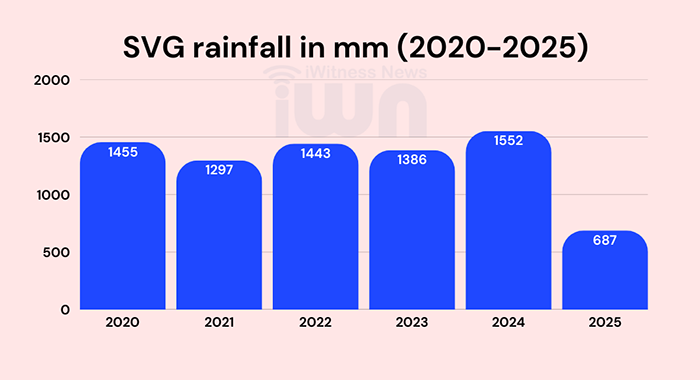
CWSA cited SVG Met Office data as showing slight fluctuations in rainfall between 2020 and 2024, followed by a drastic plunge in 2025.
The figures in the table below show slight fluctuations between 2020 and 2024 and then a drastic plunge in 2025 – 2020 (1,455.3 mm), 2021 (1,296.7 mm), 2022 (1,442.8 mm), 2023 (1,386.1 mm), 2024 (1,552 mm), 2025 (687.1 mm).
“With surface and ground water aquifers not fully replenished during the 2025 Rainy Season, it is forecast that the island will be facing the upcoming Dry Season with limited water available, compared to previous years,” Joan Ryan, the CWSA’s public relations and marketing manager said in a press release.
“This is especially crucial for communities supplied by the Montreal, Dalaway and Mamoon Water Sources, as based on our records, they are the first and most severely affected during periods of low rainfall and drought conditions.”

Ryan said the Caribbean Climate Outlook Forum’s (CariCOF) has forecast short-term drought conditions for SVG up to March and a long-term drought up to May.
“… CWSA MAY be forced to adapt and change its normal operating protocols. The rationing of water may start earlier and for longer periods of time, as well as the implementation of stringent water conservation practices.”
Ryan said CWSA has activated its internal emergency management system, meaning the close monitoring of all water sources, continued work on leak detection and repairs, heightened public awareness and the monitoring of all media outlets for public concerns.
“Homeowners are further encouraged to invest in their home water storage systems, to alleviate the impact of both planned and unplanned water disruptions,” Ryan said.
Ryan referred to the do-it-yourself video tutorial showing how to convert a plastic barrel into a water storage and distribution medium.
“Water storage tanks can be purchased from hardware stores throughout the country, and recommended sizes are dependent on your family and household needs. Currently, the suggested calculation for water storage is to allocate ten gallons per person, per day,” Ryan said.
“The effects of climate change continue to intensify and have significant impacts on the Caribbean and the world over. Prolonged periods of unpredictable climate conditions have been noted. The CWSA commits itself to monitoring and continuing to provide necessary information we continue to navigate the upcoming Dry Season together,” Ryan said.
It may be time to stop allowing the bottled water companies to take all the fresh spring water and package it into waste creating plastic bottles to sell.
The bottled water companies profits will skyrocket when people have to rely on purchasing bottled water while facing water rationing from CWSA.
The plastic waste will rise dramatically at time when it is already out of control.
These companies are a main source of environmental destruction leading to climate change yet they are empowered to continue business.
These are the fallouts from World Bank and IMF loans.
I don’t think this will or should affect Layou. This is where people travel to obtain during bad weather. BIGUT has water for the entire Central Leeward.
This is an opportunity to remove the taxes on purchasing such material. For car wash businesses they should use these tanks or setup businesses closer to the river to capture water before it enters the sea.
All rivers should have several water tanks constructed to keep all the water from entering the sea. This will allow farmers to have the water supply for their crops.