




The New Democratic Party (NDP) government will pay, next week, the salary bonus that the party promised to public sector workers during the campaign for the Nov. 27 general election.
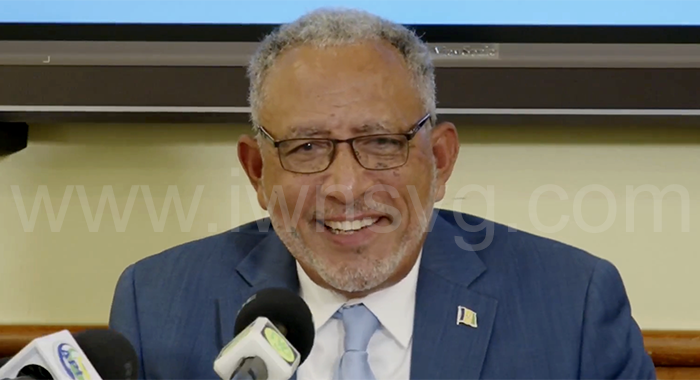
“… this initiative is a fulfilment of our pledge made to you,” Prime Minister and Minister of Finance Godwin Friday said at a press conference in Kingstown on Friday.
“We have told you that it would bring relief, and we are delivering on that mandate,” the prime minister said, adding that he had instructed the Treasury to process the payments by Jan. 30.
He said the tax-free payment will range between EC$1,000 and EC$2,000.
The prime minister further announced that his administration had decided to widen the base to include daily-paid and part-time workers, many of whom will get a bonus that is twice their regular pay.

He noted that the bonus was promised in light of the economic challenges that Vincentians are facing.
“We are committed to addressing these challenges directly, ensuring that our economic policies are not just numbers on a page, but tangible actions that lift the indigent, the poorest of the poor, other poor and working families who need support the most,” said Friday, who led the NDP to a 14-1 victory in the November polls, after 25 years in opposition.
He said that public servants — permanent and non-established — will each receive a $2,000 tax-free bonus.
Pensioners were not initially in the government’s contemplation, Friday said, adding, “but we figured it is just and right, and the case was made to us that we address them now, rather than later”.
Each pensioner will receive $1,500 at the end of this month.
The prime minister said daily paid workers — who make between EC$500 and EC$1,000 a month — will each receive EC$1,000.
Approximately 12,000 people would benefit from the bonus payout, the prime minister said.
“That is putting money back in people’s pockets in a big way,” he said, adding that the package would cost the treasury about EC$22 million.
“That is not a cost to government; that is a transfer of money into people’s pockets that the people are going to use now to stimulate the economy with additional spending,” Friday said.
“But more importantly, that they will use it to help to ease the crushing cost-of-living pressures that they have been experiencing over the years since the COVID crisis and to make ends meet.
He said that the NDP had expanded the scope of the bonus payment beyond what had been proposed to ensure that it reaches the widest possible number of beneficiaries.
“… a persuasive case was made to include the pensioners, and it will also include the daily-paid workers, part-time and full-time,” Friday said.
“Some people, they met me, they know that they do their little part-time work with the government and so on. And they said, ‘Prime Minister, are we included? Do we get the benefit?
“How could you say no? These are the people who need it the most,” Friday said, adding that while the base had been broadened, the bonus salary has been skewed to give the greatest benefits to workers at the lower end of the wage scales.
“We have adopted this approach because it ensures that those people at the lower end will receive the most significant benefit — that is, proportionately,” the prime minister said.
“Based on the approach we have adopted, we have determined that over 50% of the beneficiaries of this government programme … will receive the equivalent of 75 to 100% of their income.
“Furthermore, to ensure that every dollar counts towards meeting your needs, the cabinet decided that the bonus will be entirely tax-free, so every cent that you get, you take home and you can use for your own benefit,” the prime minister said, adding that he was “hoping to hear a clap for that”, resulting in some laughter.
“This was a central feature of our campaign coming into the elections: that we will focus on making things better for the people of this country, so that they can cope better with the pressures, the economic pressures that they are under.
“So, this decision reflects our government’s commitment to the people, to keeping our promises, to meeting the needs that are the most urgent,” the prime minister said.
He said the government will adopt other measures to improve people’s lives.
“These include matters of employment, of training, of further assistance to persons, indigent persons, vulnerable persons. But these will come later, some you will hear in the budget. But as for now, I am happy that we are able to make good on our promise to pay this bonus to the public servants,” the prime minister said.
He said that while people can say what they want, “Our government remains focused on moving this country forward.
“We can’t do it by leaving people behind while we work and building the economy and ensuring that we have more jobs available, better paid jobs available, we can’t just simply turn a blind eye to the hardships that people are feeling now to wait at some future date down the road, as we get the economy going.”
He said he expects that the measure that will be introduced in the budget next month and during the life of the administration will provide more opportunities for people to be able to work to get better pay and to make ends meet for themselves.
“But until we can do so, we have an obligation to assist those persons to make ends meet,” the prime minister said.
Friday said this is a promise that his administration is keeping and intends to “in a way that is fair, in that it includes a broad-based number of persons, and that those persons who are at the lower end, they get proportionately the greatest benefit from this policy.
“So, I’m happy today to be able to make that announcement, and I’m sure that all those public servants next week, when they receive their cheque, they will be even happier than we are presently in this room,” the prime minister said.
During the election campaign, the NDP promised to pay a bonus salary within 60 days of taking office.
Some people have interpreted this as meaning a month’s salary as a bonus.
During a joint press conference with Elroy Boucher, president of the Public Services Union, during which the union endorsed the NDP, Boucher had described the bonus as a “double-bubble”, as Friday applauded.
However, after the election, the prime minister said that his party had always promised a “salary bonus” and not a bonus salary.
Opposition Leader Ralph Gonsalves has accused the NDP of deceiving voters with the bonus promise, a central plank of its election campaign.