




Eight months after being voted out of office, leaving the country with EC$3.5 billion in debt and a debt-to-GDP ratio of 113%, Opposition Leader Ralph Gonsalves has blamed the New Democratic Party (NDP) administration’s first budget and public debt rhetoric for what he says is the lowest sovereign credit rating in St. Vincent and the Grenadines’ (SVG) history.
The former prime minister’s comments on Wednesday came in response to the June 30 decision by international ratings agency Moody’s Investors Service to downgrade the government of SVG’s long-term local- and foreign-currency issuer ratings.
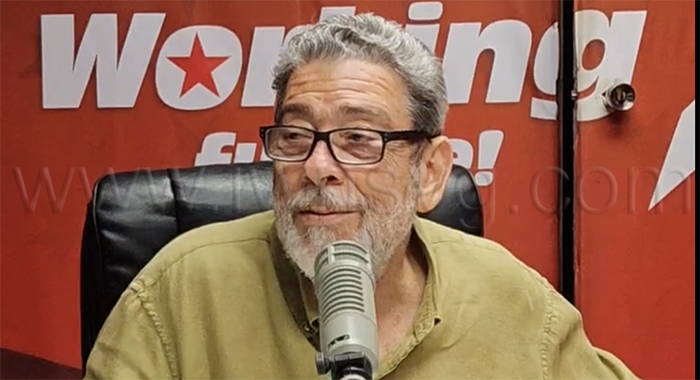
Speaking on his party’s radio programme on Wednesday, Gonsalves argued that the downgrade from B3 (stable) to Caa1 with a negative outlook under the NDP is rooted not in the stock of public debt accumulated under his Unity Labour Party (ULP) administration, but in policy choices and messaging since the change of government.
Gonsalves’ ULP administration, which came to office in March 2001 and was voted out in November, left the country with EC$3.5 billion in debt.
Prime Minister and Minister of Finance, Godwin Friday, told Parliament in January that the debt grew by 13% in 2025 to EC$3.5 billion as of Dec. 31 2025, as Gonsalves’ ULP government spent money “like a drunken sailor” ahead of the Nov. 27 general election.

The public debt was some EC$400 million more than the NDP government had thought it was when the prime minister spoke to the nation on state radio on Dec. 23, Friday, as he delivered his first budget since the ULP was voted out of office, 14 seats to one in the 15-member Parliament.
However, Gonsalves, who was minister of finance from March 2001 to November 2017, when his son, Camillo Gonsalves, took charge of the national purse, said that Moody’s has rated SVG since December 2007.
He said that from 2016 to 2025, the country maintained a B3 rating with a stable outlook, despite rising debt linked to COVID-19, the La Soufriere volcanic eruptions of April 2021, Hurricane Beryl in July 2024 and major infrastructure projects such as the EC$700 million new port in Kingstown.
Gonsalves said the new Caa1 rating places SVG firmly in Moody’s category of “poor quality, very high credit risk” sovereigns.
He explained that such a rating typically means:
- Lenders become more reluctant to extend credit;
- When they do lend, it is usually for shorter periods and at higher interest rates;
- Concessional lenders may tie loans more tightly to policy conditionalities.
He added that the negative outlook indicates Moody’s sees no near-term improvement unless there is a “dramatic” policy shift.
Three main policy triggers, says Gonsalves
Gonsalves linked the downgrade to three main developments that he said were specific to the NDP period, namely, a larger deficit and heavy market borrowing in the 2026 budget, talk of “debt swap” and the spectre of default, and no “credible” growth plan in Moody’s 2026 text.
‘Debt not new to Moody’s’
Gonsalves repeatedly stressed that Moody’s has long been aware of SVG’s elevated debt and the reasons for it.
He pointed to Moody’s 2024 report, which, by his account, recognised high public debt and the impacts of COVID-19, volcanic eruptions and Hurricane Beryl but affirmed the B3 rating with a stable outlook.
The opposition leader also said the IMF Article IV consultation in July 2024 concluded that SVG had achieved a “robust recovery from recent compounded shocks” and praised what it called “decisive policy responses, large-scale investments and robust tourism growth” under the ULP.
Gonsalves argued that these assessments undercut claims that he said were now being made by some NDP figures that the downgrade simply reflects “25 years of mismanagement”.
Gonsalves, said Moody’s periodic review in December 2025, conducted after the NDP’s election victory, maintained the B3 stable stance and laid out conditions for a possible upgrade — notably, “materially higher sustained economic growth and faster fiscal consolidation”.
He said that the assessment also warned that difficulty accessing concessional external funding, or a “material increase in market borrowing”, could “undermine the sovereign credit profile” and lead to a downgrade.
“That is exactly what the NDP’s first budget contained: a material increase in borrowing at market rates,” he said.
Liquidity pressures and ‘poor quality, very high risk’ label
Gonsalves summarised Moody’s stated reasons for the downgrade as centring on four elements: intensifying government liquidity pressures; elevated gross financing needs; a large and rising debt burden; and the authorities’ active exploration of a debt swap, in a context where they have publicly described the debt as “unsustainable”.
He contended that three of the four — liquidity pressures, gross financing needs, and the debt-swap talk — are direct consequences of NDP-era decisions, while the high debt itself was already fully accounted for in previous Moody’s and IMF assessments.
Gonsalves defends ULP’s borrowing record
Gonsalves defended the ULP’s decision over two decades to borrow heavily on concessional terms for the new port; hospital, clinics and schools; road and sea defence infrastructure; tourism and agriculture support; disaster recovery and resilience-building.
He contrasted those arrangements with what he described as the NDP’s greater reliance on short-term, higher-cost domestic borrowing and its scaling back or delaying of some pipeline concessional projects.
Gonsalves blames; CDB praises
Gonsalves’ comments blaming the government’s public statements for the downgrade contrast with the praise heaped on the government by the Caribbean Development Bank (CDB), one of its main development partners, for its honesty about the country’s finances.
In June, CDB Vice-President Isaac Solomon praised the NDP administration for what he described as a rare combination of confidence, clarity and humility in its engagement with development partners, saying this creates the conditions for effective support—provided words now translate into concrete action.
Speaking at the Development Partners Cocktail at the close of the first day of the Development Partners Round Table in St. Vincent, Solomon said events of this nature “do not happen by accident”, but reflect a government willing to invite scrutiny and articulate a clear, country-owned development vision.
“They happen because a government has the confidence to invite scrutiny, the clarity to articulate a vision, and the humility to say we cannot do this alone,” Solomon said.
“That combination is rarer than it should be. I think it deserves recognition,” he added.
Meanwhile, on Wednesday, the government said the downgrade is the result of “prolonged neglect” during the ULP 25 years in office.
Chiefain Neptune, minister of state in the Office of the Prime Minister, said that since taking office in November, the NDP administration has taken steps to strengthen the economy and directly put money in the pockets of Vincentians.
“However, the Moody’s report underscores the deep-rooted systemic economic failures left behind by the previous administration,” Neptune said.
“When we stepped into office, we understood that the economy was fragile. What we couldn’t foresee was just how bleak the legacy of neglect from the ULP truly was until we entered the Financial Complex in Kingstown.
“The NDP remains dedicated to restoring fiscal and debt stability while working to develop our nation. There’s a lot of work ahead for Prime Minister Dr. Godwin Friday and his team to address the inherited issues.”
The old fox continues to insult Vincentian’s intelligence. What a thing!
Gonzales you talking bare shit
Darth Sidious is unhappy he no longer holds the keys to the vaults.
The reporting is obviously biased since your boss was made an ambassador and is part of the incompetent regime. Stop crying Ralph Ralph and do what you said you were going to do. You all just sit in opposition and think governance is easy work. Now the tire meets the road show is what you can do, if not move aside and let knowledgeable people run the country.