



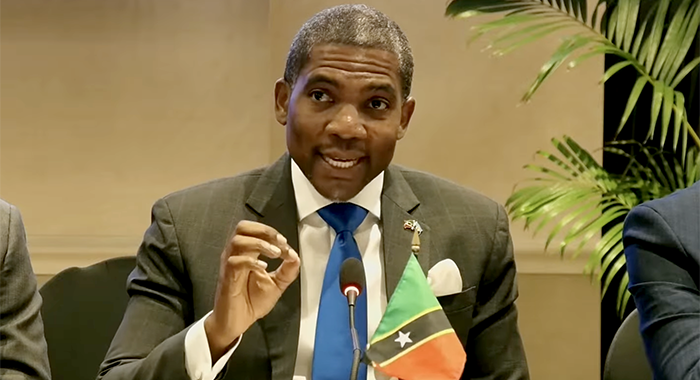

CARICOM has announced that it intends to begin humanitarian aid to Cuba as early as the end of March, but its chair, St. Kitts and Nevis’ Prime Minister Terrance Drew, has refuted press reports that the bloc has been involved in discussions with the US to support regime change in Havana.
When pressed at the closing media conference of the 50th Heads of Government Conference in Basseterre, on Friday, Drew, on at least two occasions, denied that CARICOM was involved in any discussion with US Secretary of State Marco Rubio on the matter.
Drew responded to a Miami Herald report that Fidel Castro’s grandson met with Rubio in St. Kitts and Nevis on the sidelines of this CARICOM conference and that the U.S. was promoting regime change in Cuba and that CARICOM is participating in this transition.
“Well, in the first instance, I can’t speak for the Associated Press or Miami Herald. I guess you have to ask them about that question. So, I think I’m not in a position to respond to what they have written,” Drew said.
“And I don’t dare think that I am qualified to do such. With respect to Cuba and the humanitarian efforts, we are going to respond on the humanitarian end in short order, within a month. We will give more specifics on it very, very shortly.”

Drew said CARICOM was going to “respond in a significant way to help the humanitarian situation in Cuba. So, I think that that is on the way and you’ll get more details with respect to it”.
Pressed by a Stabroek journalist for his view on CARICOM supporting the U.S.’s purported regime change in Cuba, Drews said he was “trying to understand the full context” of what the journalist was speaking about.
“You refer to an article that I have not seen, or referred to or know the basis of it,” Drew said. “So therefore, with that, CARICOM has not involved itself in any discussion of such nature.”
Drew reiterated that CARICOM is “very concerned about the humanitarian situation in Cuba” and “that is what we are responding to…
“And there was no discussion about regime change in Cuba?” the Stabroek News journalist pressed. “Regime change in Cuba with us?” Drew asked.
“Yes, with CARICOM,” the Stabroek News journalist said.
“We have not discussed that. We have discussed humanitarian matters in Cuba,” Drew replied.
Meanwhile, a Miami Herald journalist put to Drew that Rubio in his private conversations with CARICOM heads, “basically acknowledged what has been publicly reported that they are in discussions with Cuba”.
The journalist said that Cuba’s Deputy Minister of Foreign Affairs, Josefina Vidal, a former director general of the North American Division in the Ministry of Foreign Affairs, was there and she met with “several members” of Caribbean governments.
“Could you please tell us what is your position today as far as outside of the humanitarian framework? Will CARICOM assist in some sort of transitional talk as it relates to Cuba?” the journalist asked.
Drew said that at this time, CARICOM’s focus, “to put it that way, is on the humanitarian situation in Cuba, and we are making steps to help … to ease those humanitarian situations in Cuba.
“And that is what I’ve said before, and that is what I would stand by, even at this point in time,” Drew said.
In a joint statement on the situation in Cuba, CARICOM said its leaders met on Feb. 25 with Marco Rubio and that the engagement was “a highly constructive one with a frank conversation regarding the essential interests of all parties”.
The statement said that “given the strong historical, diplomatic, familial and economic ties and cooperation over the years in matters of security, there was a clear platform for all to continue to work together to build a stronger, safer, more secure and prosperous Caribbean and United States of America” which means a “more secure and prosperous neighbourhood”.
Russia, Mexico and Venezuela were the main suppliers of oil to Cuba. But the supply was disrupted in January following a US military strike on Venezuela, capturing President Nicolas Maduro.
President Trump, on Jan. 29, issued an executive order threatening tariffs against any country that ships oil to Cuba.
“The matter of the challenging situation in Cuba was also discussed. All parties recognised that there should be efforts to address the growing humanitarian crisis,” the joint CARICOM statement said.
“The Caribbean Community, cognisant of its very close relationship with both Cuba and the USA, and mindful of the extent to which the Region can be negatively affected, is willing to participate in any way that will redound to the benefit of the Cuban people, while maintaining regional stability,” it further stated.
Delivering the feature address at the opening ceremony on Feb. 27, Drew said CARICOM must address the “humanitarian situation in Cuba” because “a destabilised Cuba will definitely affect the whole region…
“A destabilised Cuba will destabilise all of us. Cuba’s population is anywhere from 9 to 12 million people. Excluding Haiti, the rest of CARICOM does not amount to 10 million people. Therefore, if a state within our community is so destabilised, it will affect all of us in the region,” he told fellow CARICOM heads.
“And as a matter of course, it is important that the community looks at the humanitarian issue in Cuba, treats it extremely seriously, and the community must serve as a conduit to ensure that there is communication and dialogue between the forces that be, so that the best opportunity can be had”, Drew told the ceremony.
The CAICOM chairman said that even though the situation “might be daunting, we have a collective effort to make to stabilise our region…”
Drew, a doctor, noted that he studied in Cuba for seven years.
“I have friends there. I have people who are like family to me. They reach out to me and tell me of their difficulties,” the St. Kitts and Nevis prime minister said.
“Food has become terribly scarce for some. Access to water has been challenging. Garbage fills the streets. Houses without electricity. I can only feel the pain of those who treated me so well when I was a student. I can feel their challenges and their difficulties,” he said.
“I do not get involved in their politics, but as a matter of humanity, it is challenging. I will say it is almost impossible not to feel the pain — the pain that is conveyed to me in messages and calls from those who I lived among. And therefore, I want to bring that to CARICOM, so that we can look at the humanitarian situation,” Drew said.