




By Ashford Peters
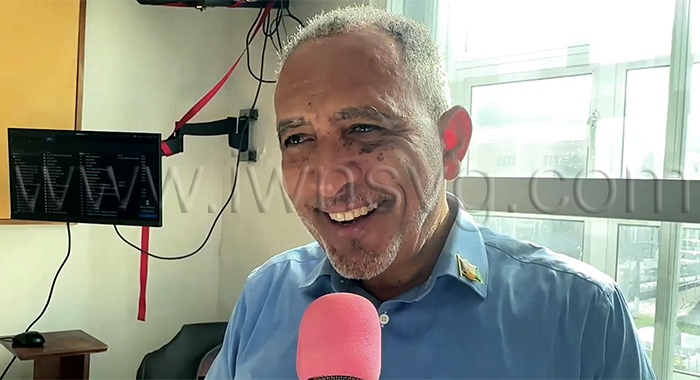
Prime Minister Godwin Friday has described as “a wonderful experience” his New Democratic Party (NDP) administration’s first 100 days.
The NDP swamped the Ralph Gonsalves-led Unity Labour Party (ULP) 14-1 in the Nov. 27 general election, ending the ULP’s quarter-century rule that began in March 2001 and involved five 5-year terms.
“It’s been a wonderful experience thus far because we now have an opportunity to deliver for the people of this country,” Friday on Hot 97 FM, during an appearance with some of his cabinet colleagues.
“It does give me a great deal of satisfaction to know that we have been able to keep our promises that we made. We said within 60 days we will do certain things to ease the cost-of-living crisis on the people in this country, and we did so. And we are continuing to look for ways in which we can make things better for the people in St. Vincent and the Grenadines.”

Friday said there are “other major policies that we have in place on the social side, but you know, in our budget, we also delivered a plan for the future of the country.
“A lot of it we can implement in this term, but a lot of it also is setting the basis for further work going forward,” Friday said.
“We have also honoured our campaign and, prior to that, our principled position that the persons who were fired under the vaccine mandate, that they would be reinstated.”
Hundreds of public sector workers lost their jobs in 2021 under the ULP administration, which fired them for failing to take a COVID-19 vaccine.
Some of them returned to work after the ULP government invited them to do so, but the NDP promised to reinstate them and pay for lost income resulting from the mandate.
Friday said his administration is “not mincing words with reinstating”.
He reiterated that his administration is saying “reinstating with all of the implications that come with that…
“We will work, and we are doing so, working with the unions, the individuals, to make this as smooth and as respectful as possible because those people have been through hell.
“We don’t want to make anything more difficult. So, we’ve delivered on that. And of course, we have our plans for various infrastructure projects that we’re going to see because people want to see things happening immediately in their constituents, and I don’t blame them,” Friday said.
The prime minister recalled what his government has referred to as a “successful” VAT-free shopping day on Dec. 19, which saw people not paying any of the consumption tax on a wide range of items.
“There was no gimmick in this. This was a serious measure to put money back in people’s pockets. So that they could re-spend it in the economy.
“And it put a shot in the arm of the business people. And they’re seeing that here is a government that really is looking out for people, is looking out for the private sector, that is serious about creating a vibrant economy that is dependent upon the local private sector and foreign direct investment. And of course, what government can do,” Friday said.
The prime minister said he is “not going to complain and whine” about the fiscal situation his administration “inherited” from the previous administration — a situation some people have been describing as a “hook in the gill”.
“I’m saying this is a situation we inherited. We are going to take whatever we have and deliver to the people of this country.
“And it’ll take a little time for us to get all of the major things done. But the things that we can effect now, we are doing them. People are seeing it in their lives every day,” Friday said.
In February, Friday presented to Parliament an EC$1.9 billion budget, his administration’s first, with no new taxes, saying the focus would be on collecting existing taxes rather than increasing existing ones.
At the end of 2025, St. Vincent and the Grenadines’ public debt stood at EC$3.5 billion or 110.3% of GDP, requiring nearly 40 cents of every dollar of current revenue to service.
During the budget presentation, Friday said the ULP administration’s “report card on generating sustained economic growth is dismal” and has been “often less than what is required to accommodate population growth and persons entering the labour force under such circumstances”.
During his appearance on Hot 97.1, Friday said that Budget 2026 has policies and plans that are going to help with the cost of living.
“Because ultimately, the way in which you help people in the country most is by creating an economy that provides opportunity for people, that provides jobs, that provides business opportunity, that people know they have a good idea and there are certain institutions in government that help you to bring it to fruition, that you’re not going to have somebody sitting in an office and looking at the thing and saying, ‘Well, who’s doing this?’ if this person can’t get off the ground.
“You have a good idea. There’s some office of government who can assist you in getting it done. Don’t be shy to come and tell them, ‘Do your work. Here’s the thing that I want to get done. You are supposed to be helping me doing it’,” Friday said.
Friday said that to help ease the cost-of-living crisis, his administration will be reducing the VAT from 16% to 13% “during the course of this year”.
The NDP has promised to reduce VAT within 60 days of coming to office, but during the budget presentation, Friday said that the government was reviewing the fiscal situation before implementing the reduction later this year.
“This is not an election gimmick. It’s part of our strategy. So why would we not do it? It’s a matter of timing … There are certain things you have to put in place in order to implement this in a way that is going to deliver the benefits that we are expecting it to do.
“But as I told you in the budget, just watch me. You’ll see what I do. So we’ll deliver,” he said.
Friday also said that as of March, public assistance, commonly called “Poor Relief”, will be increased to EC$500 as promised during the 2025 election campaign.
During his Independence Address on Oct. 27, then-prime minister Ralph Gonsalves announced that his administration, if re-elected, would increase Public Assistance to EC$360 a month — EC$140 less than what the then-opposition NDP had proposed.
Gonsalves’ proposed increase in public assistance was to be implemented last December, retroactive to three months.
Gonsalves had said that there were 4,646 people on the social welfare programme in which recipients who are less than 65 years old received EC$280 monthly, while those older than 65 got EC$300.
Another big item that came during the first 100 was the bonus package paid to public servants at the end of January.
Approximately 12,000 people, including pensioners and daily-paid/part-time workers, received the bonus the NDP promised during the height of the political campaigns leading to the Nov. 27 general elections.
The tax-free bonus was designed to help ease the cost-of-living burdens, providing relief to workers in the lower-income brackets.
The total package amounted to approximately EC$22 million, with public servants receiving EC$2,000, pensioners EC$1,500, and daily-paid/part-time workers EC$1,000.