



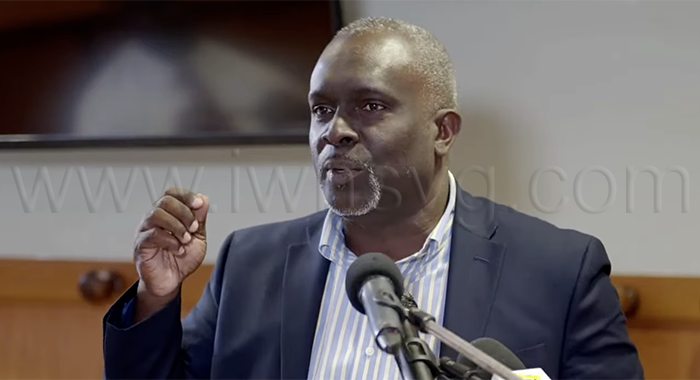

Minister of Education, Phillip Jackson, has acknowledged the challenge that school violence poses to the education system in St. Vincent and the Grenadines, telling nationals,” Vincy, we have a problem.”
“When the astronauts are in orbit or on a mission, and something is wrong, they say, ‘Houston, we have a problem’,” Jackson said at the “National Consultation on School Violence in St. Vincent and the Grenadines”, held in Kingstown on Tuesday.
“This is not just simply reporting. This is a call to duty. So, I’m saying, ‘Vincy, we have a problem.’ And the problem is not the ministers’, minister of education’s problem, or the minister of national security’s problem, or the commissioner of police’s problem, or the teachers’ problem or the principal’s problem. It is our problem,” Jackson said.
The consultation comes amidst a rise in violent clashes among students in SVG, even as students boldly proclaim their association with various gangs.
At the same time, Alia Mc Dowall, 17, a student of Central Leeward Secondary School, died on March 1, 16 months after she was stabbed in the throat outside her school, allegedly by another student of Bethel High School (BHS).

Doriel Duncan, a 17-year-old student of Bethel High School, has been granted EC$15,000 bail with one surety after being charged with wounding with intent over the stabbing of McDowall in November 2024. She returns to court on April 2.
Jackson said that acknowledging that there is a problem is the first step in addressing it.
“And the very fact that we are here at this consultation is an indication that we have recognised the problem,” he said, adding that the next step is ownership.
“In other words, if somebody thinks that another body, another person, is going to take care of the problem, at the end of the day, nobody is going to address the problem,” he said.
The consultation was attended by the top ranks of the Royal St. Vincent and the Grenadines Police Force and other national security stakeholders, education officials and administrators and students.
“Parents, community leaders, pastors, Principal, headmistresses, headmasters, teachers, van drivers, farmers, policemen, nurses, every single citizen has to say, ‘Violence in school is something that we will not tolerate in St. Vincent and ask themselves, ‘What part do I play?’” Jackson said.
The education minister said he was approaching the consultation, bearing in mind the 1961 statement of US President John F. Kennedy: “Ask not what your country can do for you — ask what you can do for your country.”
“And it is in this spirit that we approach this consultation. No matter who you are, where you are, whatever role you’re playing, ask, ‘What can I do to reduce the incidence of bullying, intimidation, gang relationships and violence in our schools?’
The minister noted the theme of the consultation, “Safer schools; safer communities”, adding that in science, there’s something called cause and effect.
“So, the way the theme is written, it’s true, safer schools as a cause, the effect is safer communities,” Jackson said, adding that if there are safer schools, students graduate feeling empowered and thereby achieving a safer community.
“But I also want to posit the reverse — and I’m not the only one who recognises this — … that what we really should be focusing on: safer communities; safer schools, because what happens in the school is a reflection of a deeper problem,” Jackson said.
He said that the symptoms of an illness are not the disease.
“The symptoms are the manifestation of something deeper. So, the problems in our schools are manifestations of a malaise in our communities,” Jackson said.
“And while I agree that safer schools eventually lead to safer communities, … I also want us to remember that safer communities lead to safer schools, because what happens at school is just a symptom of a deeper community problem.”
He said research shows that as regards student performance and misbehaviour, delinquency and ultimately, violence, one of the most important things is making sure that students feel as though they have a stake.
The minister suggested that a class singing “happy birthday” to a student and collecting donations to buy him something for recess on his or her birthday can teach students to be responsible for each other.
“… you’re making them know that they are important. They have an important stake in the school community,” said Jackson, a former educator.
“So, the research says one of the most powerful links is the concept of social bonding,” he told the consultation, adding, “When a student performs well and feels connected to their school, they have a stake in conformity.
“In other words, they feel a part and they want to protect the school. If they’re doing well, then they have something to lose: grades, sports, eligibility, teacher, respect.”
He said that on the other hand, when a student, and particularly a male, who already feels social pressure to be tough, consistently fails, “that bond, that connection, begin to break and eventually stops.
“They no longer feel they have a skin in the game, making the risk of delinquency seem much smaller.”
The minister also spoke about the “frustration-aggression cycle”, telling the consultation, “School can be a high-pressure environment.
“… and this is where it’s now linked to literacy and numeracy. For those … students who are already struggling with reading and writing and numeracy, school can be a very frustrating place.”
He said that with “the extra pressure”, the student can start to feel more and more alienated.
Jackson said that on the flip side, schools tend to brush aside issues of bullying, saying, “Oh, you’re too sensitive. Why yo so thin-skinned?”
“But those early signs are sometimes what we really have to nip in the bud when we recognise them, because the bullying behaviour might be a symptom of the student’s own experience at home or in the community, and they’re now transferring that to other students,” Jackson said.
He said bullying in school should not be ignored.
“It’s not that we’re going to make bullying the biggest thing now, but we have to pay attention to these early signals and make students feel that these issues are taken seriously,” the education minister said.