



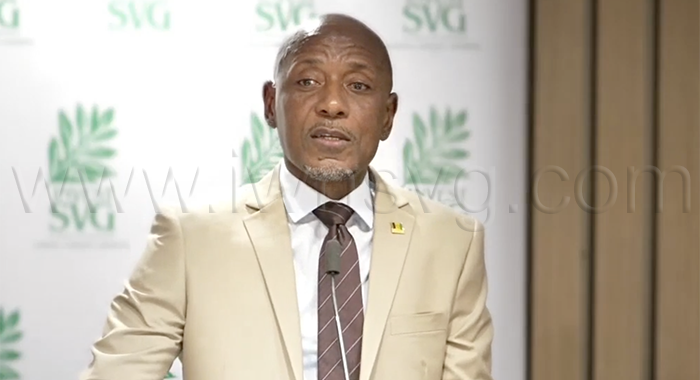

Foreign Affairs and Foreign Investment Minister Dwight Fitzgerald Bramble says St. Vincent and the Grenadines (SVG) must evolve its relationship with its diaspora “from barrels to businesses” if the country is to achieve sustainable development and tackle its economic challenges.
Speaking at the Invest SVG diaspora outreach meeting in Toronto on Saturday, Bramble said the traditional model of support from Vincentians abroad — focused on remittances, barrels and charity — remains important but is no longer sufficient.
“Our historical relationship with our diaspora is basically steeped in sending back barrels, sending remittances,” he told attendees.
“I don’t want to downplay that, because that is very important, of course. But I’m showing you how much more valuable you can be as people in the diaspora.”
‘From barrels to businesses’: Moving beyond remittances alone

Bramble echoed and sharpened a theme that had run throughout the evening’s presentations: the need to shift from short-term financial support to long‑term, productive investment.
“We’re not saying you must stop sending money home,” he said. “But we are asking that we evolve beyond remittances alone.
“While remittances help our families meet immediate needs, we need to think about long‑term investment, which has the power to build lasting generational wealth.”
He said that for decades, Vincentians abroad have kept families and communities afloat and have been “one of the strongest pillars supporting our economy — through substantial remittances, through barrels, through charitable giving,” Bramble said, referencing comments by other speakers.
“You have helped our families, you have helped our students to succeed, and you have helped our communities to grow.”
However, he insisted that the next phase of diaspora engagement must be fundamentally different.
“The next phase must be one where the moneys we send home do not only sustain households today, but also finance businesses, housing, agriculture, tourism and other productive sectors that generate long‑term opportunity and national growth for generations to come,” he said.
Small sums, big impact
Bramble told the meeting that many Vincentians at home still think of “investment” only in terms of large foreign projects, and that many abroad underestimate what they, individually, can do.
“If we have 10 Vincentians coming home and investing $50,000 Canadian each, just think about the impact that that can have — the cumulative impact that that can have,” he said.
“If we have similar ventures from across the diaspora — North America, Europe, Asia — it would make a huge difference.”
From charity to capital: ‘We cannot do this by ourselves’
Bramble said the policy of the New Democratic Party government is to reframe diaspora support so that charity and remittances are complemented — not replaced — by capital, expertise and networks.
“We have inherited a socio‑economic reality that requires every single one of us to be involved in the restructuring, the re‑engineering, the redevelopment of our country,” he said.
“We cannot do this by ourselves. Cabinet members and the ministers can’t do it alone.”
He insisted that the diaspora must be seen as a strategic partner in national development rather than a source of occasional donations.
“At the centre of any approach to development is the recognition that the diaspora is not peripheral to development, but central to it,” he said.
“This is not about [Prime Minister Godwin] Friday, this is not about Bramble… this is about us, St. Vincent and the Grenadines.”
Bramble argued that while barrels and remittances are usually consumed, investments can create jobs, build assets and expand the productive base of the economy.
“Remittances help our families meet immediate needs,” he said.
“Investment creates businesses that employ those families, builds homes for those families, and develops industries that keep those families in St. Vincent instead of forcing them to migrate.”
Sectors for diaspora: from tourism rooms to farm rows
Linking the “barrels to businesses” message to specific opportunities, Bramble pointed to tourism, agriculture, housing, agro‑processing, the blue economy and the creative industries as sectors where diaspora capital is needed.
Earlier in the meeting, government and agency officials had described gaps in hotel rooms, short‑term rentals, farm output and value‑added products.
Bramble said these were precisely the areas where diaspora investors can convert informal support into structured business ventures.
“We are talking about accommodation — boutique hotels, apartments, villas, Airbnbs,” he said, echoing tourism officials’ presentations.
“We’re talking poultry farming, agro‑processing, tourism services, transportation … introducing business networks to St. Vincent and the Grenadines.”
He argued that many of the people who now send barrels could transition into investors with proper support.
“A lot of you who send barrels can own cold rooms, distribution hubs, farms, guest houses, or small factories that produce what goes into those barrels,” he said. “Instead of only shipping things to St. Vincent, you can help us ship things from St. Vincent.”
‘Home is not just a place we remember; it is a place we build’
Bramble said the shift from barrels to businesses is ultimately about how Vincentians define their relationship with home.
“We recognise that our developmental thrust cannot be limited to St. Vincent and the Grenadines’ physical space,” he said.
“What we can do to make St. Vincent bigger and to expand our resource reach is to be more inclusive and to be more expansive — and that can only happen with the involvement of the diaspora.”
Adopting language used by other speakers earlier in the programme, he told attendees: “Home is not just a place we remember; it is a place we build.”
He appealed to Vincentians abroad to think of every barrel and every remittance as a potential first step toward ownership and enterprise.
“We’re not asking you to stop giving,” he said. “We’re asking you to own, to build, to invest — to turn what you are already doing out of love and obligation into something that also creates jobs, wealth and security at home.”
‘Work with us … let’s do this together’
Bramble stressed that his ministry, Invest SVG and the soon‑to‑be‑reconfigured consulate in Canada are being set up precisely to help facilitate that transition.
“We are strengthening the institutional framework by aligning key agencies, including Invest SVG,” he said, noting that Invest SVG now falls under his investment ministry.
“We are looking to have a more coordinated approach… to improve efficiency, reduce fragmentation, and accelerate investment facilitation.”
He said he is determined that the new approach to diaspora relations will not be rhetorical.
“I am somebody who — I don’t fail. Failure is not a part of my experience,” Bramble told the gathering. “So you can rest assured the structure is in place. You have a government with a forward‑looking approach to development…
“St. Vincent and the Grenadines’ future is dependent on your total commitment to the development of our country,” Bramble said.
“Work with us, please, because we want to work with you. Let’s do this together.”
Great idea. I live in Barbados and I help out my sister in Vincy,mainly with putting her children through school. So my intwrprwtation of what Bramble is saying is there’ll be more jobs for young people in St Vincent and therefore we won’t have to send money to our relatives like we nirmally would do. Instead,ww could invest the money we used to send back home to create more jobs and opportunities in Vincy for all Vincentians. Great idea. I am on board.
Investment is a very broad term. Why don’t they offer specifics. People invest not for love of country but for returns. Is your offering better than a 401K or CD? These guys are on a joy ride. Let us know how much it cost svg tax payerd and how many investments were secured in the end.