



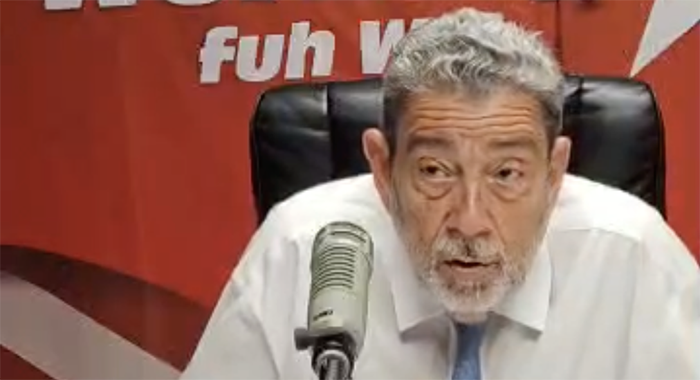

Leader of the Opposition Ralph Gonsalves has confirmed that his Unity Labour Party government had held detailed discussions with Global Ports Holdings (GPH) before it was voted out of office in November.
On June 10, the New Democratic Party government signed a memorandum of understanding with GPH, paving the way for negotiations for a 30-year concession and an EC$250 million financial investment for the phased modernisation of the cruise terminal in Kingstown.
The arrangement is for two phases and Vincentians will be allowed to invest in up to 30% of the company, while there will be local representation on the board.
However, speaking on Star Radio, his party’s radio station, on Monday, Gonsalves accused the NDP government of agreeing to a 30-year arrangement without being provided with detailed information.
Gonsalves contended that even as the government announced the MOU, it said nothing about the financial arrangements.

He said that his government and GPH held several rounds of discussions, with GPH sending the government a document shortly before the November 2025 general election.
Gonsalves did not provide any details about the contents of the document.
“A critical determination … is what is the actual amount that you are putting in real terms and how much you will be recouping from the head tax,” Gonsalves said.
This detail was important and needed to be checked to avoid repaying more than the initial investment, the opposition leader said.
Gonsalves said that details needed to be provided, including the intended cost to cover the intended period, the financing, and the percentage that would be retained by the company from head tax revenue.
And rather than await detailed proposals, he accused the government of proceeding with an agreement without providing detailed information about the intended day-to-day operations.
“But what worries people is that you agree in advance that you’re going to give them 30 years without knowing any details,” the opposition leader said.
Gonsalves said that GPH was just one of several companies to approach his government to discuss the cruise ship development, and that he had discussions with persons from the company, including GPH Chairman Mehmet Kuhmen.
He explained that he showed the first GPH delegation the site and his government’s vision for the facility’s development, which involved constructing a new terminal at the old port site and subsequently building a hotel and a performing arts centre on adjoining plots of land.
But they indicated that they did not intend to become involved in something of that magnitude, Gonsalves said.
He further explained that he consulted the Prime Minister of Antigua and Barbuda, Gaston Browne, whom he said indicated that he was satisfied with St. John’s arrangement with GPH.
There was an arrangement between the government of St Kitts and Nevis under the then Prime Minister Timothy Harris, but Gonsalves said that he later discovered that after review, it had been determined that the agreement was not best suited for that country and was eventually scrapped.
The then Freundel Stuart administration in Barbados also signed an agreement between that country and GPH to run the cruise ship port, but it was shelved after the Mia Mottley-led administration took office, Gonsalves said.
He said he did some research on GPH and found it to be a strong, professional company.
“Therefore, I don’t have any problem with Global Ports wanting to do anything with St. Vincent and the Grenadines,” Gonsalves said.
The opposition leader said that following the third meeting with GPH, his government asked them to indicate the specific details of the intended agreement.
“Because the devil is in the details,” Gonsalves said.
He said that throughout their engagement, while he noted that the company was not a philanthropic organisation and was in business to make money, the government and people of St Vincent and the Grenadines also had an interest.
He provided some of what transpired during the discussions, saying GPH representatives indicated that the company was interested in investing US$30 million and when the opportunity arose, they may invest more.
Gonsalves added that the company proposed repairing the existing facility, including the terminal, during the first phase, and then constructing an additional facility.
They further proposed that the company would manage both facilities, pointing out that it was not their intention to own them.
They opted for a long-term lease and generate income from management fees and increased head taxes from cruise ship operators, Gonsalves said.
They did not provide the details, including the intended length of the lease, the intended financial return to the company and how much they intended to keep, Gonsalves said.
“And the devil is in the details – we did not sign on to anything,” he said.
I believe that 30 years is an excessive timeframe. Instead, the government should negotiate terms that guarantee the transfer of know-how to the people of SVG, ensuring that we are capable of managing these operations ourselves once the agreement expires. While the current prime minister may no longer be in office in three decades, this contract will remain binding. Therefore, I believe long-term contracts should be capped at 15 to 20 years.
It’s amazing the way IWN jumped on this and spun the headline. Where is your story about the raise in fuel prices?