



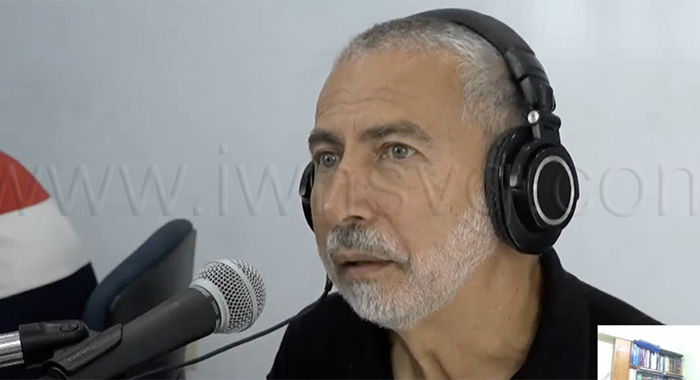

Chairman of the National Insurance Services (NIS), Stephen Joachim, has defended the directors’ decision to appoint Ronette Lewis as the executive director of the state-run social security agency, rejecting social media criticism that only an actuary is suitable for the top job.
The appointment of Lewis, the current General Manager of the Centre for Enterprise Development (CED), takes effect July 1, Joachim disclosed on Boom FM on Monday.
Joachim, who was appointed NIS chairman by the New Democratic Party (NDP) administration, said he expects Lewis to perform strongly in the role.
“I think she will do a terrific job,” he said.
‘You can’t run a country by social media’

The announcement comes amid social media commentary questioning both Lewis’s choice and the board’s approach to succession, following the departure of NIS Director Stuart Haynes, an actuary by training who headed the social security agency for nine years.
Joachim took aim at what he described as uninformed online attacks.
“There’s a lot of people out there who seem to know everything,” he said. “You can’t run a country by social media, despite what these… my friend Ralph once made a comment about ‘internet crazies’. I think he was right. A lot of these people on social media, … they’re busy criticising you, and they have opinions about everything.”
He questioned the track record of some of the most vocal critics:
“Anytime, the question I would like to ask them is: what is your track record again? What have you accomplished in your life? What makes you think that you’re in a better place to judge the actions and decisions taken by certain people when you have never been in those positions or have any idea what you’re talking about?”
Joachim pushed against the criticism that another actuary should head the NIS, adding that the institution needs a manager of people and systems, not necessarily an actuary at the helm.
He noted that while Haynes is an actuary, the day‑to‑day running of the NIS does not depend on the CEO’s actuarial work.
“I think we need a business person. We need somebody who understands how to manage people. The NIS is a people business. That is my opinion,” Jaochim said.

He pointed out that actuarial work at the NIS is largely outsourced and conducted on a periodic basis.
“We can hire actuaries as consultants. We have people with actuarial skills already in the business. We have people with investment skills. We have accountants. We even have a lawyer on the board,” he said.
“Every three years, the NIS conducts an actuarial report and we hire external actuaries. They do the evaluations and the assumptions… The manager, the director, has to implement those decisions. There is no actuarial skills being used in running the NIS. None. Zero. Nada.”
Joachim challenged critics to ground their objections in the institution’s actual needs rather than in assumptions based on Haynes’ professional background.
“Why do you need an actuary? People just say it because Stuart was an actuary,” he argued.
“If anybody doubts me, speak to Stuart Haynes. He will tell you: ‘Steve, I do not use my actuarial skills to manage the NIS. This is about managing.’”
54 applicants; 4 shortlisted
Joachim gave a detailed account of the recruitment process, stressing that the board did not hand‑pick Lewis, but worked through an external HR professional, a structured scoring system, and multiple rounds of interviews and presentations.
He said that even before he was formally appointed chairman, Haynes had informed him that he had accepted a job offer in St. Kitts.
Once Haynes’ departure date was confirmed, the board moved to formalise the process.
Haynes was asked to develop a detailed job description. The board then contracted HR consultant Janelle Allen to manage the recruitment.
“We decided we were going to hire Janelle Allen… as far as I’m aware, the best person around here when it comes to HR matters, hiring matters, and so on,” Joachim said.
“We got 54 applications for the director position,” Joachim said, adding that 54 applications were sent to Allen, who evaluated and scored them independently.
A three‑person selection committee of the board was established to handle initial reviews and interviews.
The committee scrutinised the top 10 candidates and did a scan of the remaining 44 “just to see if… there’s anybody we may have missed”.
From that pool, four candidates – two Vincentians, a Trinidadian and a Jamaican – were shortlisted for interviews.
After the Trinidadian withdrew for family reasons, the board interviewed three candidates twice: first in standard interviews, then via formal presentations on NIS‑related topics.
“You can’t say we didn’t do a thorough process,” Joachim said.
Cabinet made the appointment, not the board
Responding to claims that the NIS board had unilaterally imposed a CEO or even threatened to resign over the process, Joachim said those assertions are false.
“Is any truth to the fact that the board threatened to resign?” host Dwight “Bing” Joseph asked.
“That is not true. That is a lie,” Joachim replied and stressed that under law, the board recommends, but Cabinet appoints.
“The board does not hire anybody. The board makes a recommendation to Cabinet as to who we think is the best person to be in that position. Cabinet appoints a director and deputy director,” he said.
Joachim said the NIS leadership met with Prime Minister Godwin Friday, who has ministerial responsibility for the NIS, to explain the process and rationale before Cabinet acted.
“We met with the Prime Minister. We told him the process we had gone through… and the ultimate selection and the rationale and the reason why,” Joachim said.
“Cabinet then appoints. They agreed with the decision.”
He warned that any attempt by the Cabinet to override the board without good reason would undermine corporate governance.
“For the Cabinet to overrule the board means that they would have to have very good reasons,” Joachim said.
“Furthermore, why would you appoint a director when you didn’t consider the views of the board? What the heck’s the point of a board then?” the NIS chairman said.
“If you’re just going to overrule it, we’re going back to what we were doing before,” he said, apparently referring to the Unity Labour Party government, which was voted out of office in November 2025, after almost 25 years in office.
Stephen here is my task for you, can you research the basic qualifications for a person applying for a management position of a national insurance organization and report what you discover…
This is a great decision. Staff moral was very low because of the management style of the previous manager.
It is what it is but Mr. Joachim makes very little sense.
Reginald Thomas who ruled the NIS for years was he an Actuary?
His successor Mr. Haynes was he an Actuary?
There must therefore be some sense to selecting an Actuary since by Mr. Joachim’s very admission, every 3 years the NIS is reviewed by who? an Actuary … So hiring someone who knows nothing about the subject matter makes little sense. I shudder to think we might have to rely on Mr. Haynes for consultation if the shit hits the fan … Hope we will be open enough to accept our folly; especially if the alternative choice was in fact an Actuary!
Actually, as Joachim says, ” an actuarial review is conducted evert 3 years” and NIS have consultants who carry out this exercise. The daily management needs a general manager who understands people and business, period.
LIME CEO is not a telecoms engineer and the Brewery CEO is not a brew master nor an industrial engineer. Just like the Permanent secretaries need ni technical knowledge and the Ministers are not the subject matter experts of their ministry.
A leader (CEO) is carrying out policy set by the board. They execute the strategy through other managers and staff. His first task is to recognise that they are not the expert on all subject matters but that’s why they have a team around them. That said, look for a strong leader who’s willing to empower and support others.
Just saying.