



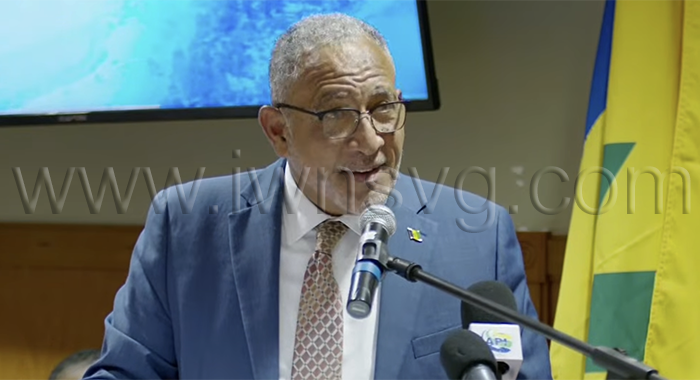

Prime Minister Godwin Friday has called for a fundamental overhaul of the global development finance system, arguing that a “one size fits all” model based on income levels is “unconscionable” and is “failing” small island developing states (SIDS) like St. Vincent and the Grenadines.
Addressing the “From Recovery to Transformation and Resilience” Development Partners Roundtable in Kingstown, the prime minister urged the United Nations and international financial institutions to “aggressively champion” the Multidimensional Vulnerability Index (MVI) as the operational standard for access to concessional financing.
“St. Vincent and the Grenadines echoes the unified position of CARICOM and the alliance of small island states that a one-size-fits-all approach to international development assistance will only continue to fail the region,” Friday told diplomats and representatives of multilateral and bilateral agencies.
He said it is “unconscionable” that Caribbean small states, which contribute less than 1% to global greenhouse gas emissions, must borrow at double-digit commercial interest rates to rebuild after climate-fuelled disasters, while developed countries pay far lower costs.
“Access to affordable lending cannot be dictated by arbitrary income metrics that ignore our acute exposure to climate devastation and geographic isolation,” the prime minister said.

Friday noted that climate projections for the Caribbean point to more frequent and more intense weather events.
“So action is not an option. The timing is what’s required, and that timing is now.”
From survival to structural change after repeated shocks
Friday anchored his call for reform in what he described as an “extraordinary” series of shocks that have hit SVG in recent years.
He mentioned the COVID-19 pandemic, the 2021 La Soufriere volcanic eruptions, Hurricane Beryl in 2024, and the inflationary impacts of global conflicts.
“As the saying goes, it would seem that we can’t catch a break, but you are here now, so maybe our fortunes will change, and the immediate future will disperse the disasters of the recent past.”
He said the combined impact of natural disasters and external crises has been “profound”, forcing the government to expand public investment to protect lives and rebuild — with serious consequences for public debt.
“In seeking to protect the welfare and rebuild what we lost, government has had to expand public investment,” Friday said.
“This has worsened the public debt, and coupled with ineffective debt management, has driven the debt to over 113% of GDP, and worse is threatened if we do not change course and pay particular attention to debt management.”
Friday stressed that while SIDS are widely recognised as vulnerable, his government does not intend to “be defined or limited” by that reality.
“Our response cannot simply be a matter of surviving from one fiscal year to the next. It must be about structurally altering our economic foundations.”
Three ‘transformative’ priorities: energy, skills and fiscal discipline
The prime minister linked the demand for fairer financing to a domestic agenda of structural reform, outlining three key areas his government wants to advance.
1. Green energy transition
Friday described the country’s dependence on imported diesel as a major drag on households and competitiveness.
He said the government intends to replace ageing generators with solar power and battery storage and remains “fiercely committed” to the national energy strategy target of 60% renewable energy by 2030.
“We remain fiercely committed to our national energy strategy, which targets a 60% renewable energy share by 2030,” he said. “I know it’s ambitious, but you gotta think big.”
2. Tackling the skills mismatch, especially for youth and women
Friday said that rapid construction and infrastructure projects are highlighting a skills gap between local workers and the demands of the economy.
“While large-scale construction activity remains a primary driver of our recovery, our local workforce, particularly our young women and young men, frequently face systemic employment gaps,” he noted.
Referring to projects such as the port modernisation and the new Arnos Vale Hospital, he said there is “huge demand for technical skills” but a “huge proportion” of certified tradespeople are imported.
“We are actively reorganising vocational training and technical education to align human capital directly with private sector needs, the needs of our economy overall,” he said.
3. Fiscal discipline under a strengthened legal framework
Friday said his government is working with technical partners to modernise and reactivate an updated fiscal responsibility framework to guide medium-term debt reduction.
“Through comprehensive public expenditure reviews, enhanced tax compliance and automated social protection delivery, we are ensuring that every dollar spent is transparent and effective,” the prime minister said.
“Our intention is to put the fiscal responsibility framework on a statutory footing.”
‘Walking up the down escalator’: beyond resilience to real progress
In the discussion that followed, Friday linked his financing reform push to a wider Caribbean debate about whether the region is truly progressing or simply coping.
He cited recent remarks by the Bahamas Prime Minister, Philip Davis, at the Caribbean Development Bank’s annual meeting, and an analogy attributed to Michael Mann about “walking up the down escalator”.
He said the Caribbean has seen “so many projects” that are completed without clearly transforming conditions on the ground.
“Very often … that question lingers because it’s a kind of, ‘Wait, let’s see what happens.’”
Friday argued that both government and development partners must focus on coordination and impact, not just activities.
‘We cannot do this alone’: shifting role of the state and appeal to partners
The prime minister also signalled a shift away from state dominance of the “commanding heights” of the economy, saying the fiscal situation leaves “not much in the way of an alternative” to greater private sector leadership.
“We’ve sent the message very clearly to the local private sector that we’re serious about this,” he added.
He framed the new approach as a different model of governance.
“Government is seen essentially not just as developing the country and handing it to the people; it really is a way of mobilising all the talents and the resources that we have domestically, internationally,” he said.
“There’s a lot of goodwill around the place. How do we coordinate this, bring this all together … so we could move forward more quickly?”
Friday repeatedly stressed that SVG, and Caribbean states more broadly, “cannot do this alone”.
“There is so much promise and possibility, but you know that a single storm … can wipe out a decade of effort and hard work to build a more prosperous society that provides for our people,” he warned.
“While we hope for better days, and we think of better fortunes that may come, we can’t rely on those vicissitudes,” he said. “We must plan, we must have partners in place, and be capable and willing to adapt and to adjust to these crises.”
The two-day roundtable, convened with the UN Resident Coordinator’s Office, also heard a detailed Growth and Stabilisation Plan from Ambassador Kevin Hope, who set out targets to reduce debt towards 60% of GDP by 2035, double long-term growth, and push poverty and unemployment into single digits.
Representatives of the UN, CDB, World Bank, CAF, EU, Canada, Germany, China, UK, CARICOM Development Fund, UNICEF, UNFPA, WFP, PAHO, GIZ and others broadly endorsed the government’s direction, while urging stronger coordination, a regional lens, and an explicit focus on the poorest and most vulnerable.
Look, we can worry about Western backing all we want, but it’s not going to help us in the long game. These global money lenders are just finding ways to keep us in a box we can’t get out of. We need to look at our own backyard. Guyana, Trinidad, and Suriname have the minerals to finance and support our development. The real prize.
totally agreed with the new PM. the financial system badly needs to revamp if small islands economies’ will survive, the global financial system is due for overhauled.