



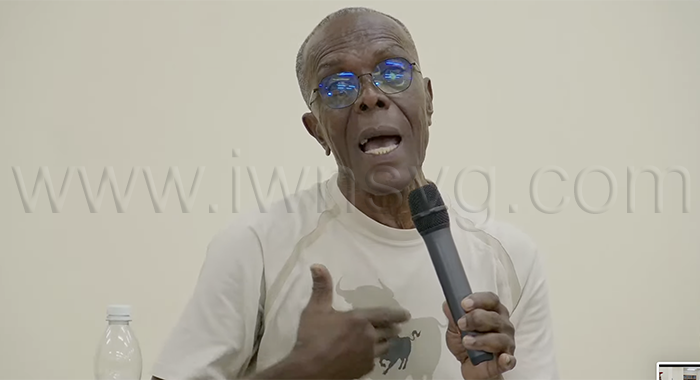

Environmental consultant Reynold Murray says the most serious environmental issue associated with the state-led sand and aggregate harvesting project at Roseau in North Leeward is the potential damage to fisheries, not deforestation or soil loss.
Addressing North Leeward residents at a community meeting on Tuesday, he urged a structured partnership with fishers and other local users of the bay.
Murray was contracted by BRAGSA, a state-owned company, to conduct an environmental and social impact assessment (ESIA) for the project.
He pushed back against accusations that there was “no consultation” and that the study ignored active farming in the Roseau Valley, located north of Richmond.
Murray, speaking at the event organised by North Leeward MP Kishore Shallow under his “North Leeward Matters” series, acknowledged gaps in the work —including the fact that no full biodiversity inventory of plant species was conducted.

He, however, pointed out that an ESIA is “not a fixed thing” and must be treated as a living document that is updated as new information emerges.
Facing direct questions from North Leeward Preservation Front representative Jill Edwards about whether he had conducted a baseline survey and plant inventory, Murray conceded that the ecological work had limits.
“If you’re asking me if we did a biodiversity inventory of all of the plants in the area, the answer is no,” he said.
Edwards argued that a baseline survey is “the first tenet” of an ESIA and said a complete inventory was “basic protocol”.
Murray, however, stressed that his mandate and the scope of the study were more focused on the nature of the material being removed and its likely downstream impacts.
Farmers and the ‘no cultivation’ claim
Murray also addressed criticism that the ESIA states there was no active farming in the Roseau area after the April 2021 La Soufriere eruption.
Local activists said this claim was contradicted by recent videos and first-hand accounts of farmers still cultivating peppers and tomatoes.
The environmentalist said that the conclusion reflected what was said at the earlier consultation meeting.
“You were here at that consultation. There were 70 persons in this room, not counting those who were outside on the road,” Murray told activist Adonis Charles, who had highlighted the discrepancy.
“I asked a question about the farming in the area, and one man, who was a farmer, stood up in the front there, and he said, since the volcanic eruption, all the farmers moved; there are no farmers up there, and nobody objected,” Murray said.
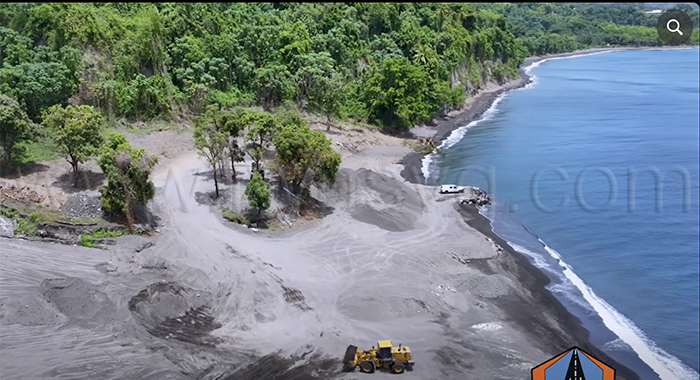
He accepted that this could now be wrong and said the document can and should be corrected.
“If there are farmers, then we can address it,” he said. “An EIA is not [a] fixed thing that it’s written up and it’s done, and nothing can happen. That’s not what it is. It’s something in progress.”
However, he objected to what he described as an attempt to portray the entire study as reckless or meaningless.
“You’re lashing it as though the impact assessment didn’t cover anything, and as though the development is going out recklessly, and I’m not going to endorse that,” he said.
‘The real issue here is fisheries’
On the question of environmental risk, Murray repeatedly steered the discussion away from headline-grabbing comparisons with the controversial Rayneau quarry at Richmond, and towards what he considers the core, evidence-based concern: impacts on fisheries.
He acknowledged that the island is too small to cordon off Roseau Bay exclusively for either fishers or miners, but said the project must be managed with the nearshore ecosystem and livelihoods in mind.
“All the other things we’re making noise about, we’re making them [out of] personal or other forces driving us, but the fisheries resource is in fact something that needs consideration,” Murray said.
He referenced concerns raised by a young female fisher at an earlier meeting and said these have been captured in the ESIA.
Rather than blanket compensation, Murray advocated for co-management and a structured understanding of actual losses and mitigation options.
“What needs to happen is a partnership developed, and we understand what their real loss is, and how we can offset [it],” he said.
“In 2001, I worked with the Soufriere Marine Management Authority in Saint Lucia. There were fishers in there, there were tourism people in there, there were boats… in that little area around the Pitons, and we developed a management plan where everybody became involved, and so everybody can benefit from the resources.”
Murray said a similar multi-stakeholder model could be used at Roseau to balance sand extraction with fishing and other uses of the bay.
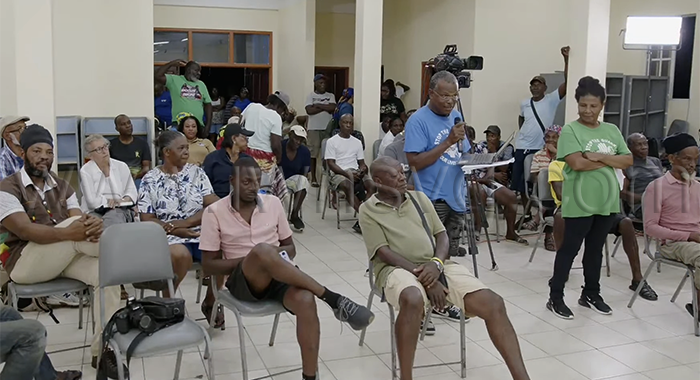
‘Approval in principle’ and the planning sequence
Critics have also claimed that site works began at Roseau before the ESIA was completed, mirroring what they describe as a pattern of “breach of protocols” at the Richmond quarry.
Murray disputed that characterisation, saying the sequence was guided by Physical Planning’s standard practice of issuing “approval in principle” subject to surveys and an ESIA.
He said BRAGSA received that preliminary approval and was explicitly allowed to carry out limited clearing to conduct survey work and design the ramp and facilities.
“So, you would have seen cutting before the assessment was complete, because in order for them to go further, they had to do some initial thing. I am not saying cutting trees randomly… I’m saying making a path and clearing enough so that they can see what they’re doing.”
Murray said that once the ESIA is completed and submitted, Planning must formally approve it, then follow the usual process of gazetting and controlled public access.
“So, it’s not that this development is trying to go ahead of any intervention from people,” Murray said.
Legal issues around ownership, access to ESIA
Another flashpoint in the meeting was the public’s demand to see the full ESIA and environmental management plan.
Activist Lennox Lampkin argued that the assessment, permits, licences and minutes of meetings should be “public knowledge”.
Murray said he supports transparency in principle, but stressed that under current law and practice, the ESIA belongs to the client who paid for it, not the consultant, and cannot simply be published at will.
“When I do an impact assessment, and I give it to Tom Jones, or he pays for it, it becomes his personal property… I can’t even use the information there again. I can’t give it to anybody. It’s his document.”
He said the planning authority, not the consultant, decides how and when members of the public can view the study, typically after it has been referenced in the Government Gazette.
To illustrate regional practice, he cited a recent project in Grenada.
“Next door, Grenada: I just did some work on a hotel in Grenada, and a person from the public wanted to get a copy of it, and they went to the planning. The planning authority said, ‘You pay $800, I will give you a copy… and nobody else could touch it’,” he said.
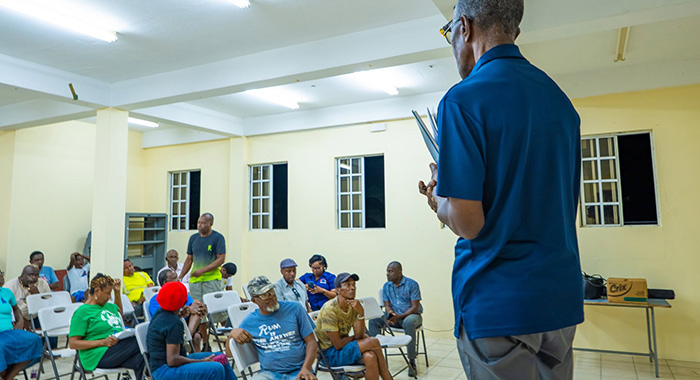
‘Let’s not pretend we didn’t do anything’
Throughout his interventions, Murray walked a line between acknowledging community grievances — particularly over the Richmond quarry, which many residents have called an “environmental disaster” — and defending his professional work on the Roseau project.
He praised the “passion” and “partnership” language used by North Leeward activists, especially on monitoring and fisheries, but warned against “hyping each other up on things that are not real…
“Environmental issues have been one of the biggest divisions among developing countries,” he said.
“Politicians and other people’s finances have used environmental issues to divide people down the middle and cause all the confusion, so they could continue to rape the world. Let’s not do that.”
He maintained that consultations were held, citing an earlier meeting with around 70 people present, and argued that some of the loudest current objections are revisiting issues that were already aired and recorded.
“I strongly support much of what you presented. I like the monitoring idea,” he told Charles.
“All I’m saying [is] let’s be honest with each other, and let’s face the things that we [have to] deal with… Don’t overlook the things that we have done, and don’t make it look as though we didn’t do anything, or that we follow suit like the others.”
For Murray, the path forward lies in updating the ESIA where it is weak, building a formal co-management framework with fishers and other users of the bay, and working within — or changing — existing laws to improve public access and accountability.