



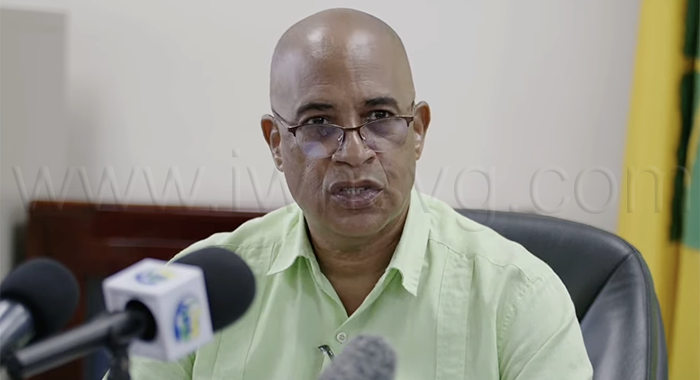

The Ministry of Health has filled a critical gap in the public health system with the appointment of Cuban psychiatrist Dr. Eloy Asanza Castillo to the Mental Health Rehabilitation Centre (MHRC).
The appointment ends what Health Minister Daniel Cummings said was about a decade-long struggle in St. Vincent and the Grenadines (SVG) to recruit and retain a specialist in the field.
Cummings, who became minister of health in December after the victory of the New Democratic Party in the November election, announced the appointment at a press conference in Kingstown on Thursday.
He framed the appointment as part of a wider effort to destigmatise, decentralise and deinstitutionalise mental health care in SVG.
“Today we are privileged that on board in the Mental Health Rehabilitation Centre is a very competent and experienced doctor who is going to assist us in this important area.”

Introducing the new psychiatrist, Cummings stressed both his qualifications and his decision to settle in SVG with his family, noting that the psychiatrist has worked in the Caribbean and Africa.
“He has come to St. Vincent and the Grenadines with his family, actually residing and working here, so he is in more ways than one one of us, and I can’t tell you how happy I am that we are able to have Dr. Castillo with us in the mental health [services].”
Meanwhile, Castillo described himself as “a simple guy” with 33 years of experience in psychiatry and traced his regional and international work before coming to SVG.
He said his first experience working abroad was in St. Lucia, where he was part of a government-to-government effort, before going on to other places like Venezuela, and then to South Africa, where he spent the last 10 years.
He said he had been in discussions with Vincentian health authorities for about three years before finally taking up the post.
“Because of family reasons, I have been in conversations for about three years with officers in the Ministry of Health, and finally it happened that I could come to St. Vincent, and really I’m very happy, I’m very happy to be part of this effort,” Castillo said.
He praised the existing mental health team for their community-based work.
“I was very happy to see a team of young professionals going to communities, knowing their names — the name of the patients — knowing the addresses, trying to help, going for the injections, and trying to follow the patients,” he said.
“I’m really happy to be here… and I will put effort in really helping you and be part of this marvellous team of health professionals in the field of mental health.”
Minister defends staff, blasts ‘dishonest’ reporting
Cummings used the announcement to push back against media criticism of MHRC staff, saying recent reports had portrayed them as uncaring and incompetent without proper investigation.
“… there have been a series of articles that painted the staff at our mental health institute as being not caring and incompetent, of not being qualified to do the work they are supposed to do,” the minister said.
“These kinds of reporting without any form of investigation are not only dishonest but they have a very serious impact on the psyche of our people.”
He said such portrayals also undermined public trust in the state’s capacity to provide mental health care.
“After all, if a government would put in place an institution to look after the mental health of our people and appoint people who do not have the competence to do that work, then that government needs to be removed. This is too serious a matter to play games with,” Cummings added.
The minister singled out psychologist Alisa Alvis as one example of highly trained local staff carrying heavy responsibilities, noting that she functions both as psychologist and administrative head of the MHRC.
“She is the administrative head of the Mental Health Rehabilitation Centre, but she is substantively the psychologist, so she has, over a period of time, been taking on these dual responsibilities,” Cummings said.
“Not a lot of people understand that to be a psychologist you have to be a very well-trained and certified individual… I can tell you from the short period I have been your minister of the level of seriousness and drive and passion that Dr. Alvis brings to this role, both a psychologist and as head of the mental health centre.”
In April, Chief Magistrate Colin John rejected reports prepared by Alvis — who has a doctorate but is not a medical doctor — and psycisians Dr. Micheal Stowe and Dr. Franklyn Joseph, saying they were not qualified to say whether a persons is mentally fit to plead to a charge and stand trial.
The court has further summoned the Alvis, in her capacity as head of Mental Health Services, and the Permanent Secretary in the Ministry of Health to appear before it in connection with the MHRC’s failure to produce a report on an accused man, with a history of mental ill health.
New psychiatrist part of wider reform push
On Thursday, Cummings framed Castillo’s arrival as one pillar in a broader reorientation of mental health policy, which he summarised as “destigmatise, decentralise, deinstitutionalise”.
Cummings said mental illness must be treated like any other medical condition, and rejected the tendency of families and communities to distance themselves from affected relatives.
“It’s as if there is some evil spell cast on the individual. The irony of that is that the exact opposite, my friends, is what is required,” Cummings said.
“Mental health illness, as I understand it, as the experts will tell us, is an illness that is treatable like any other illness, and this government has set upon a programme to do exactly that, to treat mental health as one of the several illnesses affecting our people in this country,
Among the measures outlined:
- Early intervention in schools
- Decentralised services
- Acute mental health wing in the new hospital
From ‘holding cell’ to rehabilitation
Cummings said his visit to the existing MHRC at Glen had been “one of the most painful” of his tenure, reinforcing complaints about dilapidated conditions for both patients and staff.
He said the facility had “for many years been used as a holding cell, literally basically keeping people in [a] captive environment with little resources that can assist those persons to go back into society as normal,” but insisted “that… is changing rapidly”.
Alvis told the press conference that the MHRC currently cares for about 150 inpatients at any given time, including approximately 120 long-term patients, many of whom are effectively homeless.
She said her tenure had already seen a reduction from around 190 in patients and that more work was planned to reduce unnecessary long-term hospitalisation through better discharge planning, family engagement and community-based care.
“That includes addressing things like people who are in our facility who are also in contact with the law, strengthening discharge planning, engaging with families… and, of course, as I said before, this ties into our decentralisation efforts, because when people can receive community-based care, they’re better able to stay in their homes and not end up hospitalised.”
That’s another two or three strikes on Gonsalves’ record.