



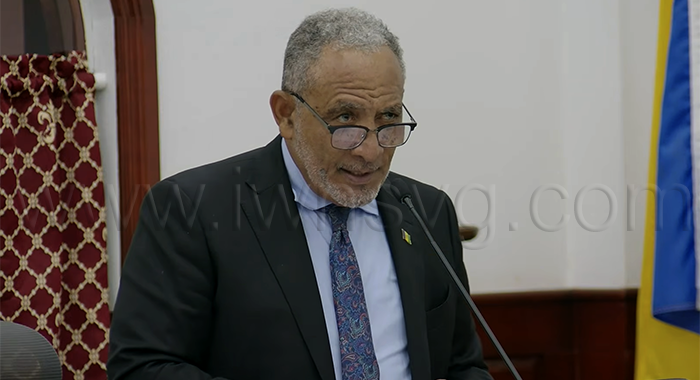

Prime Minister Godwin Friday says his government’s EC$11.8 million net debt to fuel suppliers is the price of shielding Vincentians from the full brunt of surging international oil prices.
Answering a question from Opposition Leader Ralph Gonsalves in Parliament on Thursday, the prime minister said the liability to Sol EC Ltd. and Rubis West Indies Ltd. had built up under the long‑standing bonus-malus mechanism, which is designed to stabilise domestic gasoline and diesel prices.
“That $11.8 million effectively is what the government has been holding the price down, in a sense, and subsidising the public,” the prime minister said.
How the bonus-malus system works
Friday told the House that the bonus-malus arrangement is an agreement between the government and the two approved fuel importers — Sol EC Ltd. and Rubis West Indies Ltd. — covering dutiable sales of gasoline and diesel only; aviation fuel and liquefied petroleum gas (LPG) are excluded.

He stressed two key concepts:
- Dutiable sales: Fuel on which duties and taxes “have been paid or are payable”. Only these volumes are used to compute bonus-malus.
- Price build-up (PBU): A detailed breakdown of the landed cost of fuel — including freight, insurance, duties, taxes and the company’s margin — which establishes each company’s wholesale price.
The process, as outlined by the prime minister, is that companies submit PBUs for each fuel category to the Ministry of Finance.
The minister of finance sends the PBUs to the Customs and Excise Department.
Companies then prepare monthly bonus-malus statements showing the government’s stipulated wholesale price (set by statutory rules and orders under the Price Distribution of Goods Act), the companies’ actual wholesale prices and the resulting “bonus” or “malus”.
A bonus occurs when the company’s wholesale price is below the government-set price.
For example, if the government price is EC$13 per gallon and the company’s wholesale price is EC$11 per gallon, the EC$ 2-per-gallon difference is paid by the company to the government as a bonus.
Malus occurs when the company’s wholesale price exceeds the government-set price.
For example, if the government price is EC$10 and the company’s wholesale price is EC$12, the EC$ 2-per-gallon difference is reimbursed by the government to the company.
This is a “malus” to the government.
Monthly statements for each company capture these movements, and the net position over time determines whether the government owes the company or the company owes the government.
Where the accounts stand: Rubis and Sol
Friday provided detailed figures for the period up to April 30, 2026, showing a mixed picture between the two importers.
Rubis West Indies Ltd.
- Balance brought forward (amount payable to the government) as at Dec. 31, 2025: EC $6,681,793
- January 2026: Bonus of EC $125,103.04 (government gain)
- February–April 2026:
- February malus: EC$27,087.56
- March malus: EC$860,527.66
- April malus: EC$2,750,730.34
After offsetting the 2026 malus amounts against the surplus carried over from 2025 and the January bonus, Rubis still had a net amount payable to the government of EC$3,168,551.22 as at April 30, 2026.
Sol EC Ltd.
The position with Sol is the opposite: the government owes Sol, and that liability has grown sharply in 2026.
The amount owing to Sol as at Dec. 31, 2025 was EC$6,398,540.94
Every month from January to April 2026 was a malus period, meaning the government had to compensate Sol because the regulated prices were below the company’s wholesale prices.
The total now owed to Sol as at April 30, 2026, is EC$15,022,621.67.
Net position: Gov‘t in the red
When both companies are combined, the net balance is a liability for the state, with the government owing Sol and Rubis a combined total of EC$11,854,070.45
Friday explained that this is because the government owes Sol about EC$15.0 million, while Rubis still has a credit of approximately EC$3.1 million in the government’s favour.
Shielding consumers from global oil shocks
Friday tied the build-up of the malus, particularly to Sol, to global events and the administration’s decision not to fully pass on international price spikes.
He cited the war in the Gulf and associated volatility in international oil markets as the principal external driver of higher landed fuel costs.
“The realities of the international economic and trading situation with respect to oil create continuing hardship for us as a government to absorb the increases indefinitely, and of course for the companies themselves in terms of how their own operation unfolds,” the prime minister told lawmakers.
He said that over the period of sharp price increases, the government has passed through “a portion” of the higher costs to consumers, but held back another portion.
The prime minister said that, in doing so, the government has effectively used the bonus-malus framework to limit increases in regulated wholesale and retail prices, and and to accumulate a malus liability with suppliers instead of immediately raising pump prices to full cost-recovery levels.
“The government essentially passed through a portion to the consumer, but also held back, so that the overall cost could not be too onerous on the public,” the prime minister told Parliament.
He said that the EC$11.8 million net amount represents the fiscal cost of that choice to date.
“That $11.8 million, effectively, is what the government has been holding the price down, in a sense, and subsidising the public.”
Friday warned, however, that neither the state nor the fuel companies can absorb such pressures indefinitely if global prices remain elevated.
“The longer the war goes on, the more volatile the oil price situation becomes. The greater hardship it imposes on all of us, not just in St. Vincent and the Grenadines, but all over the world,” the prime minister said.
Tense exchange over projections, pricing benchmark
In a supplementary question, Gonsalves asked about the likely malus to Sol for May and June, which he suggested could be “at least as high as April or higher”.
He asked about the benchmark the government uses to set its wholesale price, relative to the prices offered by Sol and Rubis.
However, Friday told the opposition leader that Parliament does not entertain hypotheticals.
“We don’t yet know what the situation is with respect to May, and we certainly don’t know what it is to June… When we have those facts at our disposal, we’ll make a facts-based decision,’ the prime minister said.
Gonsalves insisted that his question was about the pricing benchmark, not about speculative figures for May and June.
However, House Speaker Ronnia Durham-Balcombe ruled that the Prime Minister had already answered and directed the House to move on.
Why must an American-made war in the Middle East affect SVG? We have Trinidad, Guyana, Suriname, and Venezuela to buy our fuel from. Oh, I forget these oil refineries are run by American corporations. So it is “Long live the Empire” all over again.