



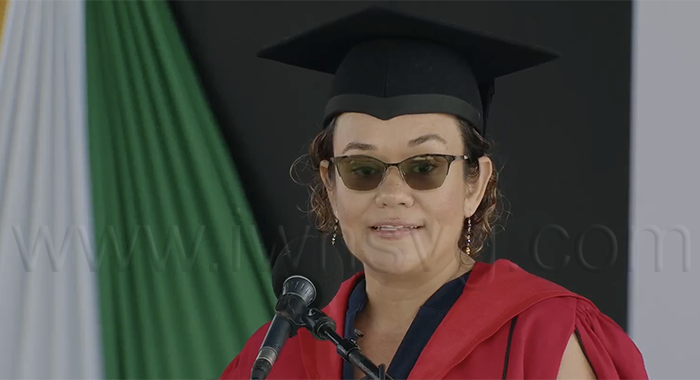

Featured speaker Andrea Veira has urged graduates of the St. Vincent and the Grenadines Community College (SVGCC) to move beyond “scrolling, comparing” and online drama, and instead use social media and digital tools to learn, create and solve real problems in their communities.
Addressing more than 900 graduates at the college’s recent commencement ceremony, Veira, a scholar, educator, researcher, and consultant who holds a doctorate, warned that while their generation enjoys unprecedented digital access, that access brings responsibility, not entitlement.
“Empowerment as a Gen Z or a millennial does not mean entitlement,” she said. “It means access, exposure, and responsibility.”
She noted that today’s young Vincentians and Caribbean people have opportunities their parents and grandparents could “not always imagine”.
Veira said these include online learning, global networks, digital platforms, entrepreneurship tools and emerging technologies such as artificial intelligence, automation, drones, robotics, and data systems.

“These are tools for empowered minds,” Veira told the graduates, “and when used with discipline and purpose, they open limitless possibilities,” she added at the ceremony, held under the theme “Tomorrow’s Leaders, Empowered Minds, Limitless Possibilities”.
Using technology only for scrolling is ‘wasting a gift’
Veira cautioned graduates against the trivial or destructive use of social media and digital technology.
“With the internet, you can learn a skill, research an idea, start a business, market your brand, connect with mentors and tell the story of your country and region to the world,” she said.
She contrasted those possibilities with the way many people currently use their phones.
“But let us be honest. If all we use technology for is scrolling, comparing, and sending voice notes about who being messy, then we are wasting a gift.”
She urged students to pause and evaluate their digital habits, saying, “So, at some point, we all must pause, touch grass, and ask, How am I using these tools to build something meaningful?”
Use social media to promote business, educate, organise
Veira argued that social media should be treated as a platform for constructive work, not merely a site for personal display or gossip.
“Use the tools available to you constructively,” she told graduates. “Use technology to learn, create, connect, innovate, and solve real problems.”
She went on to spell out what that should look like online. “Use social media not only to post, but to promote businesses, educate communities, celebrate culture, and mobilise support.”
Her advice located social media within a broader vision of digital citizenship, in which online spaces are used to strengthen local economies, public awareness and community solidarity.
AI should ‘sharpen’ thinking, not replace it
Veira linked social media to the wider technology landscape, including the rapid introduction of artificial intelligence (AI) into education and work.
She reminded graduates that they have lived through “rapid changes in technology and the arrival of artificial intelligence in teaching and learning”, and urged them to approach these changes with ethical discipline.
“Use artificial intelligence ethically, not to replace your thinking, but to sharpen it,” she advised.
In the same breath, she called on graduates to apply technology creatively across key sectors, including designing solutions for agriculture, healthcare, education, climate resilience, tourism, finance, trades, and community development.
From online noise to real impact
Throughout her address, Veira returned to the idea that tools are neutral but choices are not.
For her, the central question is not whether young people are online, but what they are doing there.
She warned that without a clear sense of purpose and values, even impressive digital skills can become shallow.
“Let your ambition be guided by values,” she said. “The world does not need more qualified people who lack compassion. It needs graduates who can combine knowledge with kindness, confidence with humility, and creativity with responsibility.”
While much of her speech celebrated the resilience and creativity of Gen Z, Veira suggested that social media and digital tools will only be truly empowering if they are tied to service, stewardship and problem‑solving — from promoting local businesses and educating communities to telling the Caribbean’s story “to the world” in a way that uplifts rather than undermines it.
In that vision, graduates are not just users of social media, but shapers of online spaces, choosing whether their time on screen contributes to “scrolling and comparing” — or to the “meaningful” building of their own futures and those of their communities.