



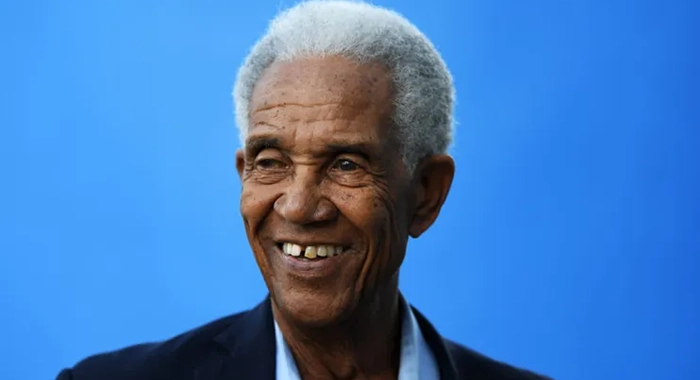

The Parliament of St. Vincent and the Grenadines on Tuesday paid tribute to former West Indies cricketer Sir Garfield Sobers, who died on Friday, aged 89.
Prime Minister Godwin Friday, an ardent cricket fan, led off the tributes, in which Parliament remembered the Barbadian legend as the undisputed standard-bearer of world cricket and a defining figure of Caribbean identity.
PM: Sobers ‘in a bracket all by himself’
Friday — speaking as a lifelong cricket fan — described Sobers as the pinnacle of the game and a formative influence on generations of Caribbean people.
He recalled growing up trying to emulate Sobers.

“For me, growing up as an ardent cricket fan, as one who felt that I could play the game like Sobers… he was the epitome of the game. He was in a bracket all by himself.”
The prime minister said that while debates would continue globally about who was the greatest cricketer, he had no hesitation in his own conclusion.
“I will not argue with anyone on that point, because I know. For me, he was the best cricketer the world has ever seen in a class by himself.”
Friday highlighted not only Sobers’ prolific run-scoring and all-round skill, but the manner in which he played — arguing that his combination of style and substance helped define the Caribbean cricketing ethos.
“It was not just run making, but doing it with style and with flair, and I believe that it is that sense of style — not just making runs, but how you make runs — that came to characterise Caribbean cricket.”
He underscored Sobers’ humility, noting that, despite his extraordinary achievements, the legend consistently downplayed his exploits.
The Prime Minister recalled the iconic moment when Brian Lara surpassed Sobers’ then world-record Test score of 365 not out, noting Sobers’ joy in seeing his own record fall.
“To see the expectation that he had, awaiting that moment so he could go and greet the new record holder with such joy and humility and generosity of spirit.”

Friday said Sobers and his contemporaries in the 1960s, 70s and 80s did far more than win cricket matches, saying they “shaped us as a people in the Caribbean”, providing a small region with proof that it could set the global standard in a major sport.
Now, he said, the region must learn to speak of Sobers entirely in the past tense.
“For the chapter is now closed, and we could only speak about him as memory in reverence, in recollection, but the life that he lived is closed, and therefore, the legacy will remain the way we had come to expect it, and will remain that way forever.”
Friday said he was “moved” by Sobers’ passing but “very much in debt” to his contributions.
The prime minister extended condolences to Sobers’ family, the people of Barbados and the global cricket community.
“At 89 he had a long innings — and that’s an appropriate metaphor. And it was a good life… a foundational part of West Indies cricket and culture.”
Tourism Minister: ‘The Caribbean’s conscience in sport’
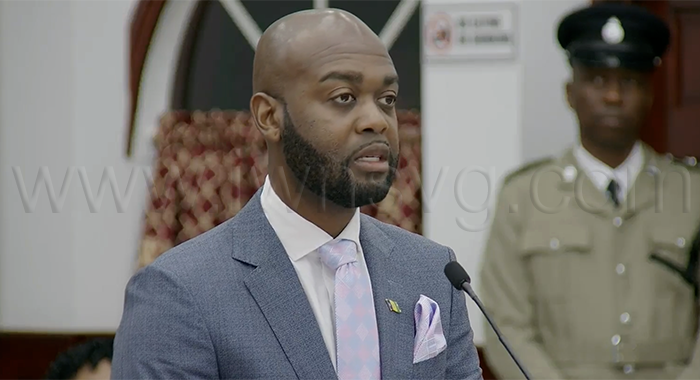
Meanwhile, Minister of Tourism, Civil Aviation and Sustainable Development Kishore Shallow, who is also president of Cricket West Indies, grounded his tribute in both statistics and symbolism, calling Sobers “one of the most complete athletes ever produced in sports, point blank”.
Shallow said that it was “very difficult to argue” against Sobers being the greatest cricketer of all time, noting that even the International Cricket Council (ICC) had effectively enshrined his status by naming its men’s international cricketer of the year award in his honour.
He referred to Sir Donald Bradman’s description of Sobers as a “five-in-one cricketer”, saying praise from a figure of Sir Donald’s stature confirmed the legitimacy of global admiration.
Shallow highlighted Sobers’ landmark 365 not out, scored in 1958 before he turned 22, and only surpassed 36 years later by Brian Lara.
“That 365 not out was his debut century, his maiden century… One run for every day of the year, which was only broken some 36 years later by the great Brian Lara.”
He summarised Sobers’ Test career as made up of 93 Test matches (1954–1974); over 8,000 runs at an average of 57, 26 Test centuries, and 235 wickets.
“He bowled medium pace, bowled his left-arm [spin], and at times he wicket-kept…” Shallow said, adding that Sir Garry had tremendous talent and captained the West Indies team for some 39 Test matches between 1965 and 1972.
But, Shallow insisted, Sobers’ importance went beyond numbers, locating Sobers squarely within the post-colonial Caribbean, arguing that the Barbadian icon became a symbol of regional excellence and identity.
For young Caribbean boys and girls, Shallow said, Sobers embodied possibility:
“He was also a symbol of possibilities, knowing that you can achieve anything if you work and dedicate yourself to it.”
The minister recounted his own first encounter with Sobers as a 15-year-old participant in the Sir Garf Sobers International Under-19 tournament in Barbados, noting that several Vincentian players – including Kenroy Peters, Romel Currency and Sunil Ambris — had played in the same competition and interacted with Sobers.
Shallow remembered him not only as a towering figure in sport, but as “a loving, decent human being… a lasting example of a devoted life to excellence, to humility, and to service”.
Opposition Leader: ‘A gift from the gods’
And, Leader of the Opposition Ralph Gonsalves placed Sobers within a broader civilizational and historical frame, calling him “a genius, someone beyond legendary, heroic. A gift from the gods, the greatest cricketer that the world has ever seen”.
Gonsalves argued that no truthful account of the Caribbean after the 1950s could omit Sobers.
Invoking British historian GM Trevelyan and Caribbean thinker CLR James, Gonsalves recalled James’ criticism of English histories that failed to acknowledge the influence of legendary cricketer WG Grace.
In the same way, he said, any serious narrative of Caribbean advancement would be incomplete without Sobers.

For Gonsalves, Sobers was both a product and shaper of Caribbean culture — embodying fairness, solidarity, teamwork, and respect for rules, all “tempered very much with gentlemanly behaviour and conduct”.
He recalled the privilege of watching Sobers in person and singled out one innings in particular — his 113 at Sabina Park in 1968 on an ill-prepared pitch against a strong English attack including John Snow, Jeff Jones, David Brown and Derek Underwood.
“On a wicket which had gaping holes… the ball was flying all over the place. And wherever the ball flew, his straight bat, with enormous agility and unorthodox shots, met the great English bowling side… It was an extraordinary performance, which is still written about in the annals of batsmanship.”
Gonsalves also emphasised Sobers’ leadership, comparing him to Frank Worrell but suggesting Sobers’ capacity to elevate others was even more pronounced.
“He had this ability to draw out of those whom he led that which they themselves did not know as yet that they possessed… that which was the best in them, which they themselves did not as yet know that they possessed.”
He noted that CARICOM had conferred on Sobers its highest honour, the Order of the Caribbean Community, while Barbados made him a living national hero and is now according him a state funeral, usually reserved for heads of state and government.
Better late than never!