



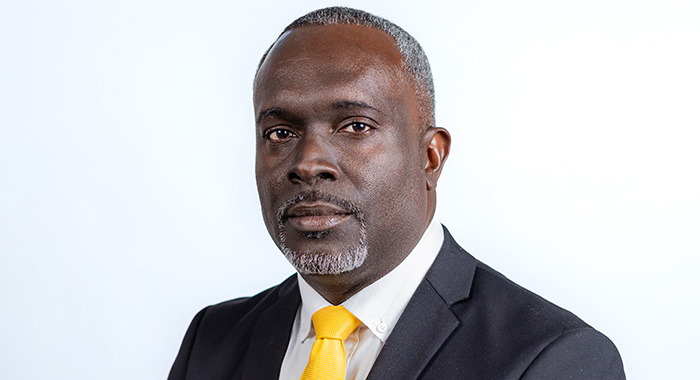

Education Minister Philip Jackson says the new policy on registration fees for new students entering secondary school is aimed at ending a “mess” of widely varying registration and related fees being charged to parents and guardians across St. Vincent and the Grenadines.
On July 15, Jackson announced the implementation of the New Democratic Party (NDP) government’s election campaign promise to remove registration-related fees for Form 1 students entering public and government-assisted private secondary schools in SVG.
He said the move was part of the government’s broader push to ease the cost of education for Vincentian families.
Speaking on NBC Radio on Tuesday, Jackson said an internal review of Form 1 registration packages revealed sharp disparities in what schools charged for similar items, as well as a proliferation of vaguely defined fees that parents struggled to understand.
“When you look at the range in the prices, they’re all over the place… and we concluded that’s really a mess,” Jackson said.

Jackson said he instructed his staff to collect and analyse registration packages from secondary schools as the government moved to implement its policy of reducing or removing school fees where possible.
The minister said the findings showed:
- Registration fees ranging from EC$30 to EC$100
- Physical education t shirts from EC$25 to EC$95
- Non-refundable “processing fees” from EC$50 to EC$100
- Report books ranging from EC$10 to EC$25
- Other charges such as “supplies” running from EC$30 to EC$50
Beyond the dollar figures, Jackson said, there was a lack of consistency in what schools charged for and how fees were labelled, adding that the situation raised questions of fairness, transparency and accountability.
‘Fuzzy’ fees under scrutiny
The minister drew a distinction between tangible items and what he called “fuzzy” fees.
He said parents generally accept paying for items they can “touch”, such as school ties, badges, polo shirts, and games uniforms.
However, he said confusion arises when parents encounter terms such as “Processing fee”, “Admission fee”, “Registration fee”.
“When you start seeing things like processing fee, admission fee, and registration fee, it starts to get a little fuzzy,” Jackson noted.
Jackson said the government’s response is rooted in its commitment to legal and regulatory clarity, universal access to secondary education, and relief for families facing economic hardship.
New standardised fee structure
He said the ministry issued a circular on July 14 to public and government-assisted secondary schools setting out a standardised fee framework.
Under the new policy, schools can charge for required items. These are school badge, school tie, physical education uniform, school polo shirt, and parent-teacher association fee — included by ministerial decision to strengthen home–school partnerships.
Optional items, for which parents can pay at their discretion, include student photograph, school handbook, report book, homework book, art supplies, music recorder and supplies, flash drive, school cooperative fee, book loan scheme (EC$50 contribution for textbooks), and exercise books, which were formerly treated as mandatory.
Jackson stressed that any reasonable exercise book, including those sent in barrels from overseas, must now be accepted once properly labelled, and students must not be harassed for using them.
Refunds where schools already collected fees
The minister acknowledged that some schools had already conducted registration under the old fee structure.
He said schools are now required to revise their registration packages to reflect the newly approved structure.
Schools are also required to identify any fees collected that are no longer permitted under the policy, arrange refunds to parents for those discontinued charges and notify parents of what will be refunded, and the date and method of repayment.
“That is the responsibility of the school, just like how they communicated up front the original fees,” Jackson said.
Impact on school finances ‘far less than people think’
Some principals, Jackson said, have expressed concern about the loss of revenue used for operational needs such as toilet paper, security, and printer toner, ink and paper.
He said the ministry had anticipated this pushback and carried out an assessment of the likely shortfall in funding.
“We did the actual research based on the data we collected, and I’m confident that we will be able to meet the shortfall. It’s far less money than most people think,” Jackson said.
The education minister said that in some schools the difference between the old and new fee structure amounted to as little as EC$60 to EC$85 per student, and that fears of a financial collapse of school operations were overstated.
“Let us not be fatalistic about it… It’s not a whole set of money that’s going to cause the school operation to suddenly crash,” he said, recalling that earlier generations attended school with no fees at all while schools “carried on well”.
The minister said the government has already allocated EC$172.2 million in recurrent expenditure and EC$63.5 million in capital spending for the education sector this year, including school operations and infrastructure projects.
The minister pointed out that the policy does not affect annual school fees charged by denominational schools.
He said these institutions are not fully funded by the state and have long been allowed to charge a separate school fee, supported in part by their congregations’ tithes and offerings.
“The new policy does not affect these,” Jackson said, noting that such fees must be clearly described as “school fees” in keeping with longstanding agreements.
He added that, in the longer term, the ministry would take a more comprehensive look at these arrangements in light of the country’s policy of universal access to secondary education.
A practical analysis in a season of reality. Well done, Mr. Minister. Well done! 👏🏽
The proud GHS alumni can each support a child so no program has to be canceled!
Next on the list should be conflict of interest in these schools!!!!
Also, those teachers who do shifty during instructional time but teach magnificently for $100 lessons!