



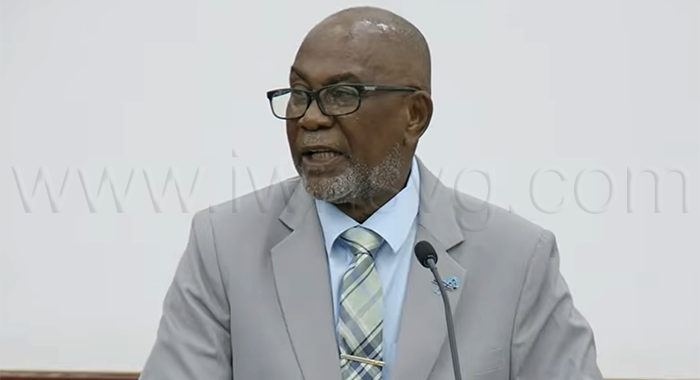

Parliament on Tuesday passed the Daily Paid and Minor Salaried Officers (Compassionate Gratuity) Bill, 2026, with Minister of the Public Service, Deputy Prime Minister St. Clair Leacock describing it as “one of the most important pieces of legislation” ever to come before Parliament and “a great day for public servants and for Vincentian workers”.
The bill puts into law a system of compassionate gratuity for non‑pensionable, low‑paid government workers — a group long described as being at the “bottom end of the totem pole” — when they retire or die in service.
While both government and opposition members supported the broad intent of the measure, the debate largely turned on how far it goes, who it covers, and how much discretion ministers should have.
Leacock presented the bill as both a people‑centred social justice measure and a bold policy choice taken in the face of acknowledged fiscal hardship.
Leacock noted that the bill was examined by a select committee that he said had “enriched” the bill and left members “richer and better for that decision”.

Wide stakeholder involvement
A central plank of Leacock’s argument was that the bill was not drafted in isolation, but shaped by broad stakeholder input.
He said the select committee deliberations included government and opposition MPs and senators, the Public Service Union, the St. Vincent and the Grenadines Teachers’ Union, the Commercial Technical and Allied Workers’ Union, the Police Welfare Association, and the National Labour Congress.
Leacock told Parliament that the committee’s work led to “a number of useful amendments” and that its members, including opposition representatives and unions, had reached unanimity on the core policy position:
“No category of government worker should ever be without recompense at the end of their working years,” the Central Kingstown MP said.
Who will benefit?
Leacock explained that the bill applies to daily paid officers — defined as people employed by government in non‑pensionable, temporary posts and paid daily; and minor salaried officers — people in non‑pensionable permanent posts in the annual Estimates who receive a modest monthly salary.
In practical terms, he said, this captures civil service grades M and L, and grades 1 and 2. These workers include customs guards, office attendants, drivers, handypeople, cooks and domestic helpers, forest guards and rangers, school bus drivers, security guards, traffic wardens, hospital attendants, laundresses, and auxiliary support workers and various apprentices and junior technical staff
Leacock estimated that nearly 4,000 workers could benefit, citing combined figures of approximately 497 minor salaried officers in grades M, L, 1 and 2; about 2,831 daily paid workers; and around 536 additional teaching staff in lower teaching grades.
Altogether, he said, they were “approaching some nearly 4,000 people… many at the bottom end of the totem pole”.
Eligibility and beneficiaries
Leacock highlighted several interpretation clauses as being crucial to how the law will function.
On the beneficiary issue, Leacock stressed that this came directly out of select committee discussions and real‑life cases presented by union representatives, including difficulties people faced accessing benefits after a spouse’s death.
The bill allows officers to name a beneficiary and later change that person, reducing the need to “trouble the courts” and navigate costly probate procedures.
Choice, timing, and the 60–65 gap
He described the problem of non‑pensionable workers who retire at 60, but are not eligible for NIS pension until 65, leaving a five‑year income gap:
“At 60, a lot of people [are] still finishing the mortgages… all kinds of demons start to attack you: blood pressure, sugar, the cancers, arthritis, dementia… At age 60, you haven’t got to see the world yet, and you want to take a trip abroad, and you can’t even raise your own passage money…”
He contrasted this with the greater flexibility some private‑sector employees enjoy, where people may work up to 65.
The bill, he said, recognises this reality and provides compassionate gratuity for non‑pensionable workers at retirement or death; and crucially, allows them to choose whether to retire at 60 and take the gratuity, or continue working up to 65 to earn more and better position themselves financially.
How and when the money will be paid
The compassionate gratuity granted under the Act shall be paid from the Consolidated Fund.
In cases of retirement, payment must be made within three months of approval of the application, and in no case later than six months.
In cases of death, the same three‑month target and six‑month maximum apply for payment to the designated beneficiary or legal personal representative.
He linked these provisions to the financial pressures facing the state but framed the bill as an “anti‑cyclical” and “people‑first” policy choice.
‘Behave yuhself’
Leacock also sounded a cautionary note to workers about conduct and performance, linking it to the minister’s discretion under the bill.
He warned that while the benefit is significant, misconduct or chronic poor performance could jeopardise it.
He urged workers to give “an honest day’s work for an honest day’s pay” and to “so conduct yourself that you shall always be in the limelight of your minister [and] your permanent secretary”.
The bill requires ministries to keep accurate employment records, including periods of service, wages and salaries, named beneficiaries, and interruptions in service.