



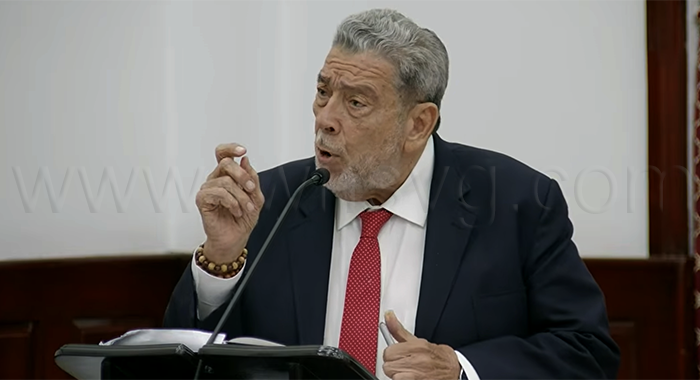

Leader of the Opposition Ralph Gonsalves on Tuesday delivered a long, technical critique of a bill to give compassionate gratuity to non-pensionable public sector workers but stopped short of saying whether he supported or opposed the legislation.
He insisted instead that his concerns would remain a “running sore” if not addressed even as the Parliament went on to pass the Daily Paid and Minor Salaried Officers (Compassionate Gratuity) Bill, 2026.
The new law grants compassionate gratuity to non‑pensionable, low‑paid public workers on retirement or death in service.
Government MPs and the two opposition senators — Carlos James and Keisal Peters — said they backed it, but Gonsalves avoided giving a clear yes or no.
Throughout his contribution, Gonsalves balanced praise and criticism, but made a point of not aligning himself clearly with either supporters or opponents of the bill.

“Those who want to say whether I support or I oppose, you have heard me, and the people have heard me,” he said as he wrapped up his contribution to the debate.
“This bill seeks to do two things … to codify existing practice of some 25 years or more, and secondly, to alter this practice in some respects, some for the better and some for the worse,” Gonsalves told the House.
‘Sui generis’ law that improves and worsens practice
Drawing on his background as a lawyer and former prime minister, Gonsalves described the bill as “sui generis” — a special‑purpose law for non‑pensionable public workers — but argued it could not be divorced from the Protection of Employment Act and the Pensions Act.
He credited the bill with codifying what he said was a 25‑year practice of paying compassionate gratuity to non‑pensionable workers.
He also noted that it removes the old 26‑year cap on reckonable service so that all years are now counted, up to a new maximum of 33⅓ years, which he called “commendable”.
“To the extent that this bill codifies existing practice … I am pleased, and to the extent that it improves in certain areas on existing practice, I’m pleased,” he said.
But he repeatedly stressed that other elements were, in his view, “for the worse”.
Missed chance to use more generous formula
Gonsalves argued that when governments began paying compassionate gratuity, they borrowed the formula from the old Protection of Employment Act: two weeks’ pay for each year of service.
Since that Act was updated in 2004 to a more generous formula for severance pay — two weeks per year for 2–10 years, three weeks for 11–25, and four weeks for years over 25 — he said the bill should have upgraded its own formula as well.
Instead, the law retains a flat two weeks per year for all years of service.
“If we are codifying, should we not improve on what had existed… and adopt the formula… [in] the Protection of Employment Act of 2004?” he said.
He acknowledged it was a “fair criticism” that his own administration, which was voted out of office in November after 25 years in office — had not made that change earlier.
Gonsalves, however, insisted that once Parliament was codifying the practice, it should now “do better” for low‑paid workers.
7‑year threshold questioned
Gonsalves also took aim at the requirement that workers must have at least seven years’ service to qualify for the gratuity.
He said this looked like it was imported from the Pensions Act, which sets similar thresholds for pensionable officers, but argued that it was ill‑suited to non‑pensionable workers, who lack security of tenure; and can be dismissed more easily by their superiors.
‘Wholly unnecessary’ ministerial power
Gonsalves also criticised Clause 9(2), which allows the minister to reduce or withhold a gratuity if, “to the satisfaction of the minister”, the worker has been guilty of negligence, irregularity or misconduct.
He distinguished between Clause 9(1), which says no absolute right to gratuity is conferred and preserves existing powers to dismiss without compensation — language he accepted as standard and close to Section 5 of the Pensions Act; and
Clause 9(2), which he said was essentially a copy of the Pensions Act’s misconduct provision transplanted into a very different employment context.
For pensionable officers, he noted, misconduct can lead to a reduced pension because they enjoy strong protections and removal is procedurally complex. For non‑pensionable workers, by contrast, an authorised officer can dismiss them with notice or pay in lieu.
He called for Clause 9(2) to be removed entirely, describing it as “wholly unnecessary”.
Gonsalves also echoed and expanded on some of the concerns raised by opposition senators, endorsing the argument that the bill should set out a clear, low‑cost administrative appeal process, rather than leaving them to pursue expensive court action.
He floated the idea that similar protections should be extended to non‑pensionable workers in statutory bodies and public enterprises, via appropriate cross‑references in legislation.
Linking to pension reform
Gonsalves used part of his presentation to warn about the long‑term sustainability of the broader public sector pension system, noting that some officers can receive combined pensions from the NIS and the state worth up to 116% of final salary.
Ralph Gonsalves has suddenly reinvented himself into Robin Hood, champion of the poor.
Darth Sidious is at it again.