




By Sharma London
When I entered the field of computer science nearly 30 years ago, the world looked very different. I was writing code on early Macintosh computers at a time when memory and processing power were precious resources. Tasks that required careful management of system infrastructure can now be accomplished with a single command.
Over the course of my career, I have witnessed major technological shifts. The rise of the internet transformed how we communicate, while cloud computing eliminated the need for organisations to own and maintain massive physical servers and localised data centres.
Today, we stand at the threshold of another shift — one that is far more radical than those before it: the evolution of artificial intelligence.
To understand the scale of this shift, we must look beyond the popular perception of AI as a simple “chat box” that answers questions or as generative in nature. We have rapidly entered the era of agentic AI — systems designed not just to suggest text and answer inquiries, but to execute multi-step workflows, analyse real-time data, and act independently without constant human intervention. There lies the known threat to employment as we know it.

Appreciative of the challenges that face small island developing states, like SVG, I view this technological shift through a dual lens. I see both rapid acceleration in global innovation and a stark reality in SVG.
In St. Vincent and the Grenadines, almost everyone carries a smartphone. We are connected as consumers, yet the national infrastructure lags dangerously behind. Most basic government transactions still require citizens to travel into Kingstown to wait in line. Our public administration remains heavily paper-bound, and vehicular traffic gridlock worsens even as the cost of fuel remains on the high side. Meanwhile, digital solutions remain untapped.
If we look beyond basic administration, agentic AI has the potential to revolutionise the very sectors that we hope will sustain the national economy:
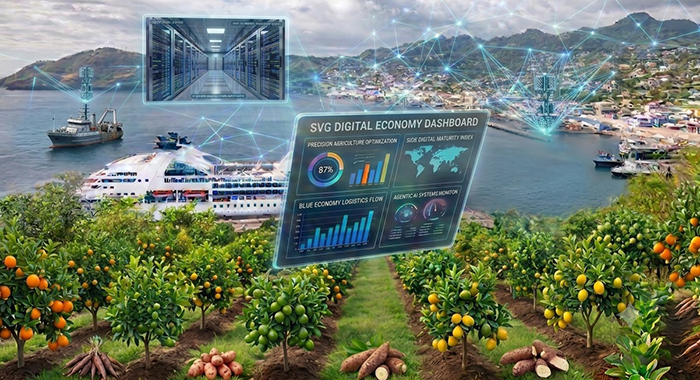
Agriculture and food sovereignty: SVG remains a heavy net importer of food, leaving it vulnerable to global supply shocks and rising costs. Autonomous AI agents can analyse soil sensors, weather patterns, and market demands in real time to guide precision farming. Smart supply chain agents can connect local farmers directly with markets, hotels, and exporters, optimising crop yields and drastically cutting the food import bill.
Tourism and hospitality: In a competitive regional market, agentic AI can power hyper-personalised, 24/7 concierge systems that manage multi-island travel logistics, handle instant bookings, and deliver bespoke guest experiences without requiring massive administrative overhead.
The blue economy: With a marine territory 90 times larger than our landmass, managing our ocean resources is critical. Autonomous marine agents can process oceanographic data, track fishing vessels, monitor reef health, and support sustainable fisheries management to protect our ocean wealth.
Government efficiency: Routine public tasks — processing land transfers, issuing licenses, updating records, and answering public inquiries — can be managed seamlessly by digital agents. Citizens across St. Vincent and the Grenadines could complete transactions in minutes from their phones, eliminating unnecessary travel into the capital.
While some of these ideas are futuristic and advanced from where we are now, they are not pies in the sky. If 50 years ago, someone had told you that the majority of Vincentians would carry a cell phone in 2026, and didn’t have to go to the post office to mail a letter anymore, you’d probably have doubts. We live in a world today where the technological possibilities are virtually limitless. It’s a matter of time before we see some of these ideas become practical solutions, if not already; even in other challenging areas such as crime.
The risk of external integration
As artificial intelligence becomes embedded in banking, agriculture, healthcare, education, logistics, government services, and commerce, the gap between technologically prepared economies and those that lag behind may widen significantly. Caribbean nations already depend heavily on external systems for correspondent banking, payments, telecommunications, and trade. If these systems evolve into AI-driven ecosystems that require advanced integration and technical expertise, countries that have not invested in readiness may find themselves struggling to participate fully in the global economy.
The critical question is: who will build and manage that transition locally?
If we do not immediately modernise our digital infrastructure and train our population, we risk creating a severe qualification gap. When the pressure to adopt or integrate autonomous systems becomes unavoidable, local institutions will have no choice but to look outward. Highly qualified foreign talent will step in to capture these high-value local roles because our citizens were not prepared in time. We cannot afford a late, reactive scramble that leaves Vincentians sidelined in their own economy. The early introduction of the ATM and coaxial cable computer network in the country should have taught us something.
This shift presents an immediate challenge for our public sector, where the government remains the largest employer in a system that is widely recognised as bloated and resource-strained.
What happens when international standards force the introduction of autonomous AI into government operations?
Agentic systems thrive on speed and accuracy. If forced upon a public sector without a human-centred strategy, the disruption could be painful. However, if the leaders act soon, AI does not have to mean job losses. Early preparation allows for systematic retraining of civil servants for higher-value roles — shifting administrative workers into data governance, digital orchestration, and specialised service management. Automation can elevate the public workforce rather than displace it, but only if laying the foundation is not delayed.
Across the region, we are beginning to see signs of awareness. Initiatives like Trinidad and Tobago’s exploration of a large-scale data centre represent a growing recognition that future economic power lies in data sovereignty and infrastructure. However, infrastructure alone is not enough. SVG urgently requires a coordinated national strategy focused on three priorities:
- Digital public infrastructure: Transitioning paper-based public services into secure, automated digital portals that eliminate mandatory trips to Kingstown, as well as process improvements to lower costs.
- Sector-specific AI integration: Deploying smart tools in agriculture, fisheries, and tourism to boost local production and reduce foreign reliance.
- Targeted workforce retraining: Updating technical curricula and upskilling civil servants to manage autonomous workflows before external forces demand it.
The concern is not that artificial intelligence is coming — it is already here. The concern is whether SVG and the wider Caribbean are preparing quickly enough to ensure that our citizens remain competitive, productive, and prosperous in a world increasingly shaped by data and intelligent systems.
The choices we make today regarding our infrastructure and education will determine our place in the modern world. While doing just enough now – with nominal increments – to maintain and keep society functioning as we know it, a significant and radical shift must be on the agenda for future generations of Vincentians to shape the digital economy as creators and managers; or we risk spending the next thirty years attempting to catch up after the gap has widened beyond reach.
*Sharma London is a computer scientist with a background in applied mathematics and software development, specialising in digital transformation as well as data and solutions architecture.
The opinions presented in this content belong to the author and may not necessarily reflect the perspectives or editorial stance of iWitness News. Opinion pieces can be submitted to [email protected].
SVG needs more than digital infrastructure; it needs productive industries that create jobs, generate exports, and give AI something meaningful to optimize. Agriculture, manufacturing, fisheries, renewable energy, and technology businesses should grow alongside investments in digital transformation.
Note to the Prime Minister:
Contact Sharma immediately and offer her a job within Government developing the technology into apps that any Citizan can download to their celphones to help wasting time standing in lines trying to get anything done
Sharma i agree and I am here to help in any way possible. I have been creating an AI Institute to be able to teach the young adults here in St Vincent I am looking to do them as cohorts and make the first few free to the students. We should have a conversation. I also think it would be beneficial to have a system in place for imports to ensure all agencies are charging properly. The possibilities are endless. [email protected]
The school i am building is
https://www.stvincentaiinstitute.org/
Dom Cortez
It is easy to sit in London, England, and profess that computer science is the answer. But for these computer sciences to succeed in SVG, you need the infrastructure to sustain these endeavors. The local entrepreneur will have a hard time competing with international and often state-sponsored enterprises.
Another AI slop article.
Pipe dreams.