



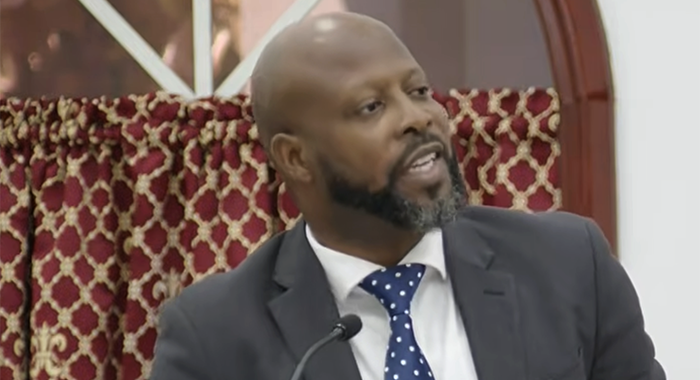

The opposition Unity Labour Party (ULP) has criticised the delay in the start of the 2026-2027 school year, saying that it demonstrates a lack of leadership and governance by the government.
Opposition Senator Carlos James said that he was “very disappointed” and that it showed a lack of seriousness and administrative quality checks and controls.
The Ministry of Education announced recently that the new school year will begin on Sept.7, one week later than originally planned.
Among the rationale for the decision was to facilitate final preparations and ensure a smooth start to the term.
“The Ministry’s directive instructed school leaders to use the extra time for tasks such as finalising staff assignments, completing classroom assignments and conducting orientation activities,” James said on Star Radio, the ULP’s radio station.

James said that by this time of year, the ULP government would have met with the technical team at the Ministry of Education and secured a budget based on the schools’ needs.
The budget would be allocated to the Ministry of Transport through BRAGSA to ensure rehabilitative work is carried out, he further stated, adding that the Ministry of Education is responsible for furniture for students and teachers.
“Remember Friday (Prime Minister Godwin Friday) said let them do their work; we don’t micromanage,” the opposition senator said.
But it was not about micromanaging but about taking accountability, James said.
He said he did not blame the technocrats for the delay in starting the new school year.
The previous administration only got involved in the event of a major natural disaster, not in situations of normal school operations, the former tourism minister said.
He pointed out that there were no major disasters in 2026 that would have set back the operation of schools.
“And you’re telling me, not even that you can get right? You can’t even open schools on time?”
He said the delay occurred because no one was checking to ensure that sufficient budget allocations were available and accessible to the Ministry of Education.
James said that each of the parliamentary representatives visited schools and met with principals.
“And we had the number; we knew there were shortcomings,” he said.
The technocrats were also consulted; therefore, they had an idea of the challenges.
By going to the schools, there was a working relationship between the then government and the principals.
“Not that you’re meddling with the Ministry of Education’s work, but if you’re representing a constituency, you have to also be the eyes and ears and looking out for your schools, your principals, you students and your families,” James said.
He added that representation was not just about physically showing up but also about dealing with administrative issues.
“They don’t know how to do this because they have not been in government and the lack of experience.”
James contended that the process went beyond the technical and operational, but also the administrative component was important.
There was no justification for the re-opening of schools to be delayed, the opposition senator said.
“You know what is going to happen in terms of the repairs; you know what is going to happen in terms of the shortage and the procurement and so on and because you have that knowledge … you have to now apply that to the reality that’s on the ground and meet the demands and ensure that schools are open in a timely fashion.”
Those were the little things that made the difference, James said, adding that reopening school one week later will have implications for completing the curriculum on time.
Poor SVG, even the school terms seem compromised! Is there no regularity or continuity in school terms? Very sad!
So Mr James is an expert on schools now, great, so let’s hear why soon after the school year opened in September 2025 the form 4 classroom at New Adelphi Secondary was found to have such a dangerous roof that the students had to be relocated. So you had class being held in the Deputy Principals office, crowded into such a stifling hot place and then the students were jammed into another forms classroom until a couple of months later when repairs finished. If you are so expert now, why were you all so clueless last year ? You were not looking out for anybody, so forget the lies and hypocrisy you ULP failures !
Well you never had shame so 🤷♀️