



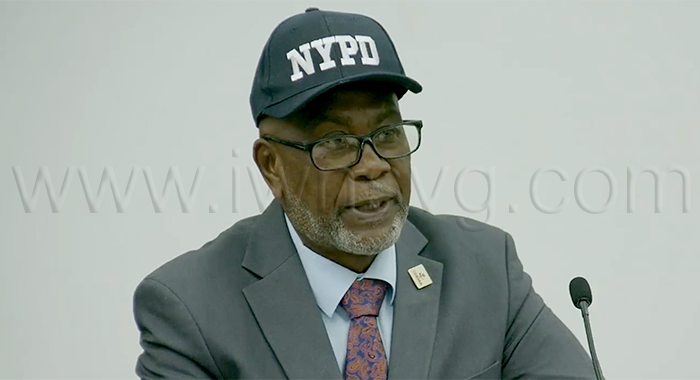

Deputy Prime Minister and Minister of National Security St. Clair Leacock says his recent visit to the New York Police Department (NYPD) is helping to shape how the government tackles gun violence and homicides in St. Vincent and the Grenadines, with an emphasis on community policing, technology, and partnerships beyond the police force.
Speaking in Parliament on Thursday, Leacock described what he saw at the NYPD and how, in his view, those practices can be adapted to a much smaller Caribbean state operating under severe financial constraints.
He cast the New York trip as part of a broader effort to build “institutional capacity” and “individual competence” in law enforcement, rather than relying on what he called the illusion that the country could “arrest or prosecute itself out of crime”.
Inside NYPD’s operations centre
Leacock told lawmakers he was hosted at NYPD’s Operations Centre, where he was briefed on how the department manages violent crime, guns and community safety in real time.

“… at a much smaller scale, at a much smaller scale, those facilities are also at our disposal at CARICOM IMPACS,” he said.
Leacock stressed that while New York’s scale is vastly different, the concepts – centralised information, fast intelligence, mobility and coordinated responses – are directly relevant to SVG.
‘We cannot prosecute or arrest ourselves out of crime’
One message from the NYPD that Leacock repeated for Parliament was that a heavy‑handed, enforcement‑only model is insufficient.
“One of the things that the practitioner said to me and stayed with me… is that we cannot prosecute or arrest ourselves out of the crime and violence situation,” he said.
He said New York officials emphasised community policing and partnerships with faith‑based organisations as critical to their strategy, and that these lessons resonated in the Vincentian context.
At the NYPD briefing, he said, police leaders were joined by members of the clergy, including rabbis and other church representatives, and community‑based actors involved in violence prevention.
Leacock said the NYPD credited significant reductions in crime to “community policing”, adding that the “functional and working relationship” between police and faith‑based organisations in New York has paid “great dividends”.
Leacock pointed to an existing Vincentian link, saying New York‑based Vincentian Wilmer Seaton has been exploring ways to support similar initiatives in SVG.
Gun buyback as a tool, not a slogan
One specific NYPD initiative Leacock highlighted was the gun buyback policy, under which authorities purchase illegal firearms from the community.
“I’m not here advocating one and the other. I’m saying it is in vogue in a tried and tested police jurisdiction, New York, and it’s been done in other Caribbean jurisdictions,” he told Parliament.
Leacock said that public discourse in SVG tends to highlight homicides more readily than the weekly seizures of illegal firearms.
“As we publish with dispatch a homicide here… to say how bad a weekend we had, we seldom see the same effervescence, enthusiasm when the police take a gun off the street,” he said, noting that in recent weeks officers have been “weekly… taking guns off the street” with little fanfare.
Applying NYPD lessons at Caribbean scale
Leacock was careful to acknowledge that SVG cannot replicate NYPD’s model wholesale, given its limited resources and small size.
However, he insisted that many of the principles and tools on display in New York are already influencing the local crime strategy.
Among these, he mentioned technology and regional surveillance, intelligence‑led targeted policing, community policing, and early intervention.
Leacock, however, repeatedly told Parliament he was constrained in how far he could go in describing operational details, referencing House rules that allow ministers to withhold information where public safety is at stake.
“I’m not going to, in my elucidation, speak to issues that compromise the men and women in uniform… because their safety is paramount in the discharge of their duties,” he said.
He said the government’s objective is “not simply to respond after crimes have occurred”, but to prevent crime, disrupt those who facilitate serious criminal activity, remove illegal firearms from communities and improve the detection and prosecution of offenders – aims he said are informed, in part, by what he observed in New York.
And people getting bail for AR 15.madness