



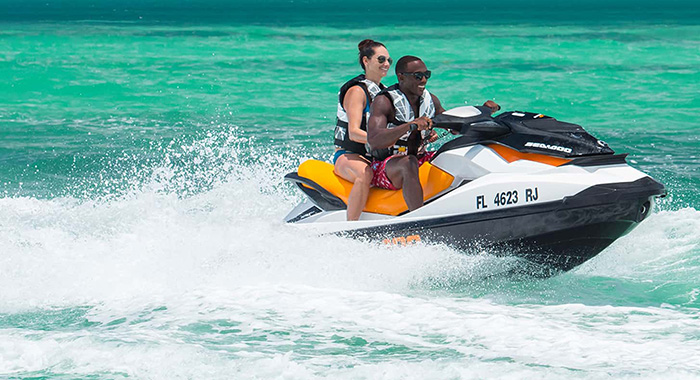

Prime Minister Godwin Friday has confirmed that his government will maintain the long-standing ban on jet skis in St. Vincent and the Grenadines, even as it pursues a broader strategy to modernise and expand the country’s tourism product through private investment and new forms of promotion.
Responding to a question from a Vincentian living in New York during a town hall meeting in Brooklyn on Sunday, Friday acknowledged the popularity of jet skis across the Caribbean, but said safety and regulatory capacity were decisive factors in keeping them out of Vincentian waters for now.
“I travel all over the Caribbean, and if it’s one thing I enjoy is jet ski,” the questioner told him, asking directly whether the ban would be lifted so that visitors and returning nationals could experience the same in SVG.
“Jet skis is an issue that has come up over and over again in certain areas,” the prime minister responded.
“We have looked at the pros and cons of it, and for the time being, we have said that we will not change with respect to that. And so it continues to be [that] we… restrict or… ban the use of jet ski in our bays and waters and so forth.”

He pointed to real safety risks as a core concern, drawing on examples from his own home community, Bequia,
“It comes to a problem of regulation,” the prime minister explained.
“I know in my own community, where you have speedboats driving just offshore, and you have swimmers, bathers there in the water, and [they] are put at great risk, not because that in itself is dangerous, but because there’s no regulation as to how it is done.”
That lack of effective enforcement and clear operating rules, he suggested, would be compounded — not eased — by adding jet skis to the mix.
“Unless we can find a solution to that with respect to jet skis,” he said, “for the time being, that is the approach that we have adopted.”
At the same time, Friday left the door open to future policy revision, describing it as an issue that could be revisited if the state’s regulatory capacity and safety framework improved.
“Sometimes it’s necessary for us to review policies that we’ve had, and we are open to doing that,” he said. “But the matter came up… since we’ve been in government, and we have confirmed the decision that was taken many years ago.”
PM outlines govt’s broader thinking on tourism
The exchange on jet skis came during a wide-ranging session in which the prime minister set out his administration’s broader thinking on tourism, investment and economic transformation, repeatedly stressing that the government can no longer rely on borrowing to build large public projects and must instead turn to private and diaspora capital.
Tourism, he argued, sits at the centre of that shift, telling the meeting, “We are entering into an era where we are going to rely more on private investment.
“We need your input. We are going to engage in public-private partnerships in a way that accelerates investment in the country and generates economic growth that brings a better standard of living, more jobs, more investment opportunities, more services… to our economy.”
As a concrete example, he pointed to ongoing negotiations with a major regional cruise port operator, Global Ports Holding (GPH), over a concession to operate and modernise the Kingstown cruise terminal.
He said the cruise terminal, which was built over 30 years ago, is in very poor condition.
“But more than that, the industry has left us behind. The ships are larger. The demands of the visitors are higher. They expect better service, all of those things.”
He argued that government simply does not have the fiscal space to undertake the necessary investment on its own, adding that through the agreement with GPH the government can get those investments immediately without adding to the national debt.
The Kingstown port proposal, the prime minister said, is a template: use private capital and expertise to modernise key tourism infrastructure, while keeping the state out of further unsustainable borrowing and capturing a share of the upside for the public purse.
It fits into what Friday described as a three-pronged recovery and development strategy: stabilising the country’s finances; protecting the most vulnerable from the burden of adjustment; and “growing our way out” of the current difficulties through stronger private-sector led growth.
That growth, he said, must return Saint Vincent and the Grenadines to its tradition of engaging external markets, including in tourism-related goods and services.
“Since we have had agriculture in the past, where we used to export — we were an export-led economy,” he reminded the audience.
“People seem to forget that we made our living by selling things abroad. Nowadays, there seems to be this reticence to take a chance, to think, well, we can’t sell things outside of St. Vincent and the Grenadines’ shores.
“We have to bring back that… environment in which we build and we invest, so that we can sell abroad, and there is a larger market, and that way we earn more, improve the standing of our people.”
Tourism, in that sense, is not only about hotels, cruise ports and attractions. It is also about building businesses, brands and experiences that can reach and draw visitors, including through modern digital channels.