



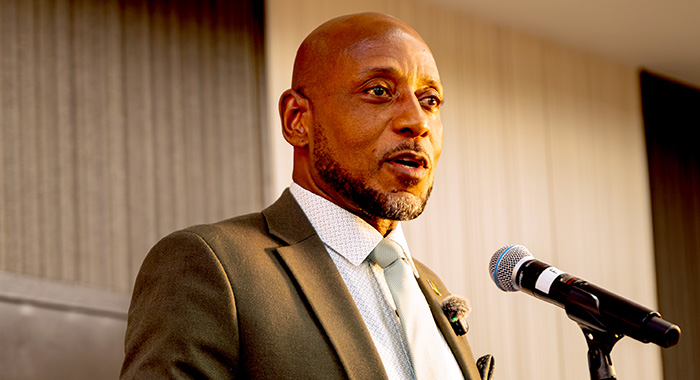

Minister of Foreign Affairs, Foreign Trade, Foreign Investment and Diaspora Affairs, Dwight Fitzgerald Bramble, has told Vincentians in New York that the government sees them not as distant supporters but as central partners in building a more resilient and inclusive economy at home.
Speaking on Saturday at a diaspora investment event in New York City, under the theme “Reconnect, Reinvest, Rebuild: Turning Vincentian Global Success into Local Opportunity”, Bramble said his ministry carries “the special responsibility” of being one of the bridges between St. Vincent and the Grenadines (SVG) and the global Vincentian family.
“Tonight, I want to speak to you very plainly,” he told the gathering. “You are not just part of our past; you are critical to our future.”
Bramble situated the theme in the lived experience of thousands of Vincentians who migrated over the decades.
He said many of them left SVG “with a suitcase of clothes, a pocket full of hope, and the blessings of family and friends”.

They went to countries such as the United States to study, work and pursue new opportunities, facing challenges but persevering, and going on to become homeowners, professionals, entrepreneurs and leaders.
“In all of this, you never forgot home,” he said. “You carried our accent, our expressions, our food, our music, and our values with you.
Moving beyond nostalgia
“You taught your children and grandchildren about ‘back home’, even if some of them have not yet walked our streets or swum in our waters.”
For Bramble, however, the current moment demands more than nostalgia.
Reconnection, he argued, must mean “building active, structured, and sustained engagement” between the government of SVG and Vincentians abroad.
He said his ministry is strengthening the diaspora desk and the country’s diplomatic missions with a clear mandate “to listen to your concerns and ideas”, “to keep you better informed about opportunities at home” and “to ensure that when you want to invest, return, or collaborate, the path is clearer and the process is smoother…
“You are not outsiders. You are Vincentians,” he noted, adding that SVG’s foreign policy, trade policy, and investment strategy “must reflect that reality”.
Turning to investment as his second plank of the theme, Bramble acknowledged the depth of the emotional bond many overseas Vincentians feel towards their homeland. “That emotional bond is powerful — and we value it,” he said, but stressed that government wants to translate that emotional connection “into enterprise and opportunity”.
He explained that reinvestment does not begin and end with large cheques but could be as simple as a professional abroad partnering with a local entrepreneur to expand a small business.
It could also be a member of the diaspora mentoring young people in SVG via online platforms, or groups of overseas Vincentians forming investment clubs focused on sectors such as tourism, agriculture, technology or renewable energy.
Bramble also highlighted the role of diaspora participation in trade missions and business expos, helping open doors for Vincentian products and services in foreign markets.
“As minister responsible for foreign trade and foreign investment, I see clearly how competitive the global environment is,” Bramble told the audience.
“Every small state is trying to attract capital, talent, and technology. But we have something unique: a global network of Vincentians who already care about our country.”
Aligning diaspora’s goodwill with real opportunities in SVG
He said the government’s task is to align the diaspora’s goodwill with real opportunities on the ground.
To that end, he said the government is working to improve the ease of doing business, identify “bankable projects” in key sectors, strengthen investor facilitation and aftercare services, and “explore ways to recognise better and engage diaspora investors as partners in development”.
The minister said:
“When you return to invest, we do not see you merely as ‘foreign investors’… We see you as members of our extended national family, coming home to help build the house.”
On the question of rebuilding, the minister framed the concept not as an admission of weakness but “a declaration of resilience”.
Like many small island developing states, he noted, SVG stands on the frontline of climate change and global economic shifts.
“We have known hardship,” he said, “but we have also shown courage, creativity, and faith.”
He argued that any serious rebuilding effort must confront the question: “What kind of economy are we building?”
His answer was an economy that is more diversified and less vulnerable to external shocks, more inclusive with opportunities for women, youth and rural communities, more innovative with technology as “a game changer”, and more sustainable, protecting “the natural beauty and resources that define us”.
In that reshaping of the economy, Bramble described diaspora engagement as “a central part of this rebuilding agenda”.
He said skills in engineering, medicine, finance, marketing, logistics and digital technologies, combined with exposure to global best practices, can help modernise key sectors, avoid costly mistakes and “seize new opportunities more quickly”.
But he was careful to clarify that the government was not asking expatriates to shoulder the entire burden.
“When we say ‘rebuild,’ we are not asking you to come and do everything,” he said. “We are inviting you to partner with our people at home, with our businesses, our institutions, and our government, in a spirit of mutual respect and shared responsibility.”
Converting global success into concrete local opportunity
Bramble also explored how the “Vincentian story” now spans multiple geographies, from Brooklyn and the Bronx to Toronto, London, Miami and across the Caribbean. Overseas Vincentians, he said, have proven themselves “in competitive environments”, learned hard lessons, and built networks and reputations.
“The question before us is: How do we convert that global success into concrete local opportunity?” he asked.
The minister said this begins with conversations such as the one in New York that evening, but “must move quickly to collaboration and commitment”.
Over the coming months and years, he pledged that his ministry, working alongside other government agencies, would “create clearer pathways for diaspora investment and business partnerships”.
It would also support knowledge exchange programmes in which diaspora experts train or advise counterparts at home, and encourage youth-focused initiatives linking young Vincentians with mentors abroad.
He also signalled an intention to “recognise and celebrate outstanding diaspora contributions, not only as a gesture of thanks, but as a signal to others that engagement is valued and meaningful…
“We want you to see St. Vincent and the Grenadines not only as the place of your birth or heritage,” Bramble said, “but as a serious place to do business, to innovate, and to make a difference.”
The minister closed on a personal note, reminding his audience that each person present carried “a unique story — a journey that took you from a small Caribbean nation to one of the great global cities of the world”.
They knew from experience, he said, “what it means to start with little and to build something meaningful”, what sacrifice looks like and “what hope feels like”.
“Imagine what we can achieve if we align your experience, your resources, and your vision with the aspirations of our people at home,” he said.
“Imagine a St. Vincent and the Grenadines where a talented young person, instead of feeling that they must leave to succeed, feels that they can also return, or stay, and thrive — because the diaspora has helped to open up new paths…
“That is the essence of our theme: to reconnect hearts and minds; to reinvest resources and knowledge; to rebuild a stronger, more inclusive, more resilient St. Vincent and the Grenadines.”