



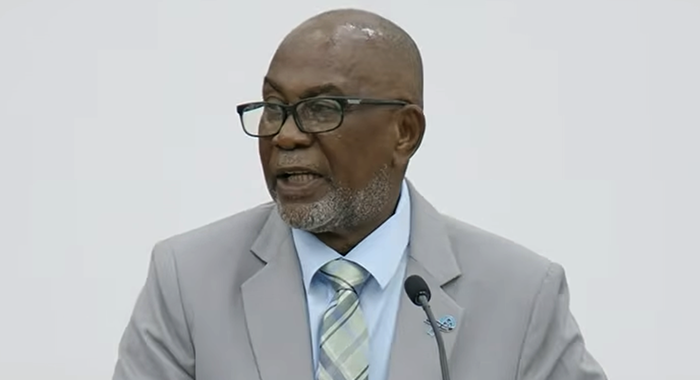

Acting Prime Minister St. Clair Leacock says elements within the public sector are actively frustrating the work of the new administration.
He said on Monday on New Times, the ruling New Democratic Party’s (NDP) radio programme, that some officials are “smooth talking” ministers while quietly resisting change and hoping the government fails.
Leacock, who is also minister of national security, delivered a blunt assessment of what he described as internal sabotage and institutional resistance inside key state agencies.
He said that while the World Bank and other partners are scrutinising the government’s economic management, the administration is also confronting a different kind of challenge at home: public officials who present themselves as cooperative, but whose “undercurrents are going in a different direction”.
Leacock recounted a conversation with another minister who had come to a similar conclusion about a senior official.

“He say, ‘So and so is a real smooth talker. But underneath is the undercurrent’,” Leacock said.
“You’re saying the things to me that you think I need to hear as a minister of government. And in the process, you say those things to me, I develop greater and greater belief in you. But underneath, the undercurrents are going in a different direction,” he further stated.
“Because you really don’t want me to succeed as a minister. You really don’t want me to succeed as a government. And you are still finding that there are a lot of government agencies in which people figure that they can trick the government, they can mislead the ministers, or you can befriend ministers, or give the impression and/or appearance that you’re moving the needle, when in fact your whole intention is for the government not to succeed and underestimating that you ain’t smarter than anybody else.”
Leacock’s comments came in the midst of a wide-ranging discussion on the government’s efforts to stabilise the economy, manage a high debt-to-GDP ratio, and respond to the findings of a recent World Bank country visit.
He painted a picture of a government trying to change course while dealing not only with fiscal constraints, but also with what he characterised as bureaucratic inertia and, in some cases, deliberate obstruction.
The deputy prime minister said that while the administration is open to criticism and committed to transparency, some of the harshest attacks are coming from people who once campaigned for change but are now effectively doing the work of the official opposition by undermining the government from within.
He accused parts of the formal opposition of being weak and directionless, and suggested that some of the fiercest critics of the new government are, in practice, filling that vacuum.
“The official opposition in St. Vincent and the Grenadines is not only weak, but they have nowhere to go. And some of our people, who you think would know better — because we are not void or afraid of criticism — instead of constructively advancing and forwarding the conversations that are favourable to your administration that is struggling with the situation, you have literally usurp the role of the opposition, and you are more opposition and more effective in the opposition politics now while you love your NDP,” Leacock said.
“And even inside of the NDP, you pick and choose who in the NDP you want to love and/or support, and who … you want to abuse”.
In that context, he described “a hell of a lot” of the criticism of the administration as “unwarranted, and impatient and unfounded, and in some cases totally nonsensical,” adding that it often flows from a mix of “ignorance and arrogance” that he called “a dangerous cocktail”.
The acting prime minister framed these internal and external pressures as part of the reason he has returned to the Monday slot on New Times, which party leader and Prime Minister Godwin Friday previously hosted:
“I believe it is necessary that we have these conversations, and be open to the criticisms and for the explanations, because in the absence of that, people have a right sometimes to speculate.
“And governmental politics and opposition politics is two different politics. This is where the [tyres hit] the road, and we have to deal with the reality that’s in front of us,” Leacock said.
Leacock’s strongest charge, however, was reserved for those he believes are using their positions inside the state to slow or derail the government’s policy agenda quietly.
While he did not name any specific ministries or departments, he made it clear that the administration is prepared to act against individuals who stand in the way of its programme.
Leacock hinted that changes are coming, saying there is “a process of dealing with that”, and predicting more decisive steps once patterns of obstruction become clear.
“You’re going to find more and more that is going to happen, where we find that there are stumbling blocks, other hindrances to getting the government policies going forward. You’re going to find incidents of that, and when people cry foul, you have to say, ‘Well, too bad.’”
Leacock’s comments on internal resistance came as he described a broader push to change the culture of government.
He criticised what he called “a lot of BS” in “some agencies of government” where “basic, simple, ordinary things can’t get done” because of red tape or deliberate foot-dragging.
The deputy prime minister argued that in many instances “the driver for the running of the country, in many instances, was political office, political kingdom, at all costs,” under the former administration, and that remnants of that mindset remain embedded in the system.
Leacock also linked internal obstruction to the government’s efforts to manage crime and protect investment.
As minister of national security, he said he is aware of attempts by some to “play games with the government”, including those who, in his view, do not want new ministers to succeed in their portfolios.
At the same time, he warned that public disorder and crime send a dangerous signal to investors, referencing violent incidents involving schoolchildren and gun crime.
“Because when that happens, you are disturbing the investment climate in St. Vincent and the Grenadines, where people get the perception that this is a disorderly country in which my money is not safe, or which someone feels not safe to go there,” he said.
Leacock insisted that the government remains committed to delivering on its mandate, but asked for “more time and more patience” from the public as it tries to unwind what he described as 25 years of mismanagement.
He argued that the administration must pursue reform “the right way” even as it confronts debt, social demands, and what he sees as quiet resistance within the state apparatus.
Leacock summarised the government’s position as that of a listening administration determined to deliver, but clear-eyed about the obstacles ahead.
“We understand the challenges that are at hand, and we know that we have to bring relief to our people in the shortest possible time.… I want to give them that assurance that this is a government that is going to deliver in the shortest possible time the expectations of the people. But we are asking for more time and more patience as we do it the right way. We don’t want to mess up on it.”